news,technology
news,technology
-

Picture from techcrunch.com
Rank 1551 -
Picture from cdn.mos.cms.futurecdn.net
Rank 1552Looking for a different day?A new NYT Strands puzzle appears at midnight each day for your time zone – which means that some people are always playing 'today's game' while others are playing 'yesterday's'. If you're looking for Monday's puzzle instead then click here: NYT Strands hints and answers for Monday, April 14 (game #407).
Strands is the NYT's latest word game after the likes of Wordle, Spelling Bee and Connections – and it's great fun. It can be difficult, though, so read on for my Strands hints.Want more word-based fun? Then check out my NYT Connections today and Quordle today pages for hints and answers for those games, and Marc's Wordle today page for the original viral word game.SPOILER WARNING: Information about NYT Strands today is below, so don't read on if you don't want to know the answers.
NYT Strands today (game #408) - hint #1 - today's theme
What is the theme of today's NYT Strands?• Today's NYT Strands theme is… Draft picks
NYT Strands today (game #408) - hint #2 - clue words
Play any of these words to unlock the in-game hints system.
STREETRISECRACKTOWERSIRECROW
NYT Strands today (game #408) - hint #3 - spangram letters
How many letters are in today's spangram?• Spangram has 12 letters
NYT Strands today (game #408) - hint #4 - spangram position
What are two sides of the board that today's spangram touches?First side: left, 6th rowLast side: right, 4th row
Right, the answers are below, so DO NOT SCROLL ANY FURTHER IF YOU DON'T WANT TO SEE THEM.
NYT Strands today (game #408) - the answers
(Image credit: New York Times)
The answers to today's Strands, game #408, are…
SOURNITROLAGERBOCKSTOUTPORTERPILSNERSPANGRAM: MICRO BREWERY
My rating: ModerateMy score: 1 hint
After fearing that today’s search would have something to do with sports drafts, I was relieved to be on the more solid ground of alcoholic beverages, and beer in particular.Cunningly, the grid featured the word BEER – but it wasn’t one of the answers. Crafty, crafty…I did struggle to get going and the word the Hint gave me – SOUR – didn’t help much. It wasn’t until I spotted LAGER that I knew what I was doing. BOCK and NITRO were both new beery words to me, although I’ve seen both incorporated into German beer brands.All in all, thirsty work.How did you do today? Let me know in the comments below.
Yesterday's NYT Strands answers (Monday, 14 April, game #407)
IRISDAFFODILTULIPHYACINTHLILYCROCUSSPANGRAM: SPRING FLOWERS
What is NYT Strands?Strands is the NYT's not-so-new-any-more word game, following Wordle and Connections. It's now a fully fledged member of the NYT's games stable that has been running for a year and which can be played on the NYT Games site on desktop or mobile.I've got a full guide to how to play NYT Strands, complete with tips for solving it, so check that out if you're struggling to beat it each day.
-
Picture from cdn.mos.cms.futurecdn.net
Rank 1553Looking for a different day?A new NYT Connections puzzle appears at midnight each day for your time zone – which means that some people are always playing 'today's game' while others are playing 'yesterday's'. If you're looking for Monday's puzzle instead then click here: NYT Connections hints and answers for Monday, April 14 (game #673).
Good morning! Let's play Connections, the NYT's clever word game that challenges you to group answers in various categories. It can be tough, so read on if you need Connections hints.What should you do once you've finished? Why, play some more word games of course. I've also got daily Strands hints and answers and Quordle hints and answers articles if you need help for those too, while Marc's Wordle today page covers the original viral word game.SPOILER WARNING: Information about NYT Connections today is below, so don't read on if you don't want to know the answers.
NYT Connections today (game #674) - today's words
(Image credit: New York Times)
Today's NYT Connections words are…
BELLREFRAINSPEEDCHORUSBRIDGEHUBRISDARLINGHEARTSHOOKAVOIDHEROCEASESPOONSPANABSTAINTRAGEDY
NYT Connections today (game #674) - hint #1 - group hints
What are some clues for today's NYT Connections groups?
YELLOW: Not involvedGREEN: Play with a deckBLUE: Parts of a classic playPURPLE: People in JM Barrie’s classic
Need more clues?We're firmly in spoiler territory now, but read on if you want to know what the four theme answers are for today's NYT Connections puzzles…
NYT Connections today (game #674) - hint #2 - group answers
What are the answers for today's NYT Connections groups?
YELLOW: DESIST GREEN: CARD GAMES BLUE: ELEMENTS OF GREEK DRAMA PURPLE: SECOND WORDS OF "PETER PAN" CHARACTERS
Right, the answers are below, so DO NOT SCROLL ANY FURTHER IF YOU DON'T WANT TO SEE THEM.
NYT Connections today (game #674) - the answers
(Image credit: New York Times)
The answers to today's Connections, game #674, are…
YELLOW: DESIST ABSTAIN, AVOID, CEASE, REFRAINGREEN: CARD GAMES BRIDGE, HEARTS, SPEED, SPOONSBLUE: ELEMENTS OF GREEK DRAMA CHORUS, HERO, HUBRIS, TRAGEDYPURPLE: SECOND WORDS OF "PETER PAN" CHARACTERS BELL, DARLING, HOOK, PAN
My rating: HardMy score: Fail
I failed completely again, wasting a lot of time barking up the wrong trees.After getting DESIST fairly easily I struggled with the remaining 12 words. I was convinced there was a group about songwriting with BRIDGE, HOOK and CHORUS all being key elements of a hit tune. Scrambling for the fourth word I included BELL and got the dreaded “groups of four” pop-up.After another mistake, I switched to collecting a group associated with Peter Pan – PAN and HOOK were locks but I went down a dead-end route and thought we were looking for elements of a particular scene, so I included BELL and BRIDGE, all very tenuous.With “one away” I really should have got the purple group, but I made the wrong choices and went for HERO and TRAGEDY.Two defeats in a row is not a good look.How did you do today? Let me know in the comments below.
Yesterday's NYT Connections answers (Monday, 14 April, game #673)
YELLOW: RESTRICT BLOCK, CHECK, DAM, STOPGREEN: TICKETED EVENTS CONCERT, GAME, MOVIE, PLAYBLUE: ASSOCIATED WITH THE GAME THE OREGON TRAILDYSENTERY, FORD, HUNT, OXENPURPLE: WHAT "FORD" MIGHT REFER TO ACTOR, CAR, DIRECTOR, PRESIDENT
What is NYT Connections?NYT Connections is one of several increasingly popular word games made by the New York Times. It challenges you to find groups of four items that share something in common, and each group has a different difficulty level: green is easy, yellow a little harder, blue often quite tough and purple usually very difficult.On the plus side, you don't technically need to solve the final one, as you'll be able to answer that one by a process of elimination. What's more, you can make up to four mistakes, which gives you a little bit of breathing room.It's a little more involved than something like Wordle, however, and there are plenty of opportunities for the game to trip you up with tricks. For instance, watch out for homophones and other word games that could disguise the answers.It's playable for free via the NYT Games site on desktop or mobile.
-
Picture from cdn.mos.cms.futurecdn.net
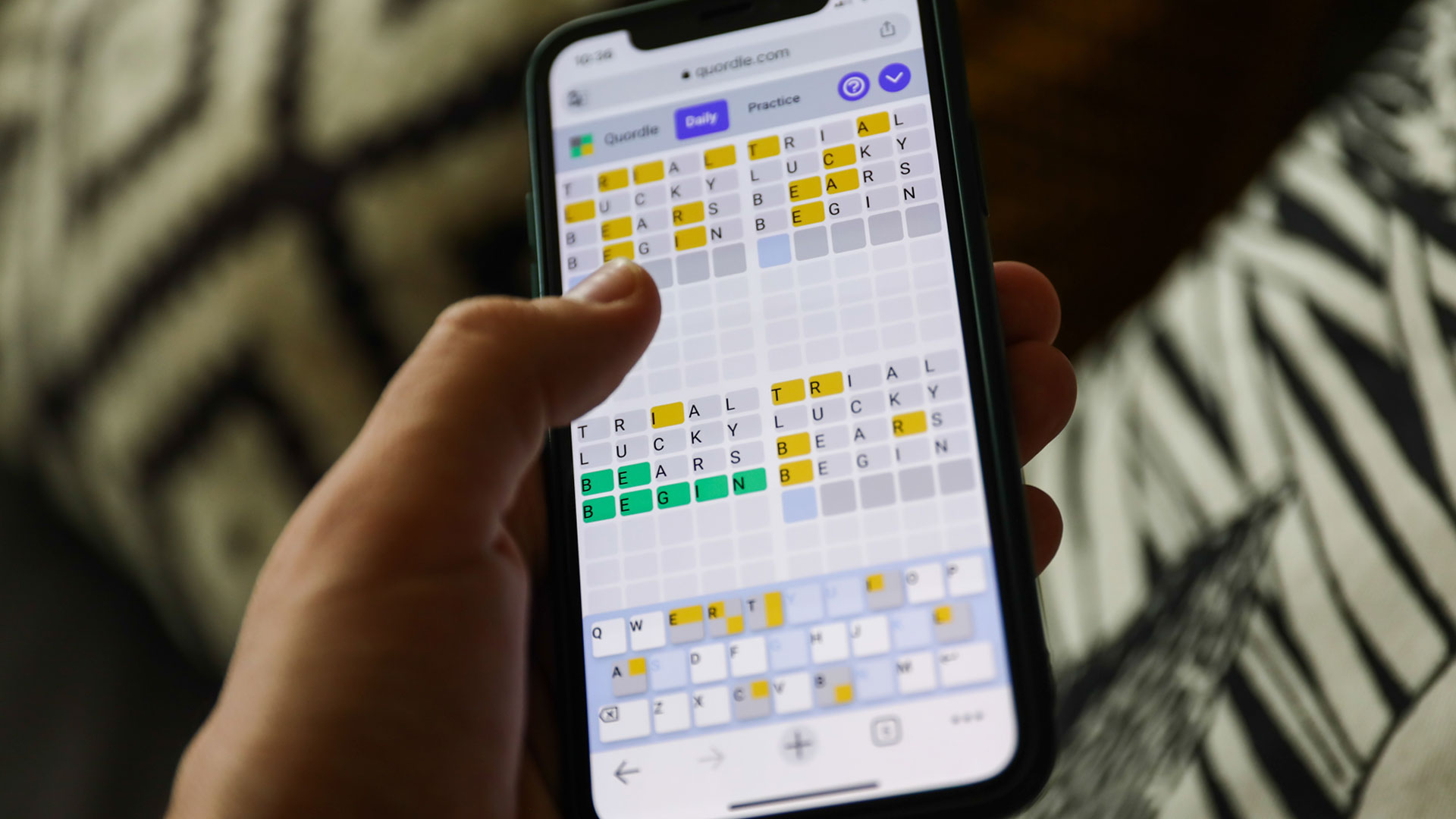
Rank 1554Looking for a different day?A new Quordle puzzle appears at midnight each day for your time zone – which means that some people are always playing 'today's game' while others are playing 'yesterday's'. If you're looking for Monday's puzzle instead then click here: Quordle hints and answers for Monday, April 14 (game #1176).
Quordle was one of the original Wordle alternatives and is still going strong now more than 1,100 games later. It offers a genuine challenge, though, so read on if you need some Quordle hints today – or scroll down further for the answers.Enjoy playing word games? You can also check out my NYT Connections today and NYT Strands today pages for hints and answers for those puzzles, while Marc's Wordle today column covers the original viral word game.SPOILER WARNING: Information about Quordle today is below, so don't read on if you don't want to know the answers.
Quordle today (game #1177) - hint #1 - Vowels
How many different vowels are in Quordle today?• The number of different vowels in Quordle today is 4*.
* Note that by vowel we mean the five standard vowels (A, E, I, O, U), not Y (which is sometimes counted as a vowel too).
Quordle today (game #1177) - hint #2 - repeated letters
Do any of today's Quordle answers contain repeated letters?• The number of Quordle answers containing a repeated letter today is 2.
Quordle today (game #1177) - hint #3 - uncommon letters
Do the letters Q, Z, X or J appear in Quordle today?• No. None of Q, Z, X or J appear among today's Quordle answers.
Quordle today (game #1177) - hint #4 - starting letters (1)
Do any of today's Quordle puzzles start with the same letter?• The number of today's Quordle answers starting with the same letter is 0.
If you just want to know the answers at this stage, simply scroll down. If you're not ready yet then here's one more clue to make things a lot easier:
Quordle today (game #1177) - hint #5 - starting letters (2)
What letters do today's Quordle answers start with?• S• M• H• F
Right, the answers are below, so DO NOT SCROLL ANY FURTHER IF YOU DON'T WANT TO SEE THEM.
Quordle today (game #1177) - the answers
(Image credit: Merriam-Webster)
The answers to today's Quordle, game #1177, are…
SLEETMERITHARSHFORAY
A very speedy game for me today, as the “first thought best thought” mindset paid off. I didn’t spend too long pondering, just went for it.On reflection there weren’t too many alternatives with regular letters – guessing BORAX instead of FORAY would have been bonkers, regardless of what might have happened in the past in Wordle.How did you do today? Let me know in the comments below.
Daily Sequence today (game #1177) - the answers
(Image credit: Merriam-Webster)
The answers to today's Quordle Daily Sequence, game #1177, are…
DEIGNLADLEOWNERQUOTA
Quordle answers: The past 20
Quordle #1176, Monday 14 April: DRAWL, CROOK, ACTOR, LANCEQuordle #1175, Sunday 13 April: SHALE, KINKY, SHORN, WHOOPQuordle #1174, Saturday 12 April: BLIND, OVOID, CACHE, THINGQuordle #1173, Friday 11 April: FOLLY, PITHY, SCOWL, CURLYQuordle #1172, Thursday 10 April: LEAST, SEWER, UNTIE, NOOSEQuordle #1171, Wednesday 9 April: LITHE, LEFTY, KNOLL, MULCHQuordle #1170, Tuesday 8 April: WIDTH, VISOR, MEDAL, BROOKQuordle #1169, Monday 7 April: BROTH, SHOUT, BRUTE, CABINQuordle #1168, Sunday 6 April: AMBER, GAUZE, STORE, SLICKQuordle #1167, Saturday 5 April: GUSTY, VAULT, WHINE, BEGATQuordle #1166, Friday 4 April: OAKEN, LOOPY, CURIO, BUTTEQuordle #1165, Thursday 3 April: ASCOT, JETTY, DRUNK, JOLLYQuordle #1164, Wednesday 2 April: INDEX, QUEEN, INCUR, STOLEQuordle #1163, Tuesday 1 April: HUMUS, BALMY, WORRY, ERECTQuordle #1162, Monday 31 March: RECUT, MOODY, WHERE, BRACEQuordle #1161, Sunday 30 March: CRIME, DRINK, CLOVE, TRUERQuordle #1160, Saturday 29 March: LATER, ODDLY, CUMIN, AGREEQuordle #1159, Friday 28 March: TERSE, MUSHY, PROVE, FRONDQuordle #1158, Thursday 27 March: CRONE, APNEA, LIGHT, AWOKEQuordle #1157, Wednesday 26 March: LEFTY, NOOSE, NOISE, TRIAD
-

Picture from cdn.mos.cms.futurecdn.net
Rank 1555Amazon reports reveals former CEO paymentsCurrent CEO Andy Jassy’s salary was $365,000 in 2024, Bezos’ was $81,840The average Amazon wage was $37,000 in 2024
Amazon paid out more to Jeff Bezos than its current CEO, Andy Jassy in 2024, but this doesn’t mean the founder had a higher salary to live off.In fact, Jassy’s salary amassed to around 4.5x more than Bezos’ - $365,000 compared with $81,840 - but where the two leaders differed was in other allowable expenses and costs.Bezos had been awarded $1.6 million in security costs in 2024, with the company defending high security expenses due to the former CEO’s low salary and company benefits.
Jeff Bezos continues to cost Amazon millions
Amazon CEO Andy Jassy, together with CFO Brian Olsavsky, Amazon Stores CEO Douglas Herrington and Chief Global Affairs & Legal Officer David Zapolsky received $365,000 in salary, a figure unchanged from the year before. AWS CEO Matt Garman received a slightly smaller $358,750 package.Defending its decision to compensate Jassy a further $1.2 million, plus tens of thousands for other C-suite execs, the company noted: “We believe that all Company-incurred security costs are reasonable and necessary and for the Company’s benefit.”“The 2024 annual total compensation of our median compensated employee (identified from all full- and part-time permanent and temporary employees worldwide, excluding our CEO) was $37,181,” Amazon also noted.Other topics covered in the Annual Meeting of Shareholders included the request for alternative emissions reporting, additional reporting on the impact of data centers and climate commitments, and a report on packaging materials.The board voted against all three requests, noting existing transparency, adherence to protocols and guidelines and work that’s already been done.Full details of the meeting can be found in Amazon’s Notice of 2025 Annual Meeting of Shareholders & Proxy Statement.
You might also like
Fancy a change? Here are the best job sites and best recruitment platformsEarn more by upskilling with the best online learning platformsMicrosoft cuts hundreds of UK jobs even as profits soared
-
Picture from o.aolcdn.com
Rank 1556Ubisoft has open-sourced Chroma, the company’s in-house colorblind assistance tool. It’s available for download via GitHub and is described as a "one-stop solution for detecting color blindness-related issues in games."
Here’s how it works. It throws a filter over the game screen that simulates various types of color blindness. This allows testers to flag accessibility issues in real time. The tool uses the Color Oracle algorithm and integrates with both single or dual-screen setups. It works with hotkeys and there’s a customizable overlay for adjusting settings. Ubisoft says that applying the filter will not impede game performance.
Ubisoft
It’s important to note what this software does and who it’s for. It simulates how a person with color blindness will experience a game, allowing devs to take action. It doesn’t fix anything on its own. However, knowing is half the battle as they say. This move by Ubisoft should allow other devs to address these concerns before shipping a game out the door.
Ubisoft isn’t the only company that has been widening the availability of accessibility tools. EA recently made a whole bunch of accessibility patents open-source. This included photosensitivity and speech recognition tech.This article originally appeared on Engadget at https://www.engadget.com/gaming/ubisoft-just-open-sourced-its-colorblind-assistance-tool-chroma-184546640.html?src=rss
-
Picture from o.aolcdn.com
Rank 1557OpenAI has announced its phasing out GPT-4.5 from its developer API in favor of its new GPT-4.1 model. When it launched, OpenAI described GPT-4.5 as its best and most capable model so far, in part because it was a more natural conversationalist and could capably mimic some notion of emotional intelligence. Despite what its name suggests, GPT-4.1 is supposed to be better and more efficient.
OpenAI says GPT-4.1 is available exclusively to developer's using OpenAI's API, and comes in three sizes, GPT-4.1, GPT-4.1 mini and GPT-4.1 nano. That means that if you won't find it as in option in the public-facing ChatGPT interface, but you could someday interact with an agent that leverages the model's improvements. GPT-4.1 is supposed to be better at coding and "long context understanding," according to OpenAI, with support for "up to one million tokens of context" and knowledge of the world up to June 2024.
Important to the decision to phase out the GPT-4.5 Preview, GPT-4.1 is also cheaper to run. OpenAI says the model is "26 percent cheaper than GPT-4o for median queries." The company imagines developers using GPT-4.1 to build agents that can work in software engineering environments, one of the more popular uses for generative AI. Even though GPT-4.5 will be eventually removed from OpenAI's API, the model preview will still be available in ChatGPT if you wan't to play with it.
OpenAI says the GPT-4.1 family is available to use today via the company's API. GPT-4.5 will be fully-phased out in three months on July 14, 2025.This article originally appeared on Engadget at https://www.engadget.com/ai/openai-is-phasing-out-gpt-45-for-developers-185554841.html?src=rss
-

Picture from techcrunch.com
Rank 1558 -

Picture from techcrunch.com
Rank 1559 -
Picture from cdn.mos.cms.futurecdn.net
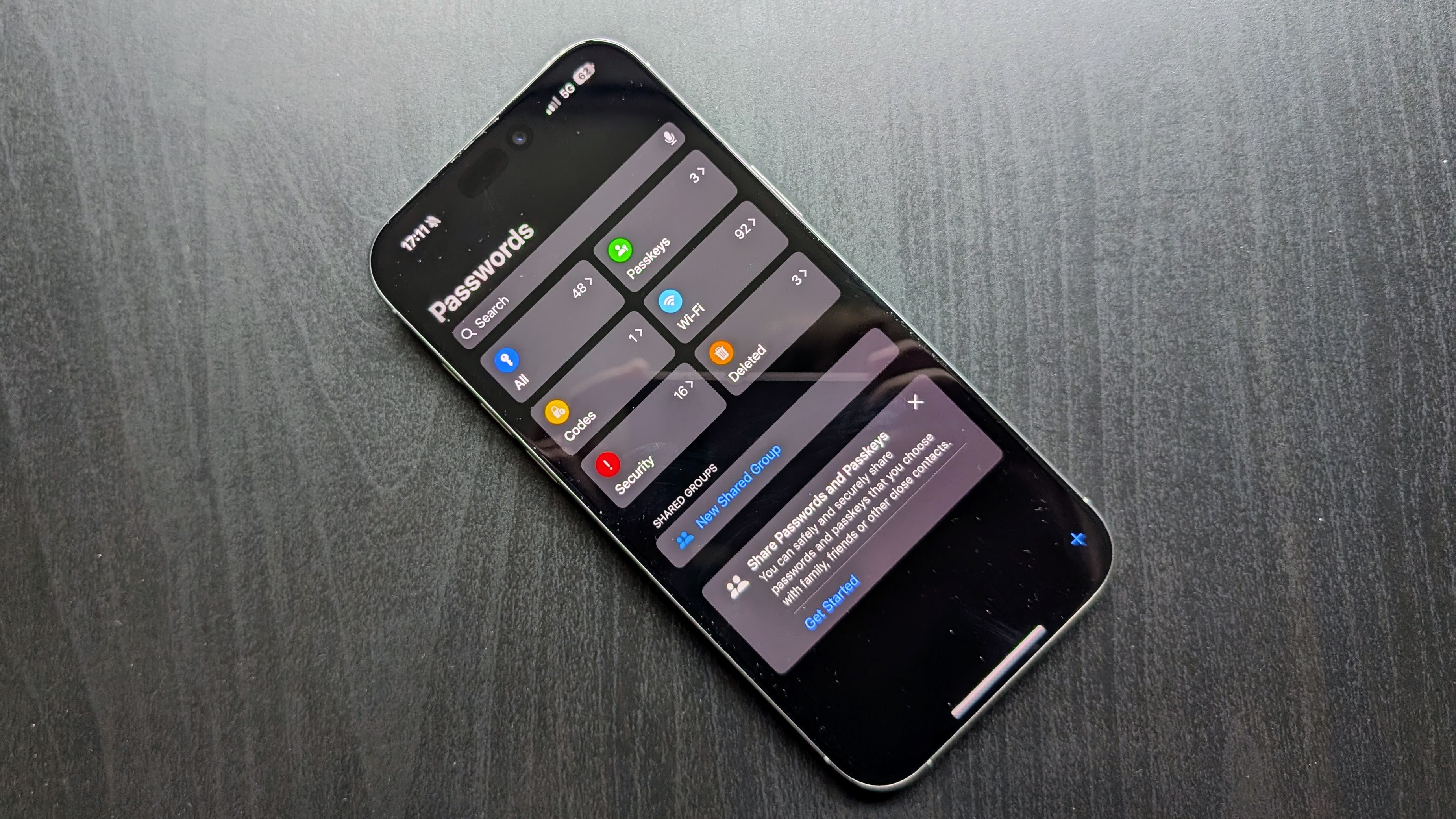
Rank 1560Even though we live in a world festooned with smart stuff, from slick ways to monitor your activity to generative AI and other such opinion-dividing tools, sometimes it’s the simple things that really feel special. And for me, it’s the iPhone’s Passwords app.Introduced with iOS 18, the Passwords app effectively builds out on Apple’s iCloud Keychain system, which allows passwords and login credentials to be saved in the cloud and automatically fill in said credentials once a security check via the likes of Face ID has been carried out.What the Passwords app does is build in a slicker interface on this functionality to facilitate easier password management. There's also support for third-party browsers, the ability to share passwords with trusted groups of people and get alerts of potential security issues.Naturally, there are third-party password management services that do all this too, but if you forget your master password – something I may have done in the past – you can be a little screwed. So having a native password manager baked into iOS is neat.And it’s a rather slick app; one that despite getting shown off at WWDC 2024, I sort of forgot about. So going by that, the app may have slipped your mind too, given how easily it integrates with daily iPhone life.But more recently, I’ve been finding out how handy it is.
A most helpful app
(Image credit: Apple)
The biggest benefit of the app is for when a freeloading family member requests the password to one of the most popular streaming series that rhymes with 'transfix', and I can’t remember it off by heart or have the patience to dig it out of the reams of nonsense that make up the family’s WhatApp chat.Instead, I simply head over to the Passwords app, let Face ID do its thing, then navigate to one of the services or accounts I use, then tap on the passwords field to reveal the collection of numbers and letters I’ve used to secure the account.From there it’s easy to copy the password and send it to the requesting party, either in a separate message, via AirDrop or set up a ‘Shared Group’ in which select passwords can be shared with select people.It’s so easy to use but also feels secure too, arguably more so than the Google password manager function in Chrome.On top of this easy password access, the app will also note which passwords may have been compromised via a leak. It then lets you trigger the process of changing them; though really that function just pushes you towards the service’s website to login and change your password there.So while Apple Intelligence tools might grab the headlines, and the Photos app has more interesting functions in iOS 18, it’s this simple Passwords app that’s grabbed my attention lately.The best Android phones have similar functionality, but in my experience it feels like the iOS 18 Passwords app… well… just works; yes, I hate myself for saying that, but that’s just how I feel.To use the app, simply search ‘Passwords’ in the drop-down menu in iOS 18. And do make sure your iCloud Keychain is synced with your iPhone to get the most out of the app.It's also worth noting the Passwords app is on macOS too, which is handy if you want to dive into your saved passwords, and discover accounts you may have forgotten about, on a larger display.
You might also like
‘The key is to build a bridge with iOS’: OnePlus has a plan to tackle Apple's smartphone industry dominanceThe best phone 2025: top smartphones you can buy today‘It will take time for foldables to become mainstream’: OnePlus defends decision to delay the OnePlus Open 2 and bow out of the foldable phones race in 2025
-

Picture from cdn.mos.cms.futurecdn.net
Rank 1561The latest AirTag alternative from Chipolo comes in colorIt's a small, circular tracker that works with Apple or Google's Find My networkIt has a built-in keyring hole for easy attachment, a speaker, and an easily replaceable battery
Sure, Apple’s AirTag might be the top dog in the world of iPhone item trackers, thanks to an exclusive feature or two. But what if I told you there is another item tracker that is just as compact, has a built-in key ring for easy attachment, and comes in several vibrant colors?Sold, right? Well, the Chipolo Pop is precisely that and is simply the colorful AirTag that I’ve always wanted. I bet a few of you've wanted that as well. Chipolo, with several other models, is not a brand-new entrant into item trackers either.Further, the Chipolo Pop supports Apple’s FindMy standard, so it will fast-pair with an iPhone and live within the FindMy app, but it’s also fully compatible with Android and Google’s network. If you’re already sold, it’s up for order now at $29 / £30 from Chipolo for one or $89 / £90 for four of them. And if you prefer Amazon, it's also up for order there.
Six colors to choose from
(Image credit: Chipolo)
Just like an AirTag or even the MotoTag – a Motorola-made item tracker that looks like Apple’s – the Chipolo Pop is a circular item tracker just 38.8 millimeters in diameter. It’s about the size of an AirTag nut and levels up the experience in two key ways.First, it comes in six colors: blue, yellow, red, green, black, and white. Second, it has a built-in key ring hole so that you can easily attach it to a set of keys, a bag, or really anything else. Chipolo ships it with a color-matched key ring as well.It’s also powered by a commonly found battery, the CR2032 – just like the AirTag. Chipolo says the Pop should last for up to a year of use. With the IP55 resistance, it can also handle a bit of water and dust. That’s handy for an item tracker that could get left outdoors.Maybe the single biggest advantage of the Chipolo Pop is that it integrates with Apple’s or Google’s FindMy device networks. This means that the tracker's location will ping off thousands of these devices to help give an accurate location. Apple’s network is made up of iPhones, iPads, and Macs.That also means that after you get the Chipolo Pop and are ready to set the item tracker up, you’ll need to hold it next to your Android phone or iPhone and follow the splash screen that appears on the device. During this, it will also link with your Google or Apple account.
(Image credit: Chipolo)
You can also stretch the mileage of the Pop and get more features with the Chipolo app for Android or iOS – here, you can set a custom alert and even have it ring your device if you click the button on the Pop in. That’s a trick even Apple’s AirTag can’t do. On Android, you can also set up alerts to notify you if you leave the Pop behind.While we haven’t tested it yet, there is a speaker integrated within the Pop – so you can ping it and hear your selected chime – and Chipolo promises it offers a “seriously loud ring.”So, for those with an iPhone, minus the AirTag’s Precision Finding, the Chipolo Pop is basically the colorful AirTag I’ve always wanted. It nearly checks off all the boxes, doesn’t raise the price, and stretches the value further.Case in point, if I get a Chipolo Pop, I don’t need to buy an additional accessory to attach it to my keys or a backpack. That isn’t the case with an AirTag.If you’re eager to add the Chipolo Pop to your keys, backpack, or other items, you can order it right now from Chipolo’s online store or on Amazon.
You might also like
The Moto Tag looks like an AirTag but boasts one feature that's a big win for Android usersApple AirTag reviewAndroid Find My Device: what is the new tracker network and how does it work?
-

Picture from cdn.mos.cms.futurecdn.net
Rank 1562With AI agents becoming an increasingly common sight in businesses everywhere, Google Cloud has become the latest major company to ramp up its efforts in the space.At its Google Cloud Next 25 event, the company unveiled several upgrades to its Agentspace platform to make agent discovery and adoption easier.Just to give things an extra boost, Google Cloud also announced a new partnership with Nvidia designed at making its offerings even more intuitive.
Google Agentspace expansion
Following the initial launch of Google Agentspace in December 2024, the updates were mainly aimed at making creating and deploying AI agents easierThis includes giving employees access to Agentspace search and analysis tools directly from the search box in Google Chrome. The multimodal search capabilities can help track down exactly the data needed within your business, or give customers access to the answers they need.The search results can cover content from the web, or from your business' most commonly-used apps and software, including the likes of Google Workspace, Microsoft 365, and apps like Jira, Salesforce, or ServiceNow.
(Image credit: Google Cloud)
Elsewhere, workers can also use a new Agent Gallery to find and deploy new agents quickly as well as creating their own agents with the new no-code Agent Designer platform - or launch some of Google's latest own-brand offerings, Idea Generation agent and Deep Research agent.In order to make sure all these new agents co-exist effectively, Google Cloud has also launched a new interoperability protocol called Agent2Agent, which it says, "will allow AI agents to communicate with each other, securely exchange information, and coordinate actions on top of various enterprise platforms or applications."Built on existing standards to allow easier integration, the company has already signed up more than 50 partners for the launch, including enterprise heavyweights such as Salesforce, PayPal, Box, Atlassian and more.Finally, to harness the power of some of the most powerful computing hardware around today, Google Cloud and Nvidia have signed a collaboration bring the former's AI models to Nvidia Blackwell HGX and DGX platforms, as well as Nvidia Confidential Computing.“By bringing our Gemini models on premises with Nvidia Blackwell’s breakthrough performance and confidential computing capabilities, we’re enabling enterprises to unlock the full potential of agentic AI,” said Sachin Gupta, vice president and general manager of infrastructure and solutions at Google Cloud.“This collaboration helps ensure customers can innovate securely without compromising on performance or operational ease.”
You might also like
Developers are pretty optimistic about AI agentsAI agents are proving remarkably popular - but firms still face a host of challengesThese are the best collaboration tools for businesses
-

Picture from cdn.mos.cms.futurecdn.net
Rank 1563Change Healthcare suffered a huge cyberattack in 2024Disruptions from that attack cost organizations millionsThe firm is now chasing repayment of loans to cover losses from these disruptions
UnitedHealth Group is “aggressively” going after small healthcare organizations that borrowed money following a huge cyberattack on its subsidy Change Healthcare.The attack is said to have affected almost 190 million Americans, and was the largest US healthcare data breach ever, and was incredibly disruptive, with systems only fully restored 9 months later, costing over $2 billion to recover from.After the attack, interest-free loans were offered by Change to help medical practices with short-term cash flow needs. The firm is now demanding these funds be “immediately” repaid, with some organizations asked to repay hundreds of thousands of dollars in just a few days.
Monitor your credit score with TransUnion starting at $29.95/monthTransUnion is a credit monitoring service that helps you stay on top of your financial health. With real-time alerts, credit score tracking, and identity theft protection, it ensures you never miss important changes. You'll benefit from a customizable online interface with clear insights into your credit profile. Businesses also benefit from TransUnion’s advanced risk assessment tools.Preferred partner (What does this mean?)View Deal
Lost revenue
Optum, UnitedHealth’s financial arm, has now confirmed it will withhold separate funds until these loans are repaid.Doctors with their own private practices used these loans to cover losses from the disruption following the cyber incident, which cost some hundreds of thousands - and some reportedly used personal savings to keep practices afloat.It’s worth noting UnitedHealth has a net worth of over $470 billion (at the time of writing), and CEO Andrew Witty made over $23 million in compensation in 2023.Optum has collected over $4.5 billion of the $9 billion debt, but since many practices lost so much in downtime thanks to the disruption, many will struggle to repay the money owed in the just 5 day timeframe Optum have imposed, with one doctor describing it as a “shakedown.”UnitedHealth paid the ransomware attackers $22 million in cryptocurrency to recover its data - but the operation was still shut down in its entirety, and Change never got its data back. Medical data is, of course, extremely sensitive, and put anyone exposed at risk of identity theft or fraud.Via CNBC
You might also like
Take a look at our picks for the best malware removal software aroundCheck out our choice for best antivirus softwareCl0p resurgence drives ransomware attacks to new highs in 2025
-

Picture from techcrunch.com
Rank 1564 -
Picture from o.aolcdn.com
Rank 1565Intel is selling off its majority share in chip-maker Altera as part of its new CEO's first steps toward stabilizing the company. The 51 percent stake sold today for $4.46 billion in a deal that is expected to close in the second half of this year. "Today's announcement reflects our commitment to sharpening our focus, lowering our expense structure and strengthening our balance sheet," CEO Lip-Bu Tan said of the sale.
Altera makes field programmable gate array chips, which are often used to power retro gaming hardware such as the Analogue consoles. The company's other products have applications ranging from military to telecom sectors. Intel acquired Altera in 2015 for a hefty $16.7 billion, which means its current valuation has taken quite a dive since that purchase. However the sale should still provide some cash flow to Intel at a critical juncture.
Tan was appointed Intel's CEO in March, following the departure of Pat Gelsinger as the company's top exec. He is expected to help change course for the company following a long string of poor decisions, and from the start of his appointment, it seemed likely that Intel would see some streamlining of its business.This article originally appeared on Engadget at https://www.engadget.com/big-tech/intel-is-selling-off-a-majority-stake-in-chip-maker-altera-for-446-billion-205015269.html?src=rss
-

Picture from cdn.mos.cms.futurecdn.net
Rank 1566GenAI can hallucinate open source package names, experts warnIt doesn't always hallucinate a different nameCybercriminals can use the names to register malware
Security researchers have warned of a new method by which Generative AI (GenAI) can be abused in cybercrime, known as 'slopsquatting'.It starts with the fact that different GenAI tools, such as Chat-GPT, Copilot, and others, hallucinate. In the context of AI, “hallucination” is when the AI simply makes things up. It can make up a quote that a person never said, an event that never happened, or - in software development - an open-source software package that was never created.Now, according to Sarah Gooding from Socket, many software developers rely heavily on GenAI when writing code. The tool could write the lines itself, or it could suggest the developer different packages to download and include in the product.
Monitor your credit score with TransUnion starting at $29.95/monthTransUnion is a credit monitoring service that helps you stay on top of your financial health. With real-time alerts, credit score tracking, and identity theft protection, it ensures you never miss important changes. You'll benefit from a customizable online interface with clear insights into your credit profile. Businesses also benefit from TransUnion’s advanced risk assessment tools.Preferred partner (What does this mean?)View Deal
Hallucinating malware
The report adds the AI doesn’t always hallucinate a different name or a different package - some things repeat.“When re-running the same hallucination-triggering prompt ten times, 43% of hallucinated packages were repeated every time, while 39% never reappeared at all,” it says.“Overall, 58% of hallucinated packages were repeated more than once across ten runs, indicating that a majority of hallucinations are not just random noise, but repeatable artifacts of how the models respond to certain prompts.”This is purely theoretical at this point, but apparently, cybercriminals could map out the different packages AI is hallucinating and - register them on open-source platforms.Therefore, when a developer gets a suggestion and visits GitHub, PyPI, or similar - they will find the package and happily install it, without knowing that it’s malicious.Luckily enough, there are no confirmed cases of slopsquatting in the wild at press time, but it’s safe to say it is only a matter of time. Given that the hallucinated names can be mapped out, we can assume security researchers will discover them eventually.The best way to protect against these attacks is to be careful when accepting suggestions from anyone, living or otherwise.
You might also like
What are AI Hallucinations? When AI goes wrongTake a look at our guide to the best authenticator appWe've rounded up the best password managers
-
Picture from o.aolcdn.com
Rank 1567In a decision almost certainly informed by the recent tariff chaos, NVIDIA is going to start making some of its AI chips and supercomputers in the US. The company announced that it's building and testing its Blackwell chips in Arizona and it plans to manufacture its AI supercomputers — presumably the recently announced DGX Spark and DGX Station — in Texas.
NVIDIA says TSMC is already making Blackwell chips in Phoenix, Arizona and the company is partnering with Amkor and SPIL for testing and packaging. In Texas, the company's supercomputers will be made by Foxconn in Houston and Wistron in Dallas. "Mass production at both plants is expected to ramp up in the next 12-15 months," NVIDIA says.
It's not entirely clear which version of NVIDIA's Blackwell chips TSMC will actually be building, but the chip maker plans to be equipped to handle a wide variety of manufacturing for US tech companies, including Apple and Qualcomm. TSMC received $6.6 billion in funding from the CHIPS Act under the Biden administration and committed to spending an additional $100 billion to expand its US operations in March.
NVIDIA has benefitted most directly from the current AI boom, and stood to be harshly impacted by the latest round of tariffs announced by President Donald Trump. As of April 11, some of those tariffs have been "paused" for computers and chips, saving companies like NVIDIA from some financial strife, but moving some manufacturing to the US is a much more permanent way to avoid the ongoing trade war.This article originally appeared on Engadget at https://www.engadget.com/computing/nvidia-is-going-to-make-ai-chips-and-supercomputers-in-the-us-213534618.html?src=rss
-

Picture from techcrunch.com
Rank 1568 -
Picture from cdn.mos.cms.futurecdn.net
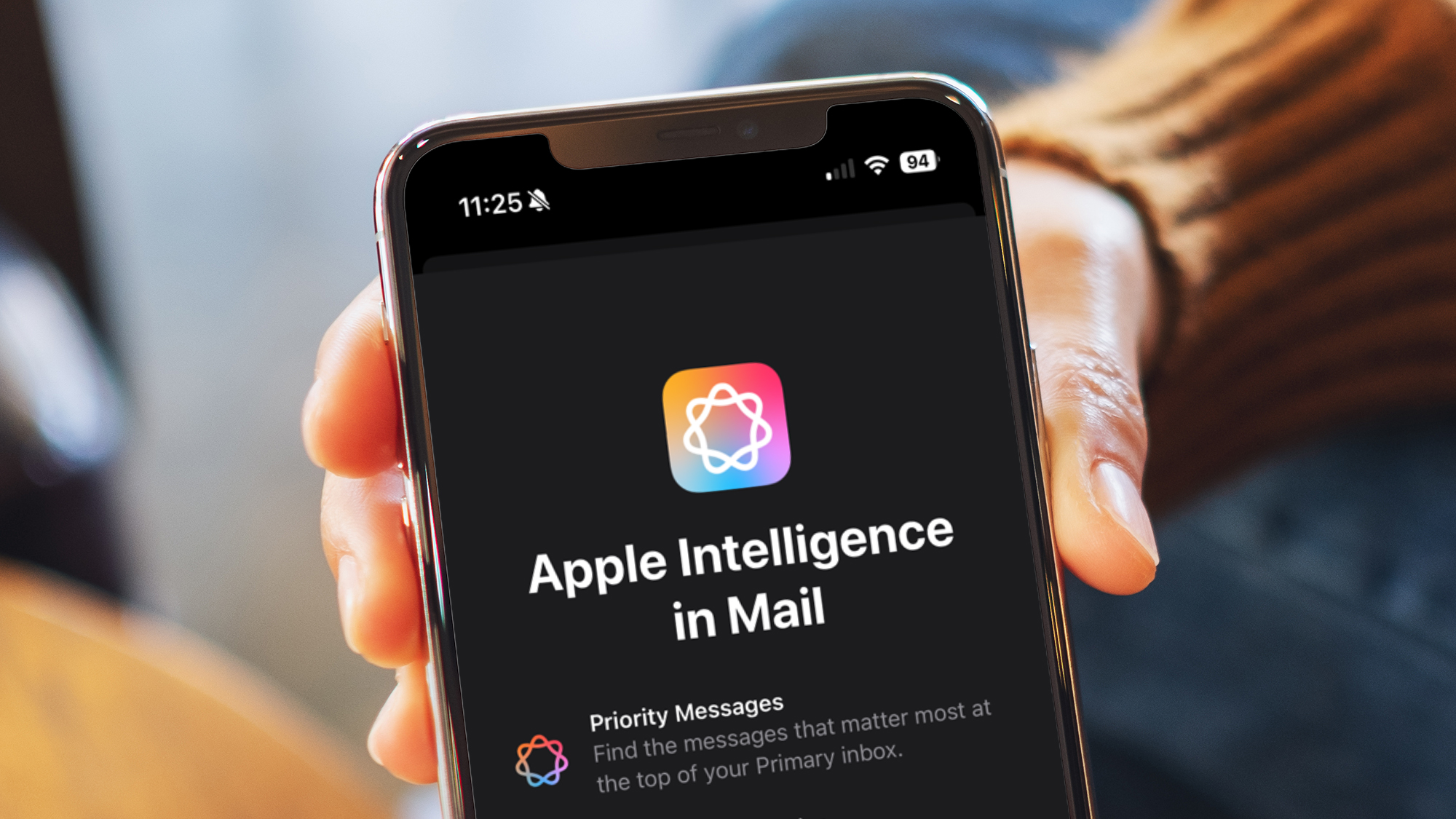
Rank 1569Apple Intelligence has not had the best year so far, but if you think Apple is giving up, you're wrong. It has big plans and is moving forward with new model training strategies that could vastly improve its AI performance. However, the changes do involve a closer look at your data – if you opt-in.In a new technical paper from Apple's Machine Learning Research, "Understanding Aggregate Trends for Apple Intelligence Using Differential Privacy," Apple outlined new plans for combining data analytics with user data and synthetic data generation to better train the models behind many of Apple Intelligence features.
Some real data
Up to now, Apple's been training its models on purely synthetic data, which tries to mimic what real data might be like, but there are limitations. In Genmoji's, for instance, Apple's use of synthetic data doesn't always point to how real users engage with the system. From the paper:"For example, understanding how our models perform when a user requests Genmoji that contain multiple entities (like “dinosaur in a cowboy hat”) helps us improve the responses to those kinds of requests."Essentially, if users opt-in, the system can poll the device to see if it has seen a data segment. However, your phone doesn't respond with the data; instead, it sends back a noisy and anonymized signal, which is apparently enough for Apple's model to learn.The process is somewhat different for models that work with longer texts like Writing tools and Summarizations. In this case, Apple uses synthetic models, and then they send a representation of these synthetic models to users who have opted into data analytics.On the device, the system then performs a comparison that seems to compare these representations against samples of recent emails."These most-frequently selected synthetic embeddings can then be used to generate training or testing data, or we can run additional curation steps to further refine the dataset."
A better result
It's complicated stuff. The key, though, is that Apple applies differential privacy to all the user data, which is the process of adding noise that makes it impossible to connect that data to a real user.Still, none of this works if you don't opt into Apple's Data Analytics, which usually happens when you first set up your iPhone, iPad, or MacBook.Doing so does not put your data or privacy at risk, but that training should lead to better models and, hopefully, a better Apple Intelligence experience on your iPhone and other Apple devices.It might also mean smarter and more sensible rewrites and summaries.
You might also like
3 things Apple needs to do at WWDC 2025 to save Apple IntelligenceHow to turn off Mail categories on iPhone, or customize them to your needsApple officially delays the AI-infused Siri
-
Picture from cdn.mos.cms.futurecdn.net
Rank 1570A new leak claims to detail the specs and pricing of AMD's upcoming Radeon RX 9060 XT GPUThe price could be as low as $269 in the US for the 8GB modelPerformance is claimed to sit between the Nvidia RTX 4060 Ti and AMD Radeon RX 7700 XT
We might finally have a proper idea of what AMD's long-awaited Radeon RX 9060 XT GPU is going to be capable of - and it's looking like it could be worthy of induction into the best graphics card hall of fame.Thanks to leaked information shared by Moore's Law Is Dead (MLID) on YouTube, we now know that the RX 9060 XT could be shipping with 32 compute units, a 128-bit memory bus with both 8GB and 16GB VRAM models available, and a TDP between 150W and 200W.Now, that's not a whole lot to go off at this point, but MLID's leak also notes that performance is 'above RTX 4060 Ti, but likely below RX 7700 XT'. Okay, so that doesn't sound that impressive, but here's the thing: the leak also includes pricing details, and it's looking very attractive on that front.The 8GB model will reportedly cost between $269 and $299, while the 16GB version is claimed to be priced at $329-379. It's unclear whether these are potential price ranges AMD itself is still contemplating, or projected price ranges for AIB partner cards. For reference, the RTX 4060 Ti - which it supposedly outperforms - originally retailed at $399, and that was almost two full years' worth of GPU price inflation ago.
Battle of the budgets
Even if AMD hits us with the high end of these price estimates, it'll be a seriously competitively priced desktop GPU. Although Nvidia has been dominating the high-performance end of the market with its RTX 5000 cards, there's no denying that AMD's biggest rival has been fumbling its budget game lately, leaving Intel (isn't that weird) as one of the best options in the affordable PC gaming space thanks to its excellent Arc B580 card.If Team Red can deliver RXT 4060 Ti-beating performance at a $269 price point, well, it's game set and match for the budget GPU market - at least, for the time being. It's worth noting, though, that MLID's source does say 'original plan as of a month ago' regarding these projected prices, likely in reference to the recent tech pricing carnage caused by Donald Trump's tariff war. So... watch this space, I guess.
(Image credit: AMD)
Another interesting point raised by the leaker was that the RX 9060 XT might lack hardware encoders - it's possible that to keep the price down, AMD has opted to include only the free-to-implement AV1 video encoder, not the (arguably better) H.264 and H.265 encode functions, since those require a licencing fee.The leaker claims there are no plans for a 'non-XT' RX 9060 card, which tracks given the two different VRAM versions and the suggested $269 base price. Additionally, AMD might be considering a Radeon RX 9050 XT, presumably priced somewhere in the $200-250 range.
You may also like...
Microsoft is digging its own grave with Windows 11, and it has to stopWindows 11 is getting a very handy change to the taskbar, as Microsoft takes a leaf from Apple’s Mac playbookMicrosoft looks to be making a big change to how you install and log in to Windows 11 – and I’m not happy about it at all
-
Rank 1571
-
Picture from o.aolcdn.com
Rank 1572Espresso Displays makes some of our favorite portable monitors, but up until now, it felt like there was a hole in its portfolio. That's because aside from its flagship model — the $800 Espresso 17 Pro — the other members of the family are slightly more affordable fare like the $469 Espresso Touch 13 and $499 Touch 15. Today, the company is plugging that gap with the Espresso 15 Pro, which packs everything I like about its bigger sibling in a more portable package for $699 (with a stand included).
Design and display
One of the things I appreciate about Espresso is that it doesn't try to do too much. The 15 Pro features an ultra minimalist design made from simple sheets of matte black aluminum along with glossy glass in front (if you prefer matte displays, you can always add one of the company's textured screen protectors). Granted, the monitor does have a bit of a chin, but aside from two USB-C ports stashed in the corner, that's really the 15 Pro's only defining exterior feature, so I'm not that bothered. All told, the display weighs 1 pound and 11 ounces, which sounds a lot heavier than it feels.
As for its specs, the Espresso 15 Pro's 4K LCD panel delivers nearly everything you want and then some. Brightness tops out at 550 nits (it was actually 556 nits according to my light meter), which is higher than the 450 nits on the 17-inch model. It also covers 100 percent of the Adobe RGB spectrum with 10-bit color (8-bit + 2-bit frame rate control). The one thing I wish Espresso included was a 120Hz refresh rate instead of being capped at 60Hz. That said, unless you're gaming or editing videos, that limitation may not be a huge factor.
Setup and special features
Sam Rutherford for Engadget
Getting the 15 Pro up and running couldn't be easier. Each USB-C port has enough bandwidth to carry power and data over a single cable, so you just need to plug in the included cord, and off you go. The one exception is for laptops that can't send out much power via USB-C, but I tested the monitor with 4 different laptops (both Mac and PC) and none of them had issues. The display even automatically downloaded the EspressoFlow software, which adds touch support to your Apple notebooks. You also get the new Glide feature that automatically positions the monitor in the right place depending on how you have it arranged next to your laptop. And by some black magic, the 15 Pro nailed it when it correctly laid out the monitor to the left of my notebook's built-in screen.
As someone who has recently been forced to use a Mac for work, the ability to quickly and easily add touch support to Apple's laptop is super nice. And while I'm far from a digital Degas, you can even use the display for drawing and sketching as the monitor also works with the company's optional stylus. This makes the 15 Pro an ideal travel companion for both people who want more screen real estate or a portable way of creating art on the go.
Accessories
In addition to screen protectors and pens, there are also a couple of important stand accessories for the 15 Pro. The first is the $49 Espresso Case, which is more of a magnetic folding cover that protects the screen while in transit that can also flip around back to become a kickstand when you're working. Like the display itself, it's a fairly simple affair that does exactly what you expect it to.
However, for those who want something more substantial, the 15 Pro also works with Espresso's $69 Stand+. It's more like what you'd see on a traditional desktop monitor, except that it can fold up for improved portability while also packing a really strong magnet that allows you to mount the monitor in a variety of positions. This thing might be too pricey for some, but I've quickly grown to appreciate how easy it makes putting the 15 Pro in the perfect position. It's more well-built than a lot of the desktop monitor stands I have. The obvious drawback is that at 1 pound and 4 ounces, the Stand+ weighs almost as much as the display itself, which is rather hefty.
Wrap-up
Sam Rutherford for Engadget
The Espresso 15 Pro has nearly everything I look for in a premium portable monitor. It features well above average brightness, a sleek but sturdy design and super simple setup. It also comes with a few special features like Glide and added touch support for Macs that help you get more out of the devices you already own. And thanks to a wealth of accessories, it can adapt to almost any use case.
While I'd like a higher refresh rate, not having it is far from a deal-breaker. That would almost certainly increase its price, and considering that the 15 Pro is already somewhat costly, starting at $699 for the monitor and the Stand+, I'm not sure the added expense would be worth it. Regardless, if you want a really portable monitor that's also more than good enough to use at home, there aren't many other displays that can match the Espresso 15 Pro.This article originally appeared on Engadget at https://www.engadget.com/computing/accessories/espresso-15-pro-review-just-a-really-nice-though-pricey-portable-monitor-230046315.html?src=rss
-

Picture from techcrunch.com
Rank 1573 -
Picture from cdn.mos.cms.futurecdn.net
Rank 1574xAI’s Grok 3 chatbot has added a voice mode with multiple personalitiesOne personality is called “unhinged” and will scream and insult youGrok also has personalities for NSFW roleplay, crazy conspiracies, and an “Unlicensed Therapist” mode
xAI’s Grok may be about to start remembering your conversations as part of a broader slate of updates rolling out, all of which seek to match ChatGPT, Google Gemini, and other rivals. Elon Musk’s company tends to pitch Grok as a plucky upstart in a world of staid AI tools; it also seems to be aiming for parity on features like memory, voice, and image editing.As spotted by one user on X, it appears that Grok will get a new "Personalise with Memories" switch in settings. This would be a big deal if it works and mark a shift from momentary utility to long-term reliability. Grok's reported memory system, which is still in development but already appearing in the web app, will allow Grok to reference previous chats.This means if you’ve been working with it on something like planning a vacation, writing a screenplay, or just keeping track of the name of that documentary you wanted to watch, Grok could say, “Hey, didn’t we already talk about this?”Grok’s memory is expected to be user-controlled as well, which means you’ll be able to manage what the AI remembers and delete specific memories or everything Grok has remembered all at once. That’s increasingly the standard among AI competitors, and it’ll likely be essential for trust, especially as more people start using these tools for work, personal planning, and remembering which child prefers which bedtime story.This should put Grok more or less on par with what OpenAI has done with ChatGPT’s memory rollout, albeit on a much shorter timeline. The breakneck pace is part of the pitch for Grok, even when it doesn't quite work yet. Some users have reported already seeing the memory feature available, but it's not available to everyone yet, and the exact rollout schedule is unclear.
Remember Grok
Of course, giving memory to a chatbot is a bit like giving a goldfish a planner, meaning it’s only useful if it knows what to do with it. Even so, xAI seems to be layering memory into Grok Web in tandem with a handful of other upgrades that lean toward making it feel more like an actual assistant and less like a snarky trivia machine.This memory update is starting to appear as a range of other Grok upgrades loom on the horizon. Grok 3.5 is expected any day now, with Grok 4 slotted for the end of the year.There’s also a new vision feature in development for Grok’s voice mode, allowing users to point their phones at things and hear a description and analysis of what's around them.It's another feature that ChatGPT and Gemini users will find familiar, and Grok’s vision tool is still being tested. Upgrades are also coming to the recently released image editing feature that lets users upload a picture, select a style, and ask Grok to modify it.It’s part of the ongoing competition among AI chatbots to make AI models artistically versatile. Combine that with the upcoming Google Drive integration, and Grok starts to look a little more serious as a competitor.Also on the horizon is Grok Workspaces, a kind of digital whiteboard for collaborating with Grok on a more significant project. These updates suggest that xAI is pivoting to make Grok seem less like a novelty and more like a necessity. xAI clearly sees Grok’s future as being more useful than just a set of sarcastic and mean voice responses.Still, even as Grok gains these long-awaited features, questions remain about whether it can match the depth and polish of its more established counterparts. It’s one thing to bolt a memory system onto a chatbot. It’s another thing entirely to make that memory meaningful.Whether Grok becomes your go-to assistant or stays a curious toy used only when some aspect goes viral depends on how well xAI can connect all these new capabilities into something cohesive, intuitive, and a little less chaotic. But for now, at least, it finally remembers your name.
You might also like
ChatGPT's memory upgrade might just be the biggest AI improvement we see all yearI tried Grok’s new AI image editing features – they’re fun but won’t replace Photoshop any time soonGrok 3’s voice mode is unhinged, and that’s the point
-
Picture from cdn.mos.cms.futurecdn.net
Rank 1575When TV manufacturers announce their new ranges each year, I'm often left feeling conflicted. I can’t help but wonder how much better the best TVs can become.If a TV is worthy of a five-star rating from me and my fellow reviewers, is that same TV suddenly redundant when its successor earns the same star rating? On the other hand, I do get excited by new technologies and features that are designed to improve image quality in the pursuit of true perfection.That second statement can certainly be applied to the Samsung S95F, the company’s flagship 4K OLED screen for 2025. Not only does it boast the same processor as its higher-end 2025 8K TVs – which should result in more impressive upscaling of non-4K content – but it also features Samsung’s second-generation Glare Free anti-reflection technology.Introduced with the S95D last year, the Glare Free technology promises to banish pesky light reflections from the screen. I saw it myself on the S95D and can comfortably say it was a big reason – combined with its overall performance – that it was awarded the TV of the year 2024.However, while it was certainly an innovative introduction, I didn't think it was quite perfect. I found blacks weren’t as deep as I'd seen in other 2024 OLED TVs without this tech, instead looking a little washed out and grey.So when I was made aware that the technology had been further refined in the S95F, I jumped at the opportunity to see it in action on both the 83-inch and 77-inch models to see if black levels had been improved.
Improvements across the board
Even with overhead lights on, no reflections can be seen on the screen of the Samsung S95F. (Image credit: Future / Max Langridge)
Samsung had set up a viewing experience of both TVs for the media in a hotel room in Sydney where I’m based. The weather wasn’t the usual bright sunshine that one would normally associate with Australia, but there was still some daylight to test the screen’s anti-reflection capabilities, along with bright overheard lights throughout the room.As I expected, the Glare Free technology on the Samsung S95F worked flawlessly, making the entire screen viewable no matter how bright the room was. It really is an impressive feat that makes it a superb screen for brightly lit homes (including those in Australia, because we do have more sunny days than overcast ones, honestly).However, I personally think the anti-glare layer does still have some impact on the overall picture quality. I admit that the second-generation panel is an improvement over the S95D – a sentiment shared by my colleague Al Griffin, who’s said that black levels are definitely elevated compared to last year’s model – but, for me, the image looks a little flat in comparison to OLED TVs from other brands.
Head-to-head
I have the LG G4 OLED TV at home, for example, which I use daily. It too has an anti-reflective coating of sorts, but I’m not going to lie and say it isn’t susceptible to reflections from overhead lights, ambient lighting or from the sun pouring in through my windows.Having said that, I’ve rarely had a major issue with reflections and I’m still able to watch content with little interference.
Image 1 of 2I find blacks to be 'more' black on the LG G4, resulting in a deeper, more cinematic image. (Image credit: Future / Max Langridge)Image 2 of 2The LG G4 does show up more reflections, although they're not as pronounced as my phone camera makes out. (Image credit: Future / Max Langridge)
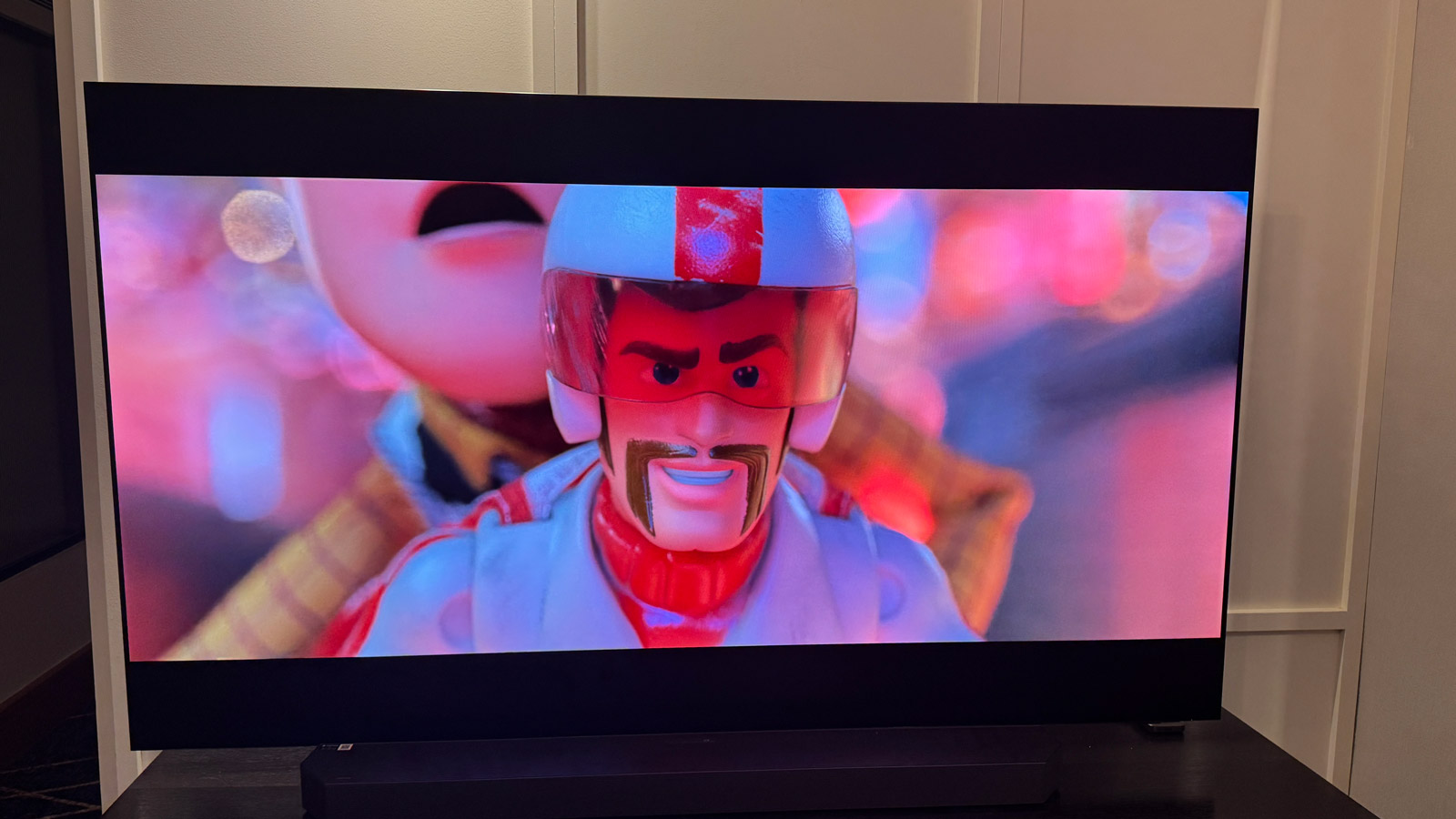
I’m also OK with the reflections it does suffer from because the image quality makes up for it in my opinion. Following my short time with the Samsung S95F, I watched the same movies on the LG G4 when I got home, which included Abigail for its dark scenes and shadow detail.At the end of Abigail when the lead character Joey leaves the house at night and gets into her van, a large tree can be seen in the background. When comparing this scene on both the Samsung S95F and LG G4, it looked more grey on the Samsung screen than on the LG. Plus, when Joey gets into the van and turns a light on, revealing dark blood on her face, I thought the scene had greater depth on the LG TV.I can't say the same for more colorful scenes, however. I watched Toy Story 3 on both screens and found much less to separate the two. Both were vibrant and punchy and an enjoyable watch overall. It's just the darker scenes that I find don't have quite the impact on Samsung's TV.In other words, I find the picture of the LG to be more cinematic than the Samsung. Don't get me wrong, though: I’m not for one moment saying the S95F is a bad TV, because it absolutely isn’t – it just doesn’t suit my personal preferences.
Waiting for the competition
All this brings me to the headline of this feature: TVs I'm more excited for that have been released, or will be released, this year. First up, perhaps unsurprisingly, is the replacement to my current TV – the LG G5.This year LG has introduced a new ‘four-stack’ OLED panel (which, as it happens, is the same screen used in the 83-inch version of the Samsung S95F) that promises higher brightness and improved color reproduction.I’ve already had a brief introduction to the G5, viewing it at LG’s offices in Sydney side by side with the G4, and my colleague Al has recently published our LG G5 review, giving it a glowing five-star rating.
The LG G5 gets a brightness boost this year, enabling it to hold up much better in brightly lit rooms. (Image credit: Future)
I can't argue with this score, as based on the content that LG was showing on the two screens, there were noticeable differences in color and detail.One video was of some models walking down a runway in dresses of various colors and one that stood out in particular to me was a red dress. The difference in the shade of red on both screens was clear as day, with the LG G5 looking punchier, yet more natural.The G5 also revealed more creases in the middle of the dress compared to the G4, indicating that it should also be capable of picking out greater detail in other content.My only concern with the G5 is the way it handles Dolby Vision, something my colleagues at What Hi-Fi? mention in their review. The vast majority of content I watch at home is mastered in Dolby Vision, so naturally I’m now worried when I get to see it properly myself. What Hi-Fi? has said LG is aware of the issue and a fix is on the way.I, of course, will have to reserve full judgement until I can watch content I’m familiar with on the G5. Still, it’s without a doubt the TV I’m most excited for this year.
But wait, there’s more…
Actually, there's still some doubt. The LG G5 was the most exciting launch for me this year… until Sony announced the Bravia 8 II QD-OLED TV – expected to begin shipping within the next couple of months.When I published my Sony Bravia 8 review, I was impressed by its beautiful, natural-looking images and brightness levels, considering it was a ‘standard’ WOLED panel with no additional brightness-boosting technology.That’s all set to change in the Bravia 8 II, which will be sold as a step-up model over the Bravia 8, rather than a full replacement. In fact, Sony has said the new model is a replacement for the A95L that’s been on sale since 2023.
(Image credit: Future)
TechRadar's entertainment-channel Managing Editor, Matt Bolton, has already seen the Bravia 8 II in action and noticed how it’s able to unearth subtle details in content and produce colors that appear more saturated. He also reaffirmed that, despite getting a brightness boost thanks to the addition of quantum dot (QD) technology, it’s the company’s latest processor and how it’s used that will likely have the greatest impact.I have also now seen the Bravia 8 II myself during a media briefing at Sony’s offices in Sydney, where it was placed side-by-side with the Bravia 8. Indeed, there was a clear difference in HDR performance, with particularly bright parts of an image – a lit-up sign, for example – being noticeably brighter on the new model.It’s these smaller details that can actually have the greatest impact on the content you watch, making Sony’s new screen one to consider.2025 is an exciting year for TVs. Samsung and LG continue with their innovation and now Sony is throwing its hat into the ring to compete in the premium OLED space. If you’re loyal to a particular brand, then I have no doubt you’ll continue to be impressed, but if you’re planning to invest in a new screen this year, then it’s clear you won't be short of talented options.
You might also like
I love LG’s new Magic Remote design for its OLED TVs – too bad only certain regions are getting itSamsung, Sony and LG OLED TVs for 2025 now have Australian pricing, and one brand is already offering huge discountsAs a home theatre fanatic, I'm thrilled that Kaleidescape's cult movie players are finally coming to Australia
-
Picture from cdn.mos.cms.futurecdn.net
Rank 1576If you’ve managed to steer clear of ChatGPT all this time, just know you might be using an OpenAI AI model soon without even realizing it.OpenAI unveiled a new suite of models aimed at developers looking to embed some AI into their software. The GPT-4.1, GPT-4.1 mini, and GPT-4.1 nano models might not declare themselves, but they seem purpose-built for subtle inclusion in other products.These aren’t the chatbots you open for conversation and then close after getting your trivia question answered to go back to your email inbox. These models power your inbox, to-do list, or budgeting app. They could fuel a recipe manager and adjust ingredient portions for any last-minute additions to the dinner party.What makes GPT-4.1 and its smaller, slightly speedier siblings different from past releases is that it is explicitly designed for developers rather than for developers in addition to a role with ChatGPT. These are workhorse models optimized for instruction-following, coding, and reasoning from vast chunks of information.That means they are very good at doing exactly what you tell them to do in a format familiar to any software developer. OpenAI also boasts about its speed and cost relative to its power, making it even more enticing for developers with an ingenious app idea but limited resources.OpenAI has ideas about apps getting much smarter thanks to its models and the clever way developers can deploy them. Picture your expense tracker automatically and accurately, immediately categorizing purchases or your notes app, producing a summary of everything that happened during a particularly chaotic day at work. Your photo editor might offer captions that don’t sound like they were written by a robot or at least like a robot that has spent some time around people.This is AI as infrastructure – not a product, not a personality, but a quiet presence that makes everything run smoother and better.
OpenAI inside
We’ve seen glimmers of this before. Gmail’s autocomplete, Photoshop's image suggestions, and other tools have plenty of AI underlying their features. However, what OpenAI is semi-obliquely promising with GPT-4.1 is that plugging AI into an app will be easy, fast, and cheap.Of course, relevant questions are raised about whether users should be alerted about the AI model since they might consciously avoid it in its more visible form. Plus, the usual privacy questions about apps get more complex with AI involved. If your grocery app starts predicting your purchases before you search, is that convenience or surveillance?Many apps might never tell you they’re using GPT-4.1 under the hood if they don't have to, especially if it’s just powering something like a search function or summarizing your reading list. There’s a good chance millions of people will be using OpenAI models every day without ever realizing it, for good or ill.Broad adoption of the models by developers might actually help with public acceptance. If AI is more like a utility and not an in-your-face feature, people might be more comfortable with it. It could be like Wi-Fi.You don’t think about the Wi-Fi noting your location when you check the weather; you simply expect it to work. AI moves from spectacle to plumbing, annoying when it fails and invisible when it works.That also means who we define as an AI used will change. Instead of someone who opens ChatGPT or Midjourney, an AI user will just be someone using an app, like how everyone using an app is technically a software user.For OpenAI, there's also a possible shift in power in their favor. By moving away from direct engagement and toward app integration, you’re ultimately relying on OpenAI whether you signed up for ChatGPT or not. Smarter tools are often more helpful, less annoying, and better at dealing with whatever task they're assigned.But it also means more of your digital life will be shaped by a handful of foundational models operated by companies that aren’t always transparent about how those models are trained, what data they’ve consumed, or what they might get wrong.So, if you’ve been proudly avoiding AI tools, get ready to either massively extend your list of software to avoid or be prepared to parse some user agreements to check for GPT-4.1's quiet reshaping of your digital world.
You might also like
ChatGPT's memory upgrade might just be the biggest AI improvement we see all yearWill Adobe's AI agents cause the death of creativity?I refuse to jump on ChatGPT’s Studio Ghibli image generator bandwagon because it goes against everything I love about those movies
-

Picture from techcrunch.com
Rank 1577 -

Picture from cdn.mos.cms.futurecdn.net
Rank 1578More than 250 companies have signed the “Secure-by-Design” (SBD) pledge from the Cybersecurity and Infrastructure Security Agency (CISA). By committing to the voluntary pledge, software manufacturers are promising to increase multi-factor authentication (MFA) for products; better enable customers to do their own patching; reduce default passwords; and decrease vulnerabilities, among additional proactive, protective practices.By embedding cyber defense from the outset of product development and system architecture, SBD is intended to transform cybersecurity from an afterthought to an essential, core element of design. Companies that fail to adopt this approach run the risk of falling behind in their security and compliance maturity, while losing consumer trust. They also could run into some very expensive problems, as the average cost of a data breach has increased to $4.88 million – up from $4.45 million in 2023.
Implementing an SBD strategy
So how do organizations effectively implement an SBD strategy? They can start by looking at the financial services sector, which is often more willing to invest in innovative approaches to security upskilling and additional preventative measures than other industries. These institutions are taking such steps because, frankly, they have to, given the immense challenges they face:Increasing – and more costly – threatsIf history has taught us anything, it’s that cyber criminals always follow the money. Financial organizations are experiencing 1,115 breaches a year, which ranks #4 among all verticals.Regulatory pressuresThe Payment Card Industry Data Security Standard (PCI DSS) and the European Union’s General Data Protection Regulation (GDPR) require financial organizations to achieve higher levels of governance and security. As part of the ongoing compliance process, the industry’s developers must bring verified skills to properly configure sensitive databases, payment gateways and portals.The critical – and fragile – state of consumer trustFinancial service firms’ customers expect no less than the absolute fortification of their personal data and transactions. If an institution suffers an attack that compromises any of this, it runs the risk of losing consumer trust with potentially devastating market/revenue consequences – if not extinction.
SBD developer readiness
Fortunately in our research, we have found that the financial industry is doing an exceptional job of positioning for SBD developer readiness. There is no quality that is more “make or break” in significance than the upgrading of the skills and tools of the people who innovate, develop and disseminate code at the heart of our digital systems.Indeed, in taking a closer look at what these companies are doing, we get a better sense of the level of developer risk management this industry is pursuing– and can help lift other industries as they “shift left” in seeking to make good on the CISA pledge.Investments in upskillingOn average, in organizations, there are less than four software security group (SSG) specialists for every 100 developers. Given how few of these specialists are on board, it’s no wonder that code-level vulnerabilities continue to plague most verticals.This speaks to the urgency of developer upskilling, with a focus on flexible, dynamic training programs that align learning within the context of “real life” threats – a “learning by doing” approach. The financial sector is considered an early adopter of these and other initiatives aimed at building security into the software development life cycle (SDLC), and has achieved high maturity rates here as a result.BenchmarkingTo ensure upskilling initiatives are working, organizations must establish baselines and benchmarks to assess whether SBD is recognized as an indispensable part of their DNA. Such benchmarking should cover the state of developers’ security skills, awareness and the measurement of their success profile against that of other industry members. With this, these leaders will truly know if their teams have earned a “license to code,” and that the inherent risk of developers with low security skills is being managed and effectively improved.Proactive threat modeling and testingFinancial services providers are quite good at regularly conducting threat modeling to address risks sooner rather than later – preferably before an attack ever has a chance to strike. The industry also relies upon strict code reviews, testing and audits to reveal vulnerabilities and additional areas of concern.By following financial institutions’ lead in establishing a baseline for developer risk management activities and implementing the described best practices, organizations across the board will cultivate a winning developer-driven security culture. This environment will prepare developers to implement robust, secure code from start to finish, to the point in which this emerges as a habit they can perform at speed.That’s when companies of all kinds will demonstrate they’re doing far more than simply signing CISA’s pledge – they’re delivering on its promise to make SBD a universal norm by acting now to defend the future.
We rate the best school coding platform.
This article was produced as part of TechRadarPro's Expert Insights channel where we feature the best and brightest minds in the technology industry today. The views expressed here are those of the author and are not necessarily those of TechRadarPro or Future plc. If you are interested in contributing find out more here: https://www.techradar.com/news/submit-your-story-to-techradar-pro
-
Picture from o.aolcdn.com
Rank 1579I recently moved and, before I had a chance to set up my smart plugs again, I found myself turning on my living room lamps manually — I sort of hated it. Reaching, twisting and visiting each one like some Victorian gaslighter felt almost silly to me after having experienced the ease of asking Alexa to “turn on all the lights.” True, there are worse problems, but like all smart home stuff, smart plugs simply make life a bit more convenient and, honestly, a little more fun.In the two years or so that I’ve been testing smart plugs, I’ve come across models that were just plain bad and others that were pretty good. I like TP-Link’s EP25 best of all, but a few others have their advantages — outdoor use, energy monitoring, dual outlets, Matter compatibility — that might make those options better for you. Here are our top picks for the best smart plugs you can buy, along with how to get the most out of your plug once you buy it.
Table of contents
Best smart plugs for 2025
Best outdoor smart plugs for 2025
What to consider when buying a smart plug
How we tested the best smart plugs
Other smart plugs we tested
Smart plug FAQs
Best smart plugs for 2025
The best outdoor smart plugs for 2025
Most people will likely use outdoor plugs for two things: patio lighting and holiday string lights. The devices are designed for the outdoors with a weatherproof protection rating of IP64 or higher, which means they’re impervious to dust and can handle splashing water from rain and sprinklers. They have a longer Wi-Fi range than indoor plugs, for obvious reasons, and many have dual outlets, with individual control over each one.
Setup is the same as for indoor plugs: you’ll use your phone to help the plug find your Wi-Fi using its companion app. The only tricky part is getting your phone within Bluetooth range of the plug (which it uses to initialize setup) and in Wi-Fi range at the same time. I had to awkwardly stand at a triangulated point in the middle of my driveway to get things communicating properly. Once set up, the plugs will communicate using your router for voice and app control and your phone needn’t be anywhere near the plug.
What to consider when buying a smart plug
Before you buy one, it helps to know how a smart plug works best. They are designed for things that have an on/off switch, making them great for turning lamps into smart lights. If you want a plug-in fan to move some air around before you get home, a smart plug can help. You can load a basic coffee maker with grounds and water the night before and wake up to a fresh pot in the morning. And instead of an air purifier running all day, you could set it to just run when you’re away. But gadgets that needs to be programmed further, or requires a stand-by mode, isn’t ideal. If you want to control built-in lights, you’ll need a smart light switch, which are more involved than smart plugs as they can involve in-wall installation. Smart bulbs are also an option for automation, and we have an entire guide devoted to those.
Some smart plugs can even monitor how much energy they use and display those figures within their companion app. That might not be much use on its own, as lamps with LED light bulbs consume very little energy, but it could help you keep tabs on your overall energy consumption.
Setup and use
Adding a smart plug to your home is relatively simple. You’ll use the manufacturer’s app to initially connect, after which you can add the plug to a compatible smart home ecosystem so you can use voice control and other features. Both the brand’s app and your smart home app will let you name the plug, set schedules and program “routines” which provide automation for multiple smart devices at once. But as you can guess, a manufacturer’s app only lets you control products from that brand. If you want whole-home automation, operating, say, a plug from TP-Link’s Kasa, a smart bulb from Philips Hue, a smart thermostat from Honeywell and a camera from Arlo without switching apps, you’ll need to use a smart home platform, which means you’ll need to consider compatibility.
Compatibility
Smart home devices connect through wireless protocols, often using more than one to communicate with your phone, smart speaker, router and in some cases, one another. The majority of smart plugs use Wi-Fi, but some have recently incorporated Matter, a relatively new wireless standard intended to solve integration issues between different brands and manufacturers, while also improving security and reliability.
More of these smart plugs are coming to market and, for now, most Matter devices work via Wi-Fi, Bluetooth and a low-power mesh network called Thread. Matter requires a controller that stays at home, like a hub or smart speaker, to manage things when you’re out and about.
As for Bluetooth, most plugs, including all Matter plugs, use the short-range protocol to get the device set up for the first time. Some can continue to run on Bluetooth in the absence of another option, but the connection isn’t as reliable and you won’t be able to control the plug when you’re away from home, or perhaps even just on the other side of the apartment.
Because Matter is relatively new, it may be easier to consider the manufacturer’s system you’d use the most. There are four major “branded” smart home platforms: Amazon’s Alexa, Google Home, Apple’s HomeKit and Samsung’s SmartThings. The first two work with the widest range of brands and are compatible with both iOS and Android devices. HomeKit not only limits app access to Apple devices, but it’s also compatible with fewer plugs. You can also turn to open-source software like Home Assistant or go with the larger functionality of IFTTT if you want to, say, have your lights turn off when your Uber arrives. For the purposes of our testing, we stuck with the four big players. Nearly every plug we looked at clearly stated which platforms it works with, both on the packaging and retail product pages.
Of course, there’s no rule that says you have to stick with one home assistant. You might have an Echo Dot in the basement, a HomePod in the living room and a Google Nest Mini in the kitchen, each controlling any compatible devices. My kid has a great time telling Alexa to turn on a light then asking the Google Assistant to turn it back off.
Photo by Amy Skorheim / Engadget
Hubs and smart plugs
All of our top picks recommended here don’t require a hub and connect directly to your home’s Wi-Fi router. That means if you already have wireless internet and a smartphone or tablet, you can quite literally plug and play. The exception is Apple’s HomeKit. If you want to pair up a compatible plug with that platform, you’ll need a HomePod speaker, Apple TV or an iPad that stays in your home to enable remote control when you’re away.
Some smart plugs require a hub regardless of which platform you use. For our guide, we focused on the simplicity (and lower cost) of options that work on their own, but hub-dependent devices may make sense in certain situations. Some companies, like Aqara for example, make a vast range of smart home products, adding automatic shades, window sensors, smart locks and air quality monitors to the more traditional cameras and plugs. If you’re going all-in on one brand and plan to get a plethora of connected devices, a hub can keep your Wi-Fi network from getting too crowded and provide a more seamless setup with reliable connectivity.
Sharing
Once a plug is set up with your platform and voice assistant of choice, anyone can control the plug just by talking. If someone else wants to control things with their phone, things get more complicated. Google makes it easiest, allowing you to invite another person just by tapping the + button within the Home app. Whomever you invite will have full access to your connected devices – including cameras – so this is only for people you trust the most.
HomeKit makes it similarly easy to grant app access to someone else, but as with most things Apple, it only works for other iOS users. Amazon only allows you to share access to your Echo, not your connected home devices.
Many smart plug manufacturers allow you to share control through their app by inviting another person via email. But this only grants access to devices of that brand. Hopefully as Matter expands, multi-admin features will become more widespread.
If you get a new Wi-Fi network
Most people will wirelessly connect their smart plugs to their home’s Wi-Fi router. Matter, Z-Wave, Thread and other smart home protocols can work over local networks, but for most setups, the signals telling your plugs what to do will be dispatched through your router. If you happen to get a new one (like I did when it became clear my very basic gateway could not handle the number of smart home devices being tested) you’ll need to take a few steps to get everything reconnected.
Depending on the brand, the steps may simply involve using the plug’s companion app to update your credentials (network name and password). Or it will require deleting the device in the companion app, doing a factory reset (typically by pressing the onboard button for 10 seconds) and setting up the plug like it's brand new. GE Sync and Emporia plugs allow for a credentials update via their apps, others, like TP-Link Kasa and Meross plugs require deletion and a factory reset to get along with your new network. Amazon’s smart plug updates automatically after updating the associated Echo device.
How we tested the best smart plugs
Before we decided which smart plugs to test, we considered brands Engadget staffers have had the best experiences with, both in review capacity and personally. We also checked out other online reviews. We then looked at factors like price, compatibility and relative popularity. I got ahold of ten indoor smart plugs and four outdoor versions from eight manufacturers.
I set up each one using its companion app, then added it to all compatible smart home platforms. Plugging in a cadre of lamps and string lights, I tested the plugs using an iPhone 11, Galaxy S10e, Echo Dot, HomePod mini and Nest Mini. I accessed the plugs via the apps and through voice commands and controlled them in my home and away from it. I programmed schedules and routines and moved the plugs to different outlets, including ones in the basement to gauge range. For the outdoor devices, I plugged them into an outlet in the garage (approximately 85 feet from my Wi-Fi router) and an outlet attached to the back of the house.
Here’s every smart plug tested before settling on our top picks:
The Amazon Smart Plug
Emporia Smart Outlet*
GE Cync Indoor
Wyze Plug
Roku Indoor Smart Plug SE
Belkin Wemo smart plug with Thread
TP-Link Kasa EP25
TP-Link Kasa Ultra Mini EP10
Meross Wi-Fi Dual
TP-Link Kasa KP125M (Matter)
Eve Energy (Matter)
Aqara Smart Plug (hub required)
AmazonBasics Outdoor Smart Plug (outdoor)
Wyze Plug Outdoor (outdoor)
TP-Link Kasa Outdoor EP40A (outdoor)
TP-LINK Outdoor Dimmer KP405 (outdoor)
*Emporia issued a recall on its smart plugs purchased before August 1, 2023 due to a potential fire risk, though no incidents were reported. The plugs have since been updated to resolve the issue and are back on sale. We tested the revised version and recommend it as the energy-monitoring pick.
As new smart plugs are released, we'll continue to try them and update this guide accordingly. We plan to add smart power strips to this guide as well.
Other smart plugs we tested
Meross Matter plug (MSS115)
I wasn’t able to test the Meross Matter plug fully. It requires Wi-Fi splitting, a process that’s certainly possible for the average consumer, but more involved than it should be, considering the more than dozen other plugs I’ve tested don’t require such a step. The plug itself also blocked the other outlet. Meross has an updated version of the Matter device on the way, one that looks to solve both issues and we’ll update this guide accordingly once we’ve had a chance to test it.
Roku Smart Plug
Roku’s smart home gear is basically Wyze equipment with an app and packaging that are more purple. The Roku smart plug performed just fine with both compatible voice assistants (Alexa and Google Assistant). The companion app doesn’t offer scheduling that revolves around the timing of the sunset in your area, but the plugs go for less than $10 each and if you’ve got a Roku TV or streaming device set up and want to keep everything on-brand, it could be a fit.
Aquara Smart Plug
The Aqara plug requires an Aqara hub. In tests, the connectivity was solid and the companion app allowed for useful if/then automations that can rope in other Aqara devices like locks, window shades, cameras and more. The plug also worked well with voice assistants from Amazon, Google and Apple. As a stand-alone plug, however, it’s tough to recommend the nearly $100 combo to anyone who isn’t planning to get a complete Aqara smart home setup.
Smart plug FAQs
What should you not plug into a smart plug?
Anything with controls that are more complicated than on/off won’t work well with a smart plug. For example, a dimmable lamp with touch controls won’t turn on when the smart plug does. A programmable coffee maker, smart TV, microwave, Instant Pot, robot vacuum — none of these make sense to use with a smart plug as they all require further input from you to start working. Appliances like a lamp with a twist knob, a basic humidifier, a coffee maker with a red-rocker switch are all good options for using with smart plugs.
You’ll also want to pay attention to the wattage and amperage rating of your smart plug. All smart plugs work with 120V outlets, and most are rated to 15A, which should handle even power-hungry appliances like a 1500 watt space heater. But be sure to check that the plug can handle whatever you’re plugging in. It’s also not wise to use a smart plug to automatically turn on appliances that require supervision, like things with heating elements (heaters, curling irons, etc).
What are the disadvantages of a smart plug?
While they’re great when everything is working properly, smart plugs can be frustrating, adding a layer of complication to the simple act of turning on a light, if something goes wrong. For example: If your Wi-Fi goes out, your smart plug won’t work. If the smart plug loses its connection to your router, it won’t work. If you change your Wi-Fi password or provider, you’ll have to re-program your smart plugs. If you forget what you named a particular plug during setup, you may be faced with an irritating conversation with your voice assistant. The best way to avoid some of those problems is to get a plug that works reliably, which is one of the features we considered for this guide.
How much power does a smart plug draw?
Smart plugs don’t draw much more power than whatever you’re plugging into them. True, they remain on standby to await instructions from your smart assistant or other controller, so they’re always using a small amount of power. But if, for example, you set a light to automatically turn off at night, and that light would otherwise stay on unnecessarily, the smart plug will save far more energy than the watt or two extra that it draws.
Do smart plugs use Bluetooth?
Some smart plugs use Bluetooth to connect to your phone during setup. After that, most connect to your home’s Wi-Fi network.This article originally appeared on Engadget at https://www.engadget.com/home/smart-home/best-smart-plug-131542429.html?src=rss
-

Picture from techcrunch.com
Rank 1580 -

Picture from cdn.mos.cms.futurecdn.net
Rank 1581The UK Government has announced a £121 million investment into quantum technologies, a move it says will help “tackle fraud, prevent money laundering, and drive growth”.The government hopes to achieve this by bolstering the UK’s world-leading research programmes, which it says will bring a “range of benefits to working people, including improved healthcare systems and boosted energy efficiency in the grid.”These are the perfect combination of big, impressive promises that are vague enough to evade any real scrutiny, with a budget that seems huge, but will most likely fall seriously short of making any real difference. Will these research projects actually bring about an end to fraud? Well, let’s start by looking at a breakdown of the spending.
An expensive venture
The new investment starts with £46.1 million through Innovate UK, and a further £21.1 million for the National Quantum Computing Centre, including a testbed programme with Innovate UK, to “to accelerate the discovery of more ways that quantum can overhaul how we work and solve problems”.To me, this suggests the government wants more sectors to adopt quantum computing, but it’s not quite sure what for yet.Quantum computing is in its infancy, and its potential is huge, but the British government is pledging hundreds of millions to a solution it hasn’t yet matched to a problem - just to avoid falling behind.These cash injections come alongside a further £10.9 million for the National Physical Laboratory’s quantum measurement programme, in order to encourage more businesses to “make full use of the technology”.Here’s the thing, though: quantum computing in its current form is outrageously expensive. Mass production of quantum computers for commercial use is still, at best guess, years away - and one single mid-range quantum computer (with 50-100 qubits) costs upwards of $1 million, SpinQ estimates.Included in the £121 million figure is £24.6 million in funding from EPSRC for five previously announced research hubs, and £15.1 million spread between 11 Quantum Technology Acceleration Fellowships to help find “more real-world applications for quantum, from drug discovery to disease diagnostics” - yet more potential uses of the new emerging technology.
Great expectations
To be clear, research is always positive, and the government should be establishing public research projects into potential use-cases for quantum computing, an area that has huge potential for public benefit - and if quantum technology can eliminate fraud then that’s fantastic.That being said, at this stage, quantum computing isn’t ready for commercialisation, and it is so expensive that £121 million is just a drop in the ocean for the technology, whereas that funding could be used to make a real, tangible difference elsewhere - like for the nature-friendly farming budget (recently cut by the government), costing the same amount, but protecting 239,000 hectares of land, or the £120 million project to help the UK transition to zero-emissions vehicles - a measurable benefit for the British public.The UK has a well-developed technology sector, but struggles with a serious skills shortage, low wages, and a productivity problem. As great as quantum technology has the potential to be, these underlying issues will taint any new developments until they’re resolved - and the government’s promise to “save millions for our economy, create thousands of jobs and improve businesses across the country” with this relatively small cash injection seems like a stretch.For context, it’s estimated that China has invested over $15 billion into public quantum funding, out-spending both the EU ($7.2 billion), and the US ($1.9 billion). To suggest that such a small investment by the UK will simultaneously tackle crime, fraud, and money laundering, as well as delivering thousands of jobs and cementing the UK as a world-leader in quantum is incredibly optimistic, and quite frankly, the money could be used elsewhere.The UK’s current 10 year plan for quantum spending commits just £2.5 billion to development, an investment level likely to be overshadowed by a host of other states. Although investments are needed, without a coherent quantum strategy and guided public policy, these are likely to be lacking.
You might also like
Take a look at our picks for the best AI tools aroundWhy businesses must prepare for a post-quantum futureWorld Quantum Day – is the internet ready for the "biggest security threat of all time"?
-

Picture from cdn.mos.cms.futurecdn.net
Rank 1582The riskiness of AI development results from the fact that modern AI tools are pushing ethical boundaries under the existing legal frameworks that weren’t made to fit them. However, the way regulators choose to proceed in light of this varies greatly between different countries and regions.The recent AI Action Summit in Paris highlighted these regulatory differences. Notably, its final statement focused on matters of inclusiveness and openness in AI development while only broadly mentioning safety and trustworthiness and without emphasizing specific AI-related risks, such as security threats or existential dangers. Drafted by 60 nations, the statement was not signed by either the US or the UK, which shows how little consensus there is in this space.
How different regulators tackle AI risks
Countries and regions differ from each other in how they regulate AI development and deployment. Nonetheless, most fit somewhere between the two poles constituted by the United States at one point of the extreme and the European Union at the other.
The US way: innovate first, regulate later
The United States has no federal-level acts regulating AI in particular; instead it relies on voluntary guidelines and market-based solutions. Key pieces of legislation include the National AI Initiative Act, which aims to coordinate federal AI research, the Federal Aviation Administration Reauthorization Act and the National Institute of Standards and Technology’s (NIST) voluntary risk management framework.In October 2023, President Biden issued an Executive Order on Safe, Secure and Trustworthy Artificial Intelligence, establishing standards for critical infrastructure, enhancing AI-driven cybersecurity and regulating federally funded AI projects. However, the US regulatory landscape remains fluid and subject to political shifts. In January 2025, President Trump revoked Biden’s executive order, signaling a potential pivot towards promoting innovation and away from regulation.Criticisms of the US’s approach include its “fragmented nature,” leading to a complex web of rules, “lack of enforceable standards,” and “gaps in privacy protection.” However, the country’s laissez-faire approach to regulating AI may very well change in the future. For instance, in 2024 alone, state legislators introduced almost 700 pieces of AI legislation and there have been multiple hearings on AI in governance, AI and intellectual property, etc. This shows that the US government doesn’t shy away from regulation but is looking for ways of implementing it without compromising too much on innovation.
The EU way: damage-prevention approach
The European Union has taken a very different approach. In August 2024, the European Parliament and Council introduced the Artificial Intelligence Act (AI Act), widely regarded as the most comprehensive piece of AI regulation to date. Employing a risk-based approach, the act imposes the most stringent rules on high-sensitivity AI systems, e.g., those used in healthcare and critical infrastructure, while low-risk applications face only minimal oversight. Certain applications, such as government-run social scoring systems, are explicitly prohibited.Similar to the GDPR, the act mandates compliance not only within the EU’s borders but also from any provider, distributor, or user of AI systems operating in the EU or offering AI solutions to its market (even if the system has been developed outside it). This may pose some challenges for US and other non-EU providers of integrated products. Criticisms of the bloc’s approach include its alleged failure to set a gold standard for human rights, excessive complexity and lack of clarity and highly exacting technical requirements at a time when the EU is seeking to bolster its competitiveness.
Regulatory middle ground
The United Kingdom has adopted a “lightweight” framework somewhere between the EU and the US. The framework is based on certain principles and core values like safety, fairness and transparency. Existing regulators, such as the Information Commissioner's Office, are empowered to implement these principles within their respective domains.In November 2023, the UK founded the AI Safety Institute (AISI), evolving from the Frontier AI Taskforce. AISI is tasked with evaluating the safety of advanced AI models, collaborating with major AI developers to conduct safety tests and promoting international standards. The UK government has also published an AI Opportunities Action Plan, outlining measures to invest in AI foundations, implement cross-economy adoption of AI and foster “homegrown” AI systems. Criticisms of the UK’s approach to AI regulation include limited enforcement capabilities (“all eyes, no hands”), a lack of coordination between sectoral legislation and a lack of a central regulatory authority.Other major countries have also found their own place somewhere on the US-EU spectrum. Canada has introduced a risk-based approach with the proposed Artificial Intelligence and Data Act (AIDA), designed to balance innovation with safety and ethical considerations. Japan has emphasized a “human-centric” approach to AI, publishing guidelines to promote trustworthy development.In China, AI regulation is tightly controlled by the state, with recent laws requiring generative AI models to align with socialist values and undergo security assessments. Australia, meanwhile, has released an AI ethics framework and is exploring updates to its privacy laws to address emerging challenges.
Establishing international cooperation
As AI technology continues to evolve, the differences between regulatory approaches will become even more apparent. Whatever the individual approach certain countries take regarding data privacy, copyright protection and other aspects, a more coherent global consensus on key AI-related risks is badly needed. International cooperation is crucial in establishing baseline standards that both address key risks and foster innovation.Currently, global organizations like the Organisation for Economic Cooperation and Development (OECD), the United Nations and several others are working to establish international standards and ethical guidelines for AI. The path forward requires everyone in the industry to find some common ground. And if we consider that innovation is moving at light speed, the time to discuss and agree is now.
We've listed the best laptop for computer science students.
This article was produced as part of TechRadarPro's Expert Insights channel where we feature the best and brightest minds in the technology industry today. The views expressed here are those of the author and are not necessarily those of TechRadarPro or Future plc. If you are interested in contributing find out more here: https://www.techradar.com/news/submit-your-story-to-techradar-pro
-
Picture from o.aolcdn.com
Rank 1583Chromebooks have become a go-to choice for students, casual users and anyone who wants a simple, fast and affordable laptop. Powered by Google’s lightweight ChromeOS, these devices are great for web browsing, streaming, word processing and using popular apps like Google Docs or Zoom. Whether you need something for school, work or everyday use, the best Chromebook can offer solid performance, long battery life and a surprisingly premium experience — all without breaking the bank.With so many models to choose from, finding the best Chromebook depends on what you need most: a bright display, solid build quality, tablet-style 2-in-1 features or just the lowest price possible. Here, we’ve collected our top picks for the best Chromebooks you can get right now, all of which have a combination of the most important features anyone would be looking for.
Table of contents
Best Chromebooks in 2025
Lenovo IdeaPad Flex 5i Chromebook Plus
Acer Chromebook Plus 514
Acer Chromebook Plus Spin 714
Acer Chromebook Plus 516 GE
Chromebook FAQs
Other Chromebooks we tested
Best Chromebooks in 2025
Chromebook FAQs
What is Chrome OS, and why would I use it over Windows?
This is probably the number one question about Chromebooks. There are plenty of inexpensive Windows laptops on the market, so why bother with Chrome's operating system? Glad you asked. For me, the simple and clean nature of Chrome OS is a big selling point. Chrome OS is based on Google’s Chrome browser, which means most of the programs you can run are web based. There’s no bloatware or unwanted apps to uninstall like you often get on Windows laptops, it boots up in seconds, and you can completely reset to factory settings almost as quickly.
Of course, simplicity will also be a major drawback for some users. Not being able to install native software can be a dealbreaker if you’re a video editor or software developer. But there are also plenty of people who do the majority of their work in a web browser, using tools like Google Docs and spreadsheets for productivity without needing a full Windows setup.
Google and its software partners are getting better every year at supporting more advanced features. For example, Google added video editing tools to the Google Photos app on Chromebooks – it won’t replace Adobe Premiere, but it should be handy for a lot of people. Similarly, Google and Adobe announced Photoshop on the web last year, something that brings much of the power of Adobe’s desktop apps to Chromebooks.
Chromebooks can also run Android apps, which greatly expands the amount of software available. The quality varies widely, but it means you can do more with a Chromebook beyond just web-based apps. For example, you can install the Netflix app and save videos for offline watching. Other Android apps like Microsoft Office and Adobe Lightroom are surprisingly capable as well. Between Android apps and a general improvement in web apps, Chromebooks are more than just portals to a browser.
What do Chromebooks do well?
Put simply, web browsing and really anything web based. Online shopping, streaming music and video and using various social media sites are among the most common daily tasks people do on Chromebooks. As you might expect, they also work well with Google services like Photos, Docs, Gmail, Drive, Keep and so on. Yes, any computer that can run Chrome can do that too, but the lightweight nature of Google Chrome OS makes it a responsive and stable platform.
As I mentioned before, Chrome OS can run Android apps, so if you’re an Android user you’ll find some nice ties between the platforms. You can get most of the same apps that are on your phone on a Chromebook and keep info in sync between them. You can also use some Android phones as a security key for your Chromebook or instantly tether your 2-in-1 laptop to use mobile data.
Google continues to tout security as a major differentiator for Chromebooks, and it’s definitely a factor worth considering. Auto-updates are the first lines of defense: Chrome OS updates download quickly in the background and a fast reboot is all it takes to install the latest version. Google says that each webpage and app on a Chromebook runs in its own sandbox as well, so any security threats are contained to that individual app. Finally, Chrome OS has a self-check called Verified Boot that runs every time a device starts up. Beyond all this, the simple fact that you generally can’t install traditional apps on a Chromebook means there are fewer ways for bad actors to access the system.
If you’re interested in Google’s Gemini AI tools, a Chromebook is a good option as well. Every Chromebook in our top picks comes with a full year of the Google One AI Premium plan — this combines the usual Google One perks like 2TB of storage and 10 percent back in purchases from the Google Store with a bunch of AI tools. You’ll get access to Gemini in Gmail, Google Docs and other apps, Gemini Advanced (which runs on the 1.5 Pro model) and more. Given that this plan is $20/month, it’s a pretty solid perk. Chromebook Plus models also include tools like the AI-powered “help me write,” the Google Photos Magic Editor and generative AI backgrounds you can create by filling in a few prompts.
As for when to avoid Chromebooks, the answer is simple: If you rely heavily on a specific native application for Windows or a Mac, chances are you won’t find the exact same option on a ChromeOS device. That’s most true in fields like photo and video editing, but it can also be the case in law or finance. Plenty of businesses run on Google’s G suite software, but more still have specific requirements that a Chromebook might not match. If you’re an iPhone user, you’ll also miss out on the way the iPhone easily integrates with an iPad or Mac. For me, the big downside is not being able to access iMessage on a Chromebook.
Finally, gaming Chromebooks are not ubiquitous, although they’re becoming a slightly more reasonable option with the rise of cloud gaming. In late 2022, Google and some hardware partners announced a push to make Chromebooks with cloud gaming in mind. From a hardware perspective, that means laptops with bigger screens that have higher refresh rates as well as optimizing those laptops to work with services like NVIDIA GeForce Now, Xbox Game Pass and Amazon Luna. You’ll obviously need an internet connection to use these services, but the good news is that playing modern games on a Chromebook isn’t impossible. You can also install Android games from the Google Play Store, but that’s not what most people are thinking of when they want to game on a laptop.
What are the most important specs for a Chromebook?
Chrome OS is lightweight and runs well on fairly modest hardware, so the most important thing to look for might not be processor power or storage space. But Google made it easier to get consistent specs and performance late last year when it introduced the Chromebook Plus initiative. Any device with a Chromebook Plus designation meets some minimum requirements, which happen to be very similar to what I’d recommend most people get if they’re looking for the best laptop they can use every day.
Chromebook Plus models have at least a 12th-gen Intel Core i3 processor, or an AMD Ryzen 3 7000 series processor, both of which should be more than enough for most people. These laptops also have a minimum of 8GB of RAM and 128GB of SSD storage, which should do the trick unless you’re really pushing your Chromebook. All Chromebook Plus models have to have a 1080p webcam, which is nice in these days of constant video calling, and they also all have to have at least a 1080p FHD IPS screen.
Of course, you can get higher specs or better screens if you desire, but I’ve found that basically everything included in the Chromebook Plus target specs makes for a very good experience.
Google has an Auto Update policy for Chromebooks as well, and while that’s not exactly a spec, it’s worth checking before you buy. Last year, Google announced that Chromebooks would get software updates and support for an impressive 10 years after their release date. This support page lists the Auto Update expiration date for virtually every Chromebook ever, but a good rule of thumb is to buy the newest machine you can to maximize your support.
How much should I spend on a Chromebook?
Chromebooks started out notoriously cheap, with list prices often coming in under $300. But as they’ve gone more mainstream, they’ve transitioned from being essentially modern netbooks to some of the best laptops you’ll want to use all day. As such, prices have increased: At this point, you should expect to spend at least $400 if you want a solid daily driver. There are still many Chromebooks out there available at a low price that may be suitable as secondary devices, but a good Chromebook that can be an all-day, every-day laptop will cost more. But, notably, even the best Chromebooks usually cost less than the best Windows laptops, or even the best “regular” laptops out there.
There are plenty of premium Chromebooks that approach or even exceed $1,000 that claim to offer better performance and more processing power, but I don’t recommend spending that much. Generally, that’ll get you a better design with more premium materials, as well as more powerful internals and extra storage space, like a higher-capacity SSD. Of course, you also sometimes pay for the brand name. But, the specs I outlined earlier are usually enough.
See Also:
Best Laptops for 2025
Best Gaming Laptops
Best 2-in-1 Laptops for 2025
Best Cheap Windows Laptops
Best Laptops for College Students
Other Chromebooks we tested
Samsung Galaxy Chromebook Plus
Samsung’s new Galaxy Chromebook Plus is one of the more unique Chromebooks out there. It’s extremely thin and light, at 0.46 inches and 2.6 pounds, but it manages to include a 15.6-inch display in that frame. That screen is a 1080p panel that’s sharp and bright, but its 16:9 aspect ratio made things feel a bit cramped when scrolling vertically. Performance is very good, and the keyboard is solid, though I’m not a fan of the number pad as it shifts everything to the left. At $700 it’s not cheap, but that feels fair considering its size and capabilities. If you’re looking for a big screen laptop that is also super light, this Chromebook merits consideration, even if it’s not the best option for everyone.This article originally appeared on Engadget at https://www.engadget.com/computing/laptops/best-chromebooks-160054646.html?src=rss
-
Picture from cdn.mos.cms.futurecdn.net
Rank 1584Car rental giant Hertz confirms suffering a data breachThe attack occurred through Cleo, a file transfer service providerThe threat actors abused a zero-day to get in
Car rental giant Hertz has confirmed suffering cyberattack which saw it lose sensitive customer information.In a data breach notification letter published on its website, the company said that the incident involved Cleo Communications, a software company that provided file transfer services for Hertz “for limited purposes”.The report says an unidentified threat actor exploited a zero-day vulnerability in the Cleo platform to exfiltrate sensitive data in October and December 2024. The attack was spotted in mid-February 2025, prompting an investigation, with the analysis concluding some customer data was taken.
Monitor your credit score with TransUnion starting at $29.95/monthTransUnion is a credit monitoring service that helps you stay on top of your financial health. With real-time alerts, credit score tracking, and identity theft protection, it ensures you never miss important changes. You'll benefit from a customizable online interface with clear insights into your credit profile. Businesses also benefit from TransUnion’s advanced risk assessment tools.Preferred partner (What does this mean?)View Deal
Hallucinating malware
“We completed this data analysis on April 2, 2025, and concluded that the personal information involved in this event may include the following: name, contact information, date of birth, credit card information, driver’s license information and information related to workers’ compensation claims,” the announcement reads.“A very small number of individuals may have had their Social Security or other government identification numbers, passport information, Medicare or Medicaid ID (associated with workers’ compensation claims), or injury-related information associated with vehicle accident claims impacted by the event.”The exact number of affected individuals is not known at this time, with a company spokesperson saying it would be, “inaccurate to say millions” of customers are affected.The identity of the attackers, or the nature of the breach, is also unknown at this time. It most likely wasn’t a ransomware attack, since it took the company months to realize it was hacked. That being said, this was most likely a simple data smash-and-grab.To mitigate the damages, Hertz is offering two years of identity monitoring and dark web monitoring services to potentially impacted individuals, through Kroll, at no cost.At press time, there was no evidence that the stolen data was misused in any way.Via TechCrunch
You might also like
Cl0p resurgence drives ransomware attacks to new highs in 2025Take a look at our guide to the best authenticator appWe've rounded up the best password managers
-
Picture from cdn.mos.cms.futurecdn.net
Rank 1585OnePlus has confirmed that the OnePlus 13T will be announced on April 24This initial launch is just for ChinaThe company has also revealed the screen size and colors of the phone
The OnePlus 13T will be announced on April 24, the company has confirmed, although in typical OnePlus fashion you won’t have to wait until then to get an official look at the phone, as it has already been shown off.A short teaser video posted to Chinese social media platform Weibo (via GSMArena) shows the front and back of the OnePlus 13T in full, complete with a flat back, curvy corners, and a choice of gray, pink, or black shades, as you can see below.You can also see that there’s a new button on the side in place of the alert slider we’re used to on OnePlus phones, and the company has previously confirmed that it's a customizable key that sounds similar to the Action button on iPhones.
The OnePlus 13T (Image credit: OnePlus)
A small screen and a big battery
In another post the company revealed that the 13T will have a 6.32-inch screen, and in an earlier teaser OnePlus said its battery would be at least 6,000mAh, which is especially impressive given that the OnePlus 13T sounds fairly compact by modern smartphone standards.That’s all the official news we have, but leaks have suggested that the OnePlus 13T will have a Snapdragon 8 Elite chipset, 16GB of RAM, a 50MP main camera, a 50MP telephoto (with 2x optical zoom), and possibly an ultra-wide camera, the specs of which haven’t yet been the subject of leaks or rumors.So this is sounding like an impressive phone – if the price is right. We should have a clearer idea of how good the OnePlus 13T is very soon, although note that, as mentioned, the April 24 announcement is just for China.Hopefully though we won’t be waiting too much longer for a global launch, as it sounds like a promising compact alternative to the OnePlus 13.
You might also like
Best OnePlus phones: the top flagship, budget, and foldable models rankedOnePlus 13 review: I'm dumbfounded, I can't find anything wrong with this phoneBest Android phones: top performing and most affordable
-
Picture from cdn.mos.cms.futurecdn.net
Rank 1586The Switch-compatible version of the 8BitDo Ultimate 2 can be pre-ordered now in the USIt's available at Amazon for $69.99In the UK, just the Windows and Android-compatible model is available
Looking to buy a new controller in anticipation for the release of the Nintendo Switch 2? You may want to check out the 8BitDo Ultimate 2, which has just had its pre-orders go live at Amazon US.US shoppers can pre-order the 8BitDo Ultimate 2 for $69.99 at Amazon, and the controller is due to ship between April 21 - 28 depending on your location and delivery options.Pre-orders have also been available in the UK for a while; here, you can place an order down for an impressively affordable £49.99 at Amazon.That's a good deal cheaper than its US counterpart. In the UK, the 8BitDo Ultimate 2 is slated to release on April 25. However, it's worth noting that this model is specifically the Windows and Android-compatible model. No Switch version in this region as of yet.
Pre-order the 8BitDo Ultimate 2 controller
The 8BitDo Ultimate 2 is worth considering especially if the lack of Hall effect sticks on the Switch 2 Pro Controller is a factor of disappointment for you. By all accounts, this looks to be an improved version of the Ultimate, which is currently sits atop our best Nintendo Switch controllers guide.UK pre-order price: Amazon - £49.99View Deal
While I've yet to personally test and review the 8BitDo Ultimate 2, it does seem like a straight upgrade over the original 8BitDo Ultimate which still sits as our 'best overall' entry in our best Nintendo Switch controllers buying guide.According to the manufacturer, the Ultimate 2 boasts TMR thumbsticks which are essentially a Hall effect variant that offers even greater precision and longevity. We've also seen TMR sticks employed in the GameSir Tarantula Pro to great effect.If you've already managed to secure a Nintendo Switch 2 pre-order, then I highly recommend checking out the 8BitDo Ultimate 2. While I thought the Switch 2 Pro Controller was a marked upgrade in my recent hands-on impressions, the Ultimate 2 is slightly cheaper ($69.99 as opposed to $74.99) and is confirmed to have drift-resistant sticks.And of course, if you're sticking with the original Nintendo Switch, the 8BitDo Ultimate 2 will be compatible with it as well as PCs and Android devices.
You might also like...
The PS5 Digital Edition has been hit with a price hike in some regions, but in great news for PS5 Pro owners the disc drive has seen a price cutNintendo Switch 2 Edition games will contain the upgrades on the cartridge, but it seems Breath of the Wild DLC will still need to be purchased separatelyNintendo says its divisive Game-Key Cards will help 'future-proof' the Switch 2
-

Picture from cdn.mos.cms.futurecdn.net
Rank 1587Metro 2033 was first released on March 16, 2010To celebrate the game's 15th anniversary, its 2014 remake is now free to keep on SteamThe developers have also shared some small details on the next Metro game
Post-apocalyptic first-person shooter Metro 2033 originally released on March 16, 2010. The debut title from developer 4A Games, the game spawned multiple sequels and even a recent VR (virtual reality) spin-off in Metro Awakening.Now, the studio has shared a new blog post to commemorate the game's 15th anniversary. "The legacy and success of Metro over the past decade and a half is something we at 4A Games are incredibly proud of," the post begins. It then reveals that long-time collaborator Dmitry Glukhovsky, author of the Metro book series upon which the games are loosely based, will continue working closely with the studio on "our next Metro title.""It is amazing to see the advancement from the pages of a novel, into a fully realized game, through ever-improving sequels, and now into a global franchise with million of players," it continues. The anniversary will be marked with "events, deals and celebratory content on the Metro social media channels" with fans encouraged to share their fondest memories and favorite moments with the hashtag #Metro15.Originally founded in Ukraine, 4A Games is now headquartered in Silema, Malta - though retains a 150 strong team in Kyiv. In addition to a new Metro game, the studio is currently working on "a brand-new unannounced IP" and wants to assure fans that "work is continuing on both of our projects despite missile strikes, air-raid sirens, and terror still raining down on Ukraine.""These circumstances are incredibly challenging, the situation remains dangerous and not within our control, but we are currently as safe as possible," the post reads. "We want to manage your expectations around the reveal of the next Metro title, it will be ready when it is ready, and we can’t wait for you to see it."With this in mind, I wouldn't expect much more news about the upcoming game any time soon. Still, the post reveals that it will feature "an even darker story" with an emphasis on themes like "conflict, the struggle for power, the horrors of tyranny, and the price of freedom" for a "hard-hitting, political, anti-war" story.If you head over to Steam right now, you are able to claim a free copy of Metro 2033 Redux, the 2014 remaster of Metro 2033, to keep which would be the perfect introduction to the franchise for newcomers. This offer is only available to until April 16, so I would act fast if you want to get your hands on it.
You might also like...
Nintendo Switch 2 vs Nintendo Switch: comparing price, specs, design, features and moreNintendo Switch 2 pre-orders live: all the latest links to check as UK begins second week, while US pre-orders remain delayedI spent four hours with Nintendo Switch 2, and it hasn't just exceeded my expectations – it's blown them away
-

Picture from techcrunch.com
Rank 1588 -
Picture from cdn.mos.cms.futurecdn.net
Rank 1589Android 15 devices require at least 32GB of storageThis is double the previous requirementThey also require the ability to share emergency contacts with emergency services
If you’re reading this site then – as a tech fan – there’s a good chance your phone has 128GB of storage or more, but that’s not true of all handsets. In fact, some Android phones ship with just 16GB of storage. With Android 15 though, that's no longer allowed.Digging into a GMS (Google Mobile Services) requirements document, Android Authority has found that Google has raised the minimum storage requirement from 16GB to 32GB for any devices that ship with or get updated to Android 15.At least 75% of that storage must be allocated to the data partition, which is the area used for apps and files.
Many cheap phones – like the Galaxy A54 – already have more than 32GB (Image credit: Future | Alex Walker-Todd)
A big boost for the cheapest phones
This should be of major benefit to the very cheapest Android phones, as 16GB simply isn’t enough in 2025 – especially when some of that is eaten up by the operating system itself. Arguably 32GB isn’t enough either, but it’s a step in the right direction.That said, there are a couple of potential downsides. For one thing, as noted, existing 16GB devices won’t be able to get Android 15 – though we doubt many phones that shipped with just 16GB of storage would have been getting much in the way of Android updates anyway.For another, this requirement could push manufacturers to increase the price of their cheapest phones. But it’s likely some people were buying 16GB phones without realizing how restrictive that would be, so at least this prevents that happening.Along with the new 32GB requirement, Google has also made it a requirement that phones running Android 15 or later allow users to share their emergency contacts during emergency calls. Users have to opt into this but it’s a handy feature that would allow emergency services to update emergency contacts on what’s going on.Technically, phone makers will still be able to avoid these requirements, but they’ll be locked out of GMS like the Google Play Store if they do, so we don’t imagine many will choose to do that.
You might also like
Best cheap phones: all the top smartphone bargainsAndroid 15: latest news and everything you need to knowAndroid 16 will bring these 5 upgrades to your phone – including one I can’t wait to try out
-

Picture from cdn.mos.cms.futurecdn.net
Rank 1590VMware ESXi 8.0 Update 3e brings back the free version of the hypervisorIt was removed in February 2024 when VMware went subscription-onlyBroadcom has addressed customers’ concerns
VMware has resumed offering a free hypervisor once more, an announcement quietly included in the release notes for ESXi version 8.0 Update 3e has revealed.The company had previously offered a popular free version of its hypervisor, but this was discontinued in February 2024 when VMware shifted fully to a subscription-based model, which meant the free version had to go.However it now appears to be available once more as a free download from the Broadcom Support portal, which requires users to be signed in.
Broadcom offers free VMware hypervisor again
Broadcom hasn’t explained why it reversed its decision, but it could be a strategic decision to attract new customers.The company got a lot of criticism when it changed its subscription models – CEO Hock Tan acknowledged widespread “unease” shortly after Broadcom’s VP for Cloud Platform addressed “questions and concerns.”Moreover, VMware’s competitors, like Nutanix and Platform9, offer free community editions of their hypervisors, while open-source alternatives also offer a free option, potentially prompting Broadcom to reconsider its decision.The company also recently reversed a licensing policy change, reducing the minimum license purchase back from 72 cores to 16 cores, thus making it cheaper for certain customers to access VMware services.Apart from reintroducing a free version, VMware ESXi 8.0 Update 3e also addresses a number of critical bugs and security vulnerabilities.Still, the company continues to face sharp criticism from customers, who have been unhappy with the licensing model shift to subscriptions, the product portfolio simplification and reported price increases.All of this has happened amid the relocation of Broadcom’s headquarters to VMware’s Palo Alto campus, while VMware’s workforce has been reduced by around half from 38,000 to 16,000 under its Broadcom ownership (via Business Insider).TechRadar Pro has asked Broadcom to share more context behind its decision to reinstate the free hypervisor, but we did not receive an immediate response.
You might also like
We’ve listed the best virtual machine softwareAccess the most advanced chips with the best cloud computing servicesVMware is making its Workstation and Fusion desktop hypervisors free for everyone
-
Picture from cdn.mos.cms.futurecdn.net
Rank 1591Right after the Ghibli-style AI image trend began to wear off, ChatGPT and similar tools found a new way to encourage people to upload their selfies into their system—this time, to make an action figure version of themselves.The drill is always the same. A photo and a few prompts are enough for the AI image generator to turn you into a packaged Barbie-style doll with accessories linked to your job or interests right next to you. The last step? Sharing the results on your social media account, of course.I must admit that the more I scroll through feeds filled with AI doll pictures, the more concerned I become. This is not only because it's yet another trend misusing the power of AI. Millions of people have agreed to willingly share their faces and sensitive information simply to jump on the umpteenth social bandwagon, most likely without thinking about the privacy and security risks that come with it.
A privacy deceit
Let's start with the obvious – privacy.Both the AI doll and Studio Ghbli AI trend have pushed more people to feed the database of OpenAI, Grok, and similar tools with their pictures. Many of these had perhaps never used LLM software before. I certainly saw too many families uploading their kids' faces to get the latest viral image over the past couple of weeks.That's true; AI models are known to scrape the web for information and images. So, many have probably thought, how different is it from sharing a selfie on my Instagram page?There's a catch, though. By voluntarily uploading your photos with AI generator software, you give the provider more ways to legally use that information—or, better yet, your face.
🚨 Most people haven't realized that the Ghibli Effect is not only an AI copyright controversy but also OpenAI's PR trick to get access to thousands of new personal images; here's how:To get their own Ghibli (or Sesame Street) version, thousands of people are now voluntarily… pic.twitter.com/zBktscNOShMarch 29, 2025
As co-founder of the AI, Tech & Privacy Academy, Luiza Jarovsky explained, the Ghibli trend just exploded; by voluntarily sharing information, you give OpenAI consent to process it, de-facto bypassing the "legitimate interest" GDPR protection.Put simply, in what Jarovsky described as a "clever privacy trick," LLM's libraries managed to get a spurge of fresh new images into their systems to use.We could argue that it worked so well that they decided to do it again – and raise the bar.
Losing control – and not just of your face
To create your personal action doll, your face isn't enough. You need to share some information about yourself to generate the full package. The more details, the closer the resemblance to your real you.So, just like that, people aren't only giving consent to AI companies to use their faces but also a sheer amount of personal information the software wouldn't be able to collect otherwise.As Eamonn Maguire, Head of Account Security at Proton (the provider behind one of the best VPN and secure email services on the market), points out, sharing personal information "opens a pandora's box of issues."That's because you lose control over your data and, most importantly, how it will be used. This might be to train LLMs, generate content, personalize ads, or more – it won't be up to you to decide.
Check out my new #Barbie AI doll 🤩 🙌🏾Box includes:✔️ First ever elected African-Caribbean woman to serve as a UK Government Minister✔️ First Black woman to sit on the Panel of Chairs✔️ First MP to use BSL to ask a question✔️ Chair of London PLPMore upgrades to come 😁 pic.twitter.com/bvnynWwMlBApril 11, 2025
"The detailed personal and behavioral profiles that tools like ChatGPT can create using this information could influence critical aspects of your life – including insurance coverage, lending terms, surveillance, profiling, intelligence gathering or targeted attacks," Maguire told me.The privacy linked to how OpenAI, Google, and X will use, or misues, this data is only one side of the problem. These AI tools could also become a hackers' honeypot.As a rule of thumb, the greater the amount of data, the higher the possibility of big data breaches – and AI companies aren't always careful when securing their users' data.Commenting on this, Maguire said: "DeepSeek experienced a significant security lapse when their database of user prompts became publicly accessible on the internet. OpenAI similarly had a security challenge when a vulnerability in a third-party library they were using led to the exposure of sensitive user data, including names, email addresses, and credit card information."This means that criminals could exploit people's faces and personal information shared to create their action figure for malicious purposes, including political propaganda, identity theft, fraud, and online scams.
Worth the fun?
While it's increasingly more difficult to avoid sharing personal information online and stay anonymous, these viral AI trends tell us the privacy and security implications aren't perhaps properly considered by most people.No matter if the use of encrypted messaging apps like Signal and WhatsApp keeps rising alongside the use of virtual private network (VPN) software – jumping on the latest viral social bandwagon looks more urgent than that.AI companies know this dynamic well and have learned how to use it to their advantage. To attract more users, to get more images and data – even better, all of the above.It's fair to say that the Ghibli-style and action figures boom is only the start of a fresh new frontier for generative AI and its threat to privacy. I'm sure some more of these trends will implode among social media users in the next months.As Maguire from Proton points out, the amount of power and data accumulating in the hands of a few AI companies is particularly concerning. "There needs to be a change – before it's too late," he said.
You might also like
In the age of AI, everybody could lose the right to anonymity Grok may start remembering everything you ask it to doWorld Quantum Day – is the internet ready for the "biggest security threat of all time"?
-

Picture from cdn.mos.cms.futurecdn.net
Rank 1592Google has stopped issuing Android 12 and 12L updatesIt means devices with the software are open to security issuesThe recommended option is to upgrade older devices
Google has stopped providing updates for Android 12, three and a half years after its launch in October 2021, so if you've got any older devices still running the software it's a good idea to start thinking about upgrading.As spotted by Android Authority and then confirmed by Google, Android 12 and the tablet variant, Android 12L, were left out of the latest round of Android security updates. Support for these software versions was officially pulled on March 31, 2025.If you've still got a phone or tablet running Android 12 or Android 12L that can't be upgraded to newer software, it won't suddenly stop working – but it will now be more vulnerable to security bugs and hacking attacks.There's a slim chance that your device manufacturer may issue further updates, but given the age of Android 12 and Android 12L now, it's unlikely. So this might be a good time to treat yourself to one of the best Android phones or best Android tablets running the latest Android 15 software.
Looking back
Android 12 introduced the Material You design (Image credit: Google)
While it's now the end of the road for Android 12, it was at one time the latest and greatest software update from Google. As with all recent Android releases, it was first showcased at the Google I/O event in the year of its release, in this case 2021.The OS ushered in a significant design change, with a visual overhaul that Google called Material You and which is still largely in place today. The design tweaks included better use of color, more rounded menus and buttons, and smoother animations.There were a raft of security and privacy updates too, which included a new privacy dashboard for Android users, easier permission management, and improved control over how apps could use your device's location information.While we're in a nostalgic mood, Google launched the Google Pixel 6 and the Google Pixel 6 Pro at the same time as Android 12. The new phones marked the debut of the distinctive rear camera bar, as well as several internal upgrades.
You might also like
Android 16 will bring these 5 upgrades to your phoneThese are the best Pixel phones you can buyAndroid 12 didn't have the smoothest of launches to begin with
-

Picture from techcrunch.com
Rank 1593 -

Picture from cdn.mos.cms.futurecdn.net
Rank 1594ColorWare has released a Crayola-inspired Apple Pencil ProThe device strongly resembles a colorful wax crayonYou can still use it like a regular Apple Pencil Pro
Apple products are known for their distinctive visual style that usually combines sleek minimalism and metallic professionalism. What it is not generally known for is a childish sense of whimsy, yet that’s exactly what you get with ColorWare’s latest custom Apple Pencil Pro. It could turn out to be one of the best iPad accessories around.Dubbed the Apple Crayon Pro, the device is an Apple Pencil Pro in function, but definitely not in form. Instead of the usual stripped-back white stylus, ColorWare’s version looks arrestingly like a wax crayon. It comes in seven colors – black, mint, pink, purple, red, white, and yellow – with the familiar paper-like wrapper around the body of the product. If you didn’t look too closely, you might not realize they were Apple Pencils at all.And although ColorWare’s modified Apple Pencil Pro looks very different to Apple’s original, it functions in the same way. You get the same accurate drawing and wireless charging as you do with a regular Apple Pencil Pro, albeit in a vastly dissimilar form factor.
A quirky custom crayon
(Image credit: ColorWare)
ColorWare is known for its reskins of popular devices and has released a slew of custom models across different product lines. You can buy a pair of retro AirPods, for example, or an original PlayStation-inspired DualSense controller. The company publishes many different designs that are available from its shop.It’s not the first time ColorWare has trained its eye on the Apple Pencil Pro, either. Last year, the company released the Apple Number 2 Pencil Pro, which was an Apple Pencil designed to look like a standard wood-and-graphite pencil.The main drawback to these fun overhauls is the price. The crayon-inspired Apple Pencil Pro costs $215 (around £160 / AU$340), for instance – an $86 markup over the $129 / £129 / AU$219 Apple Pencil Pro that Apple sells.Still, if you’re after a quirky accessory to pair with any of the best iPads, ColorWare’s Apple Pencil Pro might be worth a look. But whatever you do, don’t try to sharpen it.
You might also like
Give your AirPods a dose of retro chic with Colorware’s pricey earphone redesignsI tested 5 cheap Apple Pencil alternatives for my iPad Pro – and I'll never buy a ‘proper’ one again6 iPad accessories that are actually worth buying – and a few that aren't
-
Picture from o.aolcdn.com
Rank 1595Just before the weekend, the US Customs and Border Protection published a list of products excluded from Trump’s tariffs, including smartphones, PCs, memory chips and let’s say 80 percent of everything we write about at Engadget.
However, that’s more because they’ll be siloed into a specific product category. Commerce Secretary Howard Lutnick said in an interview on Sunday: “Those products are going to be part of the semiconductor sectoral tariffs, which are coming.”
The new exclusions would exempt many devices and parts from both the 10 percent global tariff and the steeper tariff on China. Lutnick told ABC News’ Jonathan Karl that, in doing this, the president was “just making sure everyone understood that all of these products are outside the reciprocal tariffs and they are going to have their own separate way of being considered.”
He added that semiconductor tariffs are coming “in probably a month or two.” Maybe reassess that Switch 2 pre-order.
— Mat Smith
Get Engadget's newsletter delivered direct to your inbox. Subscribe right here!
Everything else you might have missed
How to use the Apple Passwords app
Doctor Who The Robot Revolution review: Meet Belinda Chandra
The best wireless headphones
The Last of Us season 2 premiere review
The Meta Quest 3S is on sale for a record-low price
The Espresso 15 Pro is a pricey, good portable monitor
It’s bright, it’s portable, it’s expensive.
Engadget
At $699, it's a bit pricey, but the Espresso 15 Pro has pretty much everything you could want in a travel-friendly 15-inch display. And if you’re regularly wielding two screens on the go, this could be an investment. It’s brighter than predecessors, has a slick design and a stand and can even add touch support to Macs — if you want that.
Continue reading.
OpenAI is phasing out GPT-4.5 for developers
GPT-4.1 is actually newer and, importantly, cheaper to run.
OpenAI is sunsetting GPT-4.5 from its developer API in favor of its new GPT-4.1 model. (Yeah, confusing. When it launched, OpenAI described GPT-4.5 as its best and most capable model so far, in part because it was a more natural conversationalist. Can’t find it? OpenAI says GPT-4.1 is exclusively for developers using OpenAI’s API. So you won’t find it as an option in the public-facing ChatGPT interface.
Continue reading.
Samsung keeps rugged gadgets alive with new phone and tablet
IP-rated for enterprise.
Samsung
Samsung has announced two new rugged devices, the Galaxy XCover 7 Pro and the Galaxy Tab Active 5 Pro, which feature removable backplates and user-replaceable batteries.
It’s an enterprise affair but comes with all of Samsung’s Galaxy AI features and Google’s latest features, like Circle to Search. The toughness credentials include IP68 water and dust resistance, MIL-STD-810H certification for drops, programmable buttons and a battery you can replace yourself.
Continue reading.This article originally appeared on Engadget at https://www.engadget.com/general/the-morning-after-engadget-newsletter-111558256.html?src=rss
-

Picture from cdn.mos.cms.futurecdn.net
Rank 1596Composer Joris de Man has said he would "love to be onboard" for another Killzone gameDe Man thinks Guerrilla Games is focused on its Horizon Zero Dawn series right nowThe Killzone composer thinks "it's been long enough" for him to come back for another entry
Joris de Man, the composer best known for Guerrilla Games' Killzone and Horizon series, has expressed interest in returning to create the music for another Killzone game.Speaking to TechRadar Gaming ahead of PlayStation: The Concert Tour, a live event dedicated to PlayStation's most iconic games like The Last of Us, God of War, and Bloodborne, Joris de Man discussed his career and the process of creating music for Killzone and Horizon Zero Dawn.When asked if he would ever be interested in returning to work on another Killzone game for Guerrilla Games, de Man said he would "love to be onboard" if the opportunity arose."I think they're [Guerrilla Games] kind of firmly focused on what they're doing now," de Man said, "because, in a way, Horizon was kind of a reaction to having done five or six Killzones, and it was like, we want to do the antithesis of this, because we've been doing it for so long, and creatively we need a change, and because that's what starts happening if you keep churning these things out for the people working on them."The composer explained that developers work on one game for up to five years compared to players who may only spend a couple of months with one, so he can understand why Guerrilla wanted to move away from the Killzone series to work on a new IP, like Horizon."If you're doing that two three times in a row, that could be almost your entire career, and so I can understand that from their perspective, that they're probably not too keen to revisit that, but that doesn't mean that someone else couldn't do it," he said."And I'm curious if that's going to happen, but honestly, I don't know. But if it happens, I'd love to be on board, because it's been long enough for me to come back to it again if that were to happen."The last Killzone game, Killzone Shadowfall, was released as a PS4 launch title back in 2014, so it's been some time since we've heard anything about the series.For now, Guerrilla Games is putting all its focus on developing its popular Horizon series and is seemingly working on the next game, but its rumored Horizon Zero Dawn MMO has reportedly been canceled.
You might also like...
Best PS5 games 2025 - top PlayStation 5 titles to play right nowNintendo Switch 2 pre-orders live: latest UK stock updates as My Nintendo Store's pre-order date arrives, while US pre-orders remain delayedYes, Nintendo Switch 2 Edition games will contain the upgrades on the cartridge, but it seems Breath of the Wild DLC will still need to be purchased separately
-
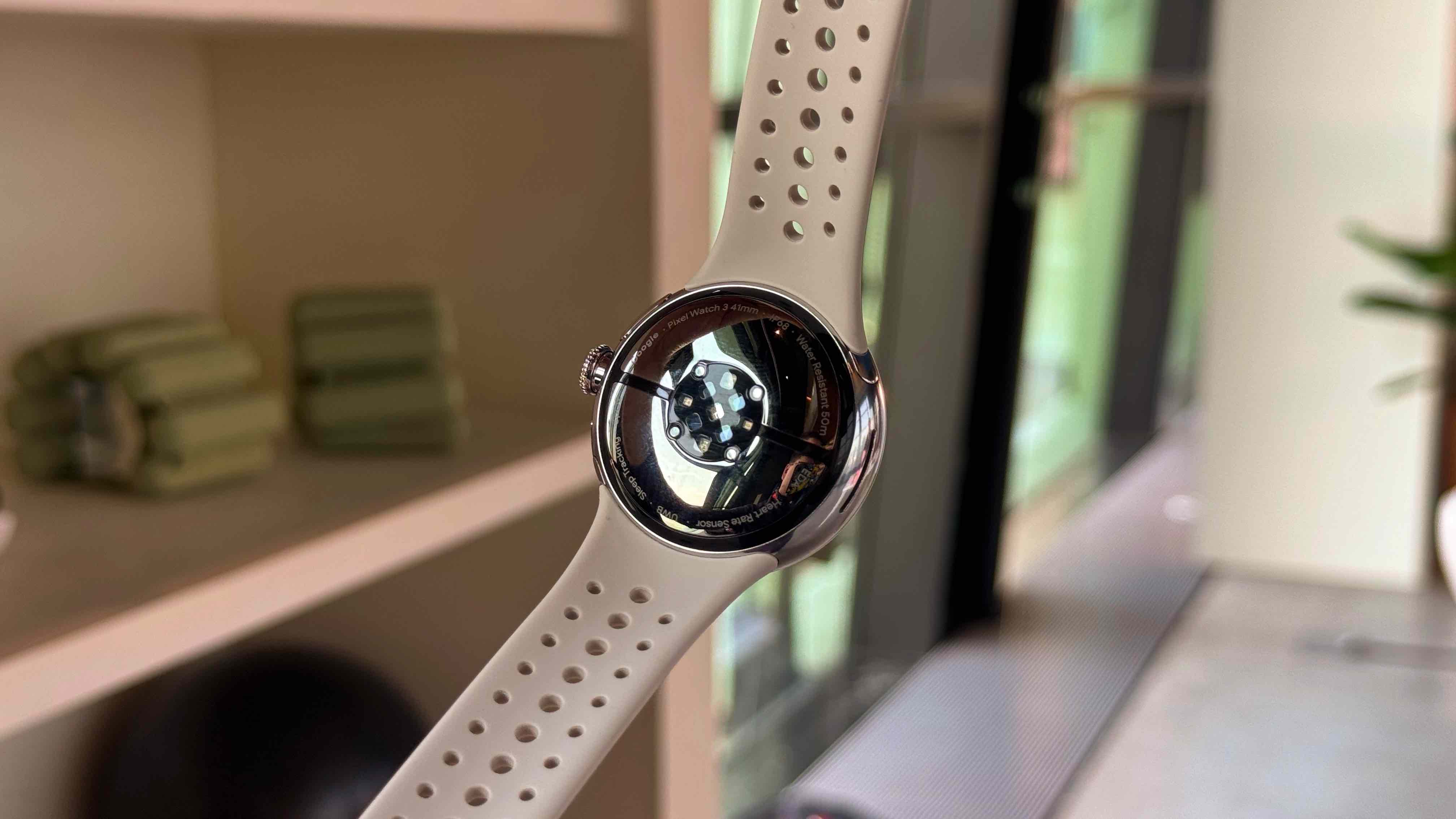
Picture from cdn.mos.cms.futurecdn.net
Rank 1597Google is bringing Gemini to Wear OSIt's part of a broader rollout to replace Google Assistant across its ecosystemThe AI assistant has been spotted again, this time in code for Google's Wear OS Assistant app
Google is planning to replace Assistant across its ecosystem with its potent Gemini AI, and Wear OS could be the next platform to get the treatment, with code suggesting the upgrade could be very close at hand.We've known about Gemini coming to Wear OS for a while, and now the feature has been spotted buried in the code of the Assistant app for Wear OS, possibly indicating that a launch could be imminent.As spotted by 9to5Google, the Google Assistant app for Wear OS has been updated and now features several references to Google Gemini buried within its code. Here's what we know, and what it tells us about Gemini.
Google Gemini on Wear OS
The code strings reveal the usual popups you might expect to see following a Wear OS Gemini update, specifically "Gemini is now on your watch" and "Get started with Gemini: Speak naturally and get more done with a personal AI assistant on your watch."However, the leak also includes some details about how the feature will work and what you might be able to do with it.“You’re using Gemini on your phone and now it’s the assistant on your watch. To talk to Gemini, hold down the side button, or just say “Hey Google,” if you’ve turned on that setting," another prompt says.Furthermore, 9to5 reports functions found in the code strings, including "set alarms, timers, message your contacts, and more." As the report notes, that's broadly similar to Google Assistant's current suite of functions.Google Gemini has plenty of advanced features for Mail, weather updates, and beyond. Whether these more advanced features will come to Wear OS remains to be seen. However, the limited processing power and battery of even the best Android smartwatches indicates that we're unlikely to get every Gemini feature on Wear OS.As to a rollout timeline, there's no firm date as yet, but this code sighting seems to indicate that Gemini is very close indeed. One possibility is that Google could reserve the rollout for the advent of the Pixel Watch 4, which we'd expect to see as the replacement for the Pixel Watch 3 later this year.
You may also like
Download Google's latest Pixel Watch update now to solve notification lag and crashing issuesGoogle Gemini reportedly spotted on Wear OS – could a rollout be close at hand?Google says it will fix broken Wear OS 5.1 update, but why does this keep happening?
-

Picture from cdn.mos.cms.futurecdn.net
Rank 1598Game consoles like the Nintendo Switch 2 will reportedly be hit by a 145% US tariff on goods made in ChinaAn internal assessment memo by a "major Apple and Nintendo supplier" states that electronics made in China will be impacted by the ongoing trade warCertain tech products were initially exempt from "reciprocal" tariffs, but the Trump administration has now confirmed otherwise
The Nintendo Switch 2 and other game consoles will reportedly be hit by a 145% US tariff on imported goods made in China.That's according to an internal assessment memo by a "major Apple and Nintendo supplier" seen by Nikkei Asia, which stated that consoles made in China, like the highly anticipated Switch 2, are likely to be hit by the ongoing trade war.Although the Trump administration recently announced that certain tech products will be exempt from "reciprocal" tariffs, US President Donald Trump has now confirmed (via BBC) this won't be the case and that Chinese-made smartphones and other electronics will be moved into a different levy "bucket".This means any electronics made in China, like some Nintendo Switch 2 units, will be affected and potentially cost more.Following the long-awaited Switch 2 Direct and the imposed tariffs, Nintendo announced that US pre-orders have been delayed from its original April 9 date "in order to assess the potential impact of tariffs and evolving market conditions."Since then, Canada pre-orders have also been delayed, but Nintendo has confirmed that the console's launch date is unchanged and will provide US and Canadian buyers with a new pre-order date soon.The Nintendo Switch 2 officially launches on June 5, 2025, and will cost $449.99 / £395.99 or $499.99 / £429.99 for a Mario Kart World bundle. Pre-orders are now live in the UK.
You might also like...
Nintendo Switch 2 pre-orders live: latest UK stock updates as My Nintendo Store's pre-order date arrives, while US pre-orders remain delayedNintendo Switch 2 vs Nintendo Switch: comparing price, specs, design, features and moreYes, Nintendo Switch 2 Edition games will contain the upgrades on the cartridge, but it seems Breath of the Wild DLC will still need to be purchased separately
-

Picture from cdn.mos.cms.futurecdn.net
Rank 1599Washing and drying your clothes is a regular part of household chores and cleaning. But as the cost of living continues to rise, many people are having to cut back on household tasks to keep energy costs down and save money on monthly bills.One of the most common areas that people look at to make cuts is laundry, as it's often seen as something that racks up energy usage and prices – but that’s not the case with Miele.To help customers save money on their bills while keeping clothes fresh, clean and lasting a lifetime, Miele has completely reinvented its laundry collection for 2025. The new Miele A+++ rated washing machines and tumble dryers offer more capacity, gentler cycles and time-saving washes than ever before – and they’re more cost and energy-efficient too.
Feel the power with PowerWash
With the new Miele laundry range, power is at the forefront of its design, thanks to its PowerWash technology, which guarantees A+++ rated wash results in as little as 49 minutes. All Miele washing machines and tumble dryers are A+++ rated, meaning they have the highest level of energy efficiency, so not only are you getting the best cleaning results every time, but you’re saving money and energy as you do so.The new Miele washing machines, including the standout of the range – the Miele WWG880WCS Freestanding Washing Machine, uses PowerWash technology for the ultimate cleaning performance. Combined with its internal honeycomb drum surface, the Miele WWG880WCS Freestanding Washing Machine protects your clothes’ fibres during cleaning to keep them in perfect condition, whether you’re washing wool, shirts or athleisure.Along with its TwinDos automatic detergent dispenser, the Miele WWG880WCS Freestanding Washing Machine perfectly adds the right amount of detergent to your wash to keep your clothes smelling fresh. Its digital display makes it easy to flick through the different cycles, and it even has a Quick Mode where you can do a full cotton wash in less than half the time you would with a standard washing machine.
Save time, money and energy with EcoSpeed
When it comes to saving money around your household, tumble dryers have gotten somewhat of a reputation and are often avoided as much as possible. While it’s true that tumble dryers are more expensive to run compared to other appliances, heat pump dryers are more energy and cost efficient – and Miele’s new A+++ rated tumble dryer range is no exception.The Miele TWC640WP Freestanding Heat Pump Tumble Dryer and the Miele TWH780WP Freestanding Heat Pump Tumble Dryer are both heat pump models that help you save time and money on your dryer. As Miele tumble dryers are A rated, you won’t have to worry about high drying costs as they’ve been engineered to use energy efficiently to get the best results while keeping prices low.For example, Miele’s new tumble dryers have EcoSpeed technology that can tackle a full load of laundry 20 minutes faster than its predecessors. The dryers also have multiple drying programmes to choose from to help keep costs and energy usage even lower.
Achieve the Perfect Dry
What’s most impressive about the new Miele tumble dryers, especially the Miele TWD640WP Freestanding Heat Pump Tumble Dryer, is its Freshen Up programme. Whether you’ve left your clothing in the washer for too long and it’s started to smell, or you don’t quite get the stench out of your gym clothes, the Miele TWD640WP Freestanding Heat Pump Tumble Dryer can sort that for you.The Freshen Up programme on the Miele TWD640WP Freestanding Heat Pump Tumble Dryer helps get rid of unwanted odours. Working alongside the dryer’s special steam cycles, like PowerFresh, users can freshen up clothing without wasting water. Its PerfectDry feature also helps save energy as it adjusts the drying process for different loads so your clothes are perfectly dry every time.Miele dryers also have a SteamFinish setting which helps smooth out wrinkles, keeping your clothes in top condition throughout the entire washing-drying process.
Make it smart
(Image credit: Miele)
Like most of today’s home appliances, select models from the new Miele laundry range come with smart technology. The Miele WWG880WCS Freestanding Washing Machine and the Miele WWR860WPS Freestanding Washing Machine are compatible with the Miele app so you can use your smartphone to control and customise your washes.Alongside the two washing machines, the Miele TWD640WP Freestanding Heat Pump Tumble Dryer, the Miele TWC640WP Freestanding Heat Pump Tumble Dryer, the Miele TWH780WP Freestanding Heat Pump Tumble Dryer and the Miele TWL780WP Freestanding Heat Pump Tumble Dryer also have smart connectivity.Users can start, stop, pause and schedule a wash from anywhere around your home, as well as creating programmes and checking in on the laundry’s progress. With the Miele app, you’ll also be alerted when your washing machine or tumble dryer has finished, plus you can monitor their energy consumption.
-

Picture from cdn.mos.cms.futurecdn.net
Rank 1600Zenless Zone Zero Version 1.7 launches on April 23, 2025It adds a new story chapter, plus two new S-rank agents to playThis is on top of new in-game events and gameplay modes
Zenless Zone Zero Version 1.7, or 'Bury Your Tears with the Past', will launch next week on April 23 and brings a wealth of new content to the popular urban fantasy game.Foremost, the update introduces a new story chapter that concludes the arc from the game's first season. It will see players discovering the truth behind the Sacrifice crisis, learning more about the enigmatic Hugo and partnering with a special investigator to venture into the hollow.
Image 1 of 4Vivian carries a parasol and a rapier (Image credit: Hoyoverse)Image 2 of 4Hugo is finally becoming a playable agent (Image credit: Hoyoverse)Image 3 of 4Robin's cards can have a range of effects (Image credit: Hoyoverse)Image 4 of 4Overtimeboo is a whole mood (Image credit: Hoyoverse)
Two new playable S-rank characters will be added, both members of the Mockingbird faction. Vivian, an ether anomaly agent, is armed with both a parasol and a rapier, which can be used to seamlessly shift between ground and aerial attacks. Hugo, an ice attack agent, carries a suitcase that can transform into a deadly scythe, slicing through enemies. He has the special ability to trigger the Totalize effect when hitting stunned foes, which inflicts additional damage based on the remaining duration of the stun effect.In addition to this, two new Bangboo companions are also on the way. There's the S-rank Robin, a Mockingbird member capable of throwing randomized cards with a wide range of effects, and my personal favorite the A-rank Overtimeboo. A tired office worker, Overtimeboo brings a whole desk and PC setup to the battlefield, typing away happily until a computer crash sends them into a fit dangerous fit of rage.As someone who has lost hours of important work to PC issues in the past, I can certainly relate and will be trying to add this upcoming arrival to my team as soon as possible.No update would be complete without a slew of new in-game events and this time around the most significant is 'Say It With Flowers'. This sees players embrace the role of a flower shop manager, creating unique floral arrangements. By completing design commissions, you will be able to unlock plenty of rewards and permanent interactive floral arrangement gameplay for Quality Time mode.The Fall Guys inspired Bangboo Bash is also making a return with a ranked mode, offering exclusive event titles and plenty of polychromes for those eager to climb the ranks.If you want to try Zenless Zone Zero ahead of the update, the game is available now as a free-to-play title on PC, mobile, and PlayStation 5.
You might also like...
Claim a free Xbox FPS with your Amazon Prime subscription, plus loads of great PC games including two massive RPGsAssassin's Creed Nexus VR finally let me perform a leap of faith in virtual reality and I didn’t even throw upThis indie game gets cheaper when it's cold outside


