News
This constantly updated list features the latest and most important news articles, ranked in order of significance. The top stories highlight major developments, breaking news, and critical updates across various topics, ensuring you stay informed about the most pressing issues. As new articles are added, the list adapts to reflect the latest priorities, keeping the most impactful stories at the forefront. Whether it’s global events, technology breakthroughs, or industry trends, this dynamic list ensures you always have access to the most relevant and timely information.
-

Picture from cdn.mos.cms.futurecdn.net
Rank 46751New research found that Apple and Google keep offering VPN apps without revealing their Chinese ownershipAt least five may have ties with a Shanghai-based firm believed to have links with the Chinese militaryExperts first uncovered this threat in April 2025At least 17 China-linked free VPN apps may still be hidden in Apple and Google app stores, and big tech could be making a profit – as revealed by new research.In April, experts at Tech Transparency Project (TTP) first uncovered that millions of free VPN users across 20 apps may have sent their data to China without knowing it. Five of these were reported to have ties with Qihoo 360, a Shanghai-based firm believed to have links with the Chinese military.Now, about six weeks later, TTP researchers have found that most of these VPNs are still available in the US Apple and Google app stores. They also said to have found evidence that Apple and Google may also be profiting from these apps.Which are the free VPNs affected?(Image credit: Geralt / Pixabay)TTP's initial report found that more than 20 of the top 100 free VPNs available on the US Apple App Store had undisclosed ties with China.Five of these apps (Turbo VPN, VPN Proxy Master, Thunder VPN, Snap VPN, and Signal Secure VPN) are reportedly linked with Qihoo 360 – a company the US sanctioned on national security grounds for its alleged ties with the Chinese military in June 2020.While the best VPN services promise to boost online privacy and work with strict no-log policies, Chinese-owned VPNs are subjected to stricter data retention rules and can be forced to share user data with the government upon request.After another check in May, an update to the report claims that, despite some of these being quitely removed, "two other apps linked to Qihoo 360 – Turbo VPN and VPN Proxy Master – remained available in the US Apple App Store, along with 11 other Chinese-owned apps identified in TTP’s report."The latter are X-VPN, Ostrich VPN, VPNIFY, VPN Proxy OvpnSpider, WireVPN - Fast VPN & Proxy, Now VPN, Speedy Quark VPN, Best VPN Proxy AppVPN, HulaVPN, and Pearl VPN.NEW: Apple and Google’s app stores continue to offer VPNs that are surreptitiously owned by Chinese companies, over 6 weeks after TTP first identified them.The latest findings also show Apple and Google may be profiting from these apps by taking a cut of subscription revenue. pic.twitter.com/fGzvBhPtOwJune 12, 2025Researchers also found that the Google Play Store in the US offered 11 free VPN apps with shady Chinese ownership, which include four Qihoo 360-connected services (Turbo VPN, VPN Proxy Master, Snap VPN, and Signal Secure VPN).The other are X-VPN, Speedy Quark VPN, VPNIFY, Ostrich VPN, VPN Proxy OvpnSpider, HulaVPN, and VPNProxy AppVPN.Not only that, though. During TTP’s May spot check, researchers noticed that some of the VPNs listed as free in the app stores offer in-app purchases on top."That means Apple and Google may be profiting from these Chinese-owned VPNs when Americans pay for subscriptions or other add-ons," the new report reads.On the Google Play Store, some of the Chinese-owned VPNs also come with a banner saying they contain advertisements.Turbo VPN was one of the several Chinese-owned VPNs TTP researchers found to contain ads in the US Google Play – TTP took this screenshot in May 8, 2025 (Image credit: Tech Transparency Project (TTP))TTP said that Apple, Google, Qihoo 360, and most of the listed developers of the apps did not respond to their request for comment.TechRadar approached both Google and Apple for a comment.Apple told TechRadar the company has some strict guidelines in place for VPN app developers, including not using, or disclosing any data for any purpose to third parties. Yet, Apple said it doesn't limit app distribution based on where the provider is based.We are still waiting for a response from Google at the time of publication.We can confirm that the China-linked VPN apps are also available in the UK's official app stores, and that's likely other markets are also affected.If you are looking for a trustworthy free VPN service, we recommend you check our dedicated guide here. Today's top recommendations are Privado VPN and Proton VPN.You might also likeOver 2.5 billion free Android VPN users at risk of data leaks2024 saw a surge in malicious free VPN appsIt's not just free VPNs, these premium services may be bad for your privacy
-

Picture from techcrunch.com
Rank 46752 -

Picture from static.independent.co.uk
Rank 46753 -
Picture from static.independent.co.uk
Rank 46754 -

Picture from static.independent.co.uk
Rank 46755 -

Picture from assets3.cbsnewsstatic.com
Rank 46756 -

Picture from assets3.cbsnewsstatic.com
Rank 46757 -

Picture from assets2.cbsnewsstatic.com
Rank 46758 -

Picture from image.cnbcfm.com
Rank 46759 -

Picture from static.independent.co.uk
Rank 46760 -

Picture from static.independent.co.uk
Rank 46761 -

Picture from static.independent.co.uk
Rank 46762 -

Picture from assets1.cbsnewsstatic.com
Rank 46763 -

Picture from assets1.cbsnewsstatic.com
Rank 46764 -

Picture from assets1.cbsnewsstatic.com
Rank 46765 -

Picture from assets2.cbsnewsstatic.com
Rank 46766 -

Picture from assets2.cbsnewsstatic.com
Rank 46767 -

Picture from static.independent.co.uk
Rank 46768 -

Picture from static.independent.co.uk
Rank 46769 -

Picture from assets2.cbsnewsstatic.com
Rank 46770 -

Picture from assets3.cbsnewsstatic.com
Rank 46771 -

Picture from assets3.cbsnewsstatic.com
Rank 46772 -

Picture from assets1.cbsnewsstatic.com
Rank 46773 -

Picture from assets3.cbsnewsstatic.com
Rank 46774 -

Picture from assets2.cbsnewsstatic.com
Rank 46775 -

Picture from assets3.cbsnewsstatic.com
Rank 46776 -

Picture from assets3.cbsnewsstatic.com
Rank 46777 -

Picture from assets3.cbsnewsstatic.com
Rank 46778 -

Picture from assets3.cbsnewsstatic.com
Rank 46779 -

Picture from assets2.cbsnewsstatic.com
Rank 46780 -

Picture from image.cnbcfm.com
Rank 46781 -

Picture from image.cnbcfm.com
Rank 46782 -

Picture from static.independent.co.uk
Rank 46783 -

Picture from assets1.cbsnewsstatic.com
Rank 46784 -

Picture from assets3.cbsnewsstatic.com
Rank 46785 -

Picture from assets2.cbsnewsstatic.com
Rank 46786 -

Picture from assets3.cbsnewsstatic.com
Rank 46787 -

Picture from assets2.cbsnewsstatic.com
Rank 46788 -

Picture from assets3.cbsnewsstatic.com
Rank 46789 -

Picture from assets2.cbsnewsstatic.com
Rank 46790 -
Picture from o.aolcdn.com
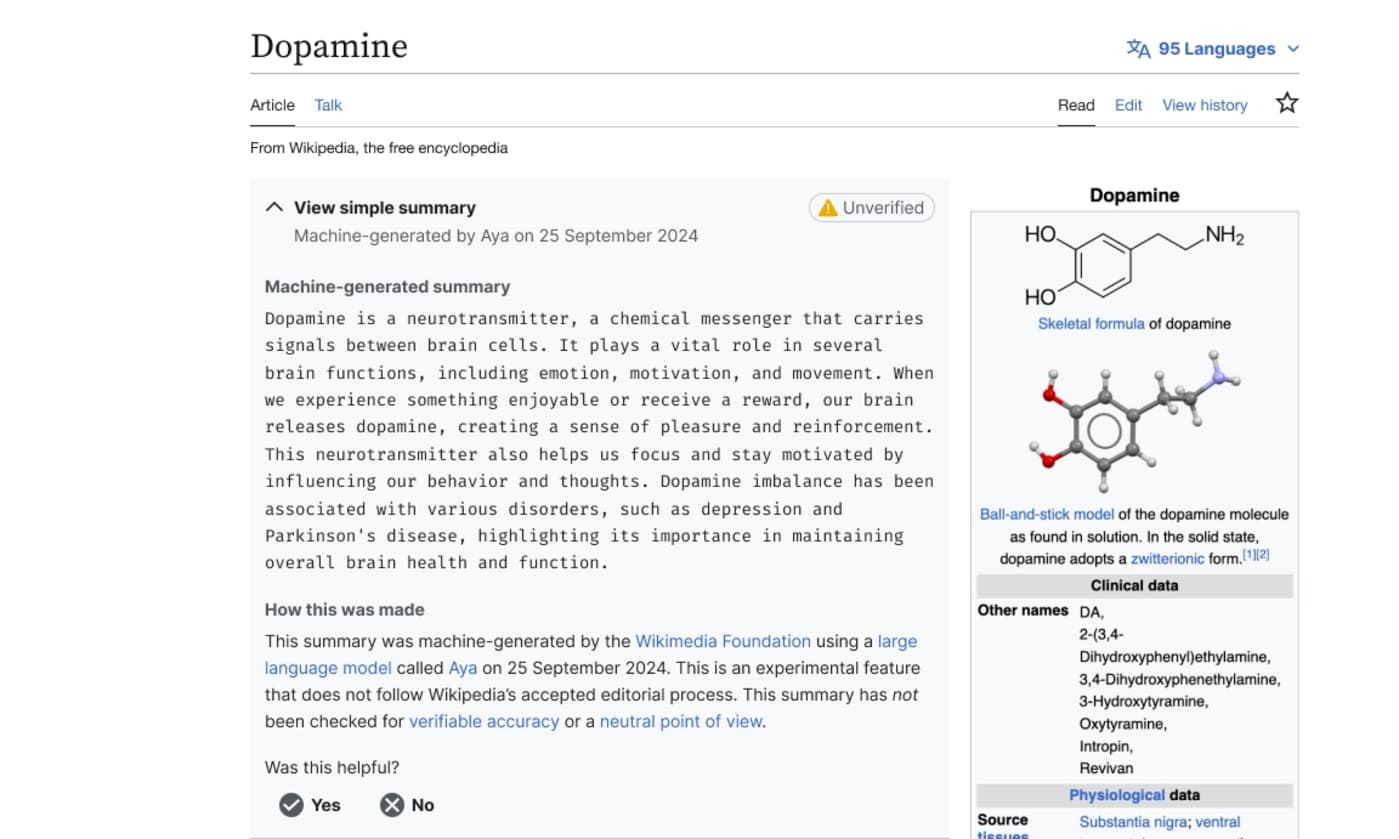
Rank 46791Wikipedia is backing off a plan to test AI article summaries. Earlier this month, the platform announced plans to trial the feature for about 10 percent of mobile web visitors. To say they weren't well-received by editors would be an understatement. The Wikimedia Foundation (WMF) then changed plans and cancelled the test.
The AI summaries would have appeared at the top of articles for 10 percent of mobile users. Readers would have had to opt in to see them. The AI-generated summaries only appeared "on a set of articles" for the two-week trial period.
Editor comments in the WMF's announcement (via 404 Media) ranged from "Yuck" to "Grinning with horror." One editor wrote, "Just because Google has rolled out its AI summaries doesn't mean we need to one-up them. I sincerely beg you not to test this, on mobile or anywhere else. This would do immediate and irreversible harm to our readers and to our reputation as a decently trustworthy and serious source."
"Wikipedia has in some ways become a byword for sober boringness, which is excellent," the editor continued. "Let's not insult our readers' intelligence and join the stampede to roll out flashy AI summaries."
This screenshot from 404 Media shows another version of an AI-generated summary on a Wikipedia page. The planned test would have only showed up on the mobile web version of the site.Wikimedia Foundation
Editors' gripes weren't limited to the idea. They also criticized the nonprofit for excluding them from the planning phase. "You also say this has been 'discussed,' which is thoroughly laughable as the 'discussion' you link to has exactly one participant, the original poster, who is another WMF employee," an editor wrote.
A Wikimedia Foundation spokesperson shared the following statement with Engadget:
“The Wikimedia Foundation has been exploring ways to make Wikipedia and other Wikimedia projects more accessible to readers globally. This two-week, opt-in experiment was focused on making complex Wikipedia articles more accessible to people with different reading levels. For the purposes of this experiment, the summaries were generated by an open-weight Aya model by Cohere. It was meant to gauge interest in a feature like this, and to help us think about the right kind of community moderation systems to ensure humans remain central to deciding what information is shown on Wikipedia.
For these experiments, our usual process includes discussing with volunteers (who create and curate all the information on Wikipedia) to make decisions on whether and how to proceed with building features. The discussion around this feature is an example of this process, where we built out a prototype of an idea and reached out to the Wikipedia volunteer community for their thoughts.
It is common to receive a variety of feedback from volunteers, and we incorporate it in our decisions, and sometimes change course. We welcome such thoughtful feedback — this is what continues to make Wikipedia a truly collaborative platform of human knowledge.
As shared in our latest post on the community discussion page, we do not have any plans to continue the experiment at the moment, as we continue to assess and discuss the feedback we have already received from volunteers.”In the "discussion" page, the organization explained that it wanted to cater to its audience's needs. "Many readers need some simplified text in addition to the main content," a WMF employee wrote. "In previous research, we heard that readers wanted to have an option to get a quick overview of a topic prior to jumping into reading the full article."
The organization didn't rule out future uses of AI. But they said editors won't be left in the dark next time. "Bringing generative AI into the Wikipedia reading experience is a serious set of decisions, with important implications, and we intend to treat it as such," the spokesperson told 404 Media. "We do not have any plans for bringing a summary feature to the wikis without editor involvement."
Update, June 13, 2025, 12:52PM ET: This story has been corrected to note that Wikipedia never actually started its AI summary test. The plan was announced, but cancelled before it took place. A statement from the Wikimedia Foundation has also been added, and the headline has been updated as well. This article originally appeared on Engadget at https://www.engadget.com/ai/wikipedia-cancels-plan-to-test-ai-summaries-after-editors-skewer-the-idea-200029899.html?src=rss
-

Picture from assets2.cbsnewsstatic.com
Rank 46792 -

Picture from assets1.cbsnewsstatic.com
Rank 46793 -

Picture from assets3.cbsnewsstatic.com
Rank 46794 -

Picture from assets3.cbsnewsstatic.com
Rank 46795 -

Picture from assets3.cbsnewsstatic.com
Rank 46796An Ohio doctor who received a flood of threats over a pro-vaccine social media post is standing by her message. In a playful TikTok video, Dr. Nicole Baldwin showed the benefits of vaccines, and said they do not cause autism. But that prompted a barrage of hateful responses. Despite scientific evidence that there’s no link between vaccines and autism, a recent poll found 46% of parents are still unsure. Dr. Jon LaPook joins “CBS This Morning” to discuss how doctors can counter misinformation about vaccines.
-

Picture from assets1.cbsnewsstatic.com
Rank 46797 -

Picture from assets1.cbsnewsstatic.com
Rank 46798 -

Picture from assets1.cbsnewsstatic.com
Rank 46799 -
Picture from o.aolcdn.com
Rank 46800Google’s AI Overviews do not save me time. For one, I work for a tech blog and am therefore professionally curious as to whether or not the generated answers are correct, so I spend a few ticks figuring that out. (Answer: Sometimes, but not always!)
Then things get existential as I contemplate how long a self-cannibalizing system can sustain itself — if the AI gives answers pulled from websites that survive on visits from readers, what happens when no one visits those sites because AI cribbed the answer? Will I still get to write for websites if websites die from traffic starvation? It’s a lot to think about when all I want is TSA’s latest lithium-ion battery regulations.
Curiously (and unhelpfully) the first result when you Google “How to turn off AI Overviews in Chrome” doesn’t actually answer the question. The entry, from Google Support, discusses turning the feature off back when AI Overviews were experimental and handled through Google Labs. Navigate a little further down that page and you’ll see:
Note: Turning off “AI Overviews and more” in Search Labs will not disable all AI Overviews in Search. AI Overviews are part of Google Search like other features, such as knowledge panels, and can’t be turned off.
Thankfully, I work with intelligent people and one of them supplied me with a simple method of ensuring each search performed in a Chrome browser bypasses the AI Overview and uses results from the Web tab only. Here’s how you too can avoid wasted time (and energy) so you can search like it's 2024.
How to turn off AI Overviews in Chrome on desktop
Click the three dots in the upper right corner of your Chrome browser
Go to Settings > Search engine > Manage search engines and search
Under Site search, click the Add button
Enter Name: Google/Web
Enter Shortcut: https://www.google.com/
Enter URL: {google:baseURL}search?udm=14&q=%s
Click Add
Google / Engadget
Then, (hat tip to Tom’s Hardware for helping me figure this bit out) set the search type to default by clicking the three dots next to the shortcut you just created and clicking Make default.
Now, go Google “the best laptop power banks” and click on the Engadget entry (usually one to four results down) and spend a few moments looking at the ads (and the picture of my desk) before you move on so I can still have a job in 2026.
Other methods for turning off AI Overviews in Google Chrome
In that same Tom’s Hardware article, Avram Piltch links to the extension he built, which is a super easy way to hide the AI Overviews from sight. It’ll still generate the response, you just won’t see it. I prefer the Web method above, to avoid any unnecessary machine processing on my behalf, but the extension is easier and keeps you on the familiar “All” search results tab with knowledge panels, video results and the like.
To turn off the AI Overview for Chrome on your phone, I’ll direct you to the fine folks at tenbluelinks. Just open the link in your phone’s browser and follow the steps for Android or iOS.This article originally appeared on Engadget at https://www.engadget.com/big-tech/how-to-turn-off-googles-ai-overviews-in-web-searches-170009873.html?src=rss