News
This constantly updated list features the latest and most important news articles, ranked in order of significance. The top stories highlight major developments, breaking news, and critical updates across various topics, ensuring you stay informed about the most pressing issues. As new articles are added, the list adapts to reflect the latest priorities, keeping the most impactful stories at the forefront. Whether it’s global events, technology breakthroughs, or industry trends, this dynamic list ensures you always have access to the most relevant and timely information.
-

Picture from static.independent.co.uk
Rank 27451 -

Picture from static.independent.co.uk
Rank 27452 -

Picture from static.independent.co.uk
Rank 27453 -

Picture from static.independent.co.uk
Rank 27454 -

Picture from image.cnbcfm.com
Rank 27455 -

Picture from cdn.mos.cms.futurecdn.net
Rank 27456At 3 a.m. during a red team exercise, we watched customer’s autonomous web agent cheerfully leak the CTO’s credentials - because a single malicious div tag on internal github issue page told it to. The agent ran on Browser Use, the open source framework that just collected a headline-grabbing $17 million seed round.That 90-second proof-of-concept illustrates a larger threat: while venture money races to make large-language-model (LLM) agents “click” faster, their social, organizational, and technical trust boundaries remain an afterthought. Autonomous browsing agents now schedule travel, reconcile invoices, and read private inboxes, yet the industry treats security as a feature patch, not a design premise.Our argument is simple: agentic systems that interpret and act on live web content must adopt a security-first architecture before their adoption outpaces our ability to contain failure.Agent explosionBrowser Use sits at the center of today’s agent explosion. In just a few months it has acquired more than 60,000 GitHub stars and a $17 million seed round led by Felicis with participation from Paul Graham and others, positioning itself as the “middleware layer” between LLMs and the live web.Similar toolkits - HyperAgent, SurfGPT, AgentLoom - are shipping weekly plug-ins that promise friction-free automation of everything from expense approval to source-code review. Market researchers already count 82 % of large companies running at least one AI agent in production workflows and forecast 1.3 billion enterprise agent users by 2028.But the same openness that fuels innovation also exposes a significant attack surface: DOM parsing, prompt templates, headless browsers, third-party APIs, and real-time user data intersect in unpredictable ways.Our new study, "The Hidden Dangers of Browsing AI Agents" offers the first end-to-end threat model for browsing agents and provides actionable guidance for securing their deployment in real-world environments.To address discovered threats, we propose a defense in depth strategy incorporating input sanitization, planner executor isolation, formal analyzers, and session safeguards. These measures protect against both initial access and post exploitation attack vectors.White-box analysis Through white-box analysis of Browser Use, we demonstrate how untrusted web content can hijack agent behavior and lead to critical cybersecurity breaches. Our findings include prompt injection, domain validation bypass, and credential exfiltration, evidenced by a disclosed CVE and a working proof of concept exploit - all without tripping today’s LLM safety filters.Among the findings:1. Prompt-injection pivoting. A single off-screen element injected a “system” instruction that forced the agent to email its session storage to an attacker.2. Domain-validation bypass. Browser Use’s heuristic URL checker failed on unicode homographs, letting adversaries smuggle commands from look-alike domains.3. Silent lateral movement. Once an agent has the user’s cookies, it can impersonate them across any connected SaaS property, blending into legitimate automation logs.These aren’t theoretical edge cases; they are inherent consequences of giving an LLM permission to act rather than merely answer, which acts a root cause for the outlined exploit above. Once that line is crossed, every byte of input (visible or hidden) becomes potential initial access payload.To be sure, open source visibility and red team disclosure accelerate fixes - Browser Use shipped a patch within days of our CVE report. And defenders can already sandbox agents, sanitize inputs, and restrict tool scopes. But those mitigations are optional add-ons, whereas the threat is systemic. Relying on post-hoc hardening mimics the early browser wars, when security followed functionality, and drive-by downloads became the norm.Architectural problemGovernments are beginning to notice the architectural problem. The NIST AI Risk-Management Framework urges organizations to weigh privacy, safety and societal impact as first-class engineering requirements. Europe’s AI Act introduces transparency, technical-documentation and post-market monitoring duties for providers of general-purpose models rules that will almost certainly cover agent frameworks such as Browser Use.Across the Atlantic, the U.S. SEC’s 2023 cyber-risk disclosure rule expects public companies to reveal material security incidents quickly and to detail risk-management practices annually. Analysts already advise Fortune 500 boards to treat AI-powered automation as a headline cyber-risk in upcoming 10-K filings. Reuters: “When an autonomous agent leaks credentials, executives will have scant wiggle room to argue that the breach was “immaterial.”Investors funneling eight-figure sums into agentic start-ups must now reserve an equal share of runway for threat-modeling, formal verification, and continuous adversarial evaluation. Enterprises piloting these tools should require:Isolation by default. Agents should separate planner, executor and credential oracle into mutually distrustful processes, talking only via signed, size-bounded protobuf messages.Differential output binding. Borrow from safety-critical engineering: require a human co-signature for any sensitive action.Continuous red-team pipelines. Make adversarial HTML and jailbreak prompts part of CI/CD. If the model fails a single test, block release.Societal SBOMs. Beyond software bills of materials, vendors should publish security-impact surfaces: exactly which data, roles and rights an attacker gains if the agent tips. This aligns with the AI-RMF’s call for transparency regarding individual and societal risks.Regulatory stress tests. Critical-infrastructure deployments should pass third-party red-team exams whose high-level findings are public, mirroring banking stress-tests and reinforcing EU and U.S. disclosure regimes.The security debtThe web did not start secure and grow convenient; it started convenient, and we are still paying the security debt. Let us not rehearse that history with autonomous browsing agents. Imagine past cyber incidents multiplied by autonomous agents that work at machine speed and hold persistent credentials for every SaaS tool, CI/CD pipeline, and IoT sensor in an enterprise. The next “invisible div tag” could do more than leak a password: it could rewrite PLC set-points at a water-treatment plant, misroute 911 calls, or bulk-download the pension records of an entire state.If the next $17 million goes to demo reels instead of hardened boundaries, the 3 a.m. secret you lose might not just embarrass a CTO - it might open the sluice gate to poison supplies, stall fuel deliveries, or crash emergency-dispatch consoles. That risk is no longer theoretical; it is actuarial, regulatory, and, ultimately, personal for every investor, engineer, and policy-maker in the loop.Security first or failure by default for agentic AI is therefore not a philosophical debate; it is a deadline. Either we front-load the cost of trust now, or we will pay many times over when the first agent-driven breach jumps the gap from the browser to the real world.We feature the best AI chatbot for business.This article was produced as part of TechRadarPro's Expert Insights channel where we feature the best and brightest minds in the technology industry today. The views expressed here are those of the author and are not necessarily those of TechRadarPro or Future plc. If you are interested in contributing find out more here: https://www.techradar.com/news/submit-your-story-to-techradar-pro
-
Picture from o.aolcdn.com
Rank 27457Regardless of what kind of exercise you’re into, if you’re working out, you’ll want a pair of wireless workout headphones. They allow you to be free and untethered during a serious weight-lifting session, a 5K run, an hour at the skate park and everywhere in between where you’re moving and sweating a ton. There are dozens of great wireless headphones and wireless earbud options out there, but for exercise in particular, there are additional factors to consider before picking one up like water resistance, battery life and overall comfort.At Engadget, we’ve tested a bunch of fitness-ready headphones and earbuds to come up with our top picks, plus some advice to consider before you pick up a pair. All of our top picks below will work in and out of the gym, so you can invest in just one pair and make those your daily driver. If you’re primarily a runner, check out our list of best headphones for running.
Best workout headphones for 2025
Others wireless workout headphones we tested
Apple AirPods Pro
The Apple AirPods Pro have an IP54 rating, which protects them from brief encounters with dust and splashes. While that’s more dust protection than many other earbuds we tested, it’s the same level of water resistance that most exercise-specific competitors have. We generally like the AirPods Pro, but the Beats Fit Pro offer many of the same features and conveniences (namely good transparency mode and the H1 chip), with a design that’s more appropriate for working out.
Beats Powerbeats Pro
The Powerbeats Pro are a good alternative to the Beats Fit Pro if you’re a stickler for a hook design. However, they cost $50 more than the Fit Pro (although they often hover around $180) and don’t offer any significant upgrades or additional features aside from their design. They’re also quite old at this point (launched in 2019) and it appears Beats is putting more effort into upgrading and updating its newer models rather than this model.
Anker Soundcore AeroFit Pro
The Soundcore AeroFit Pro is Anker’s version of the Shokz OpenFit, but I found it to be less secure and not as comfortable as the latter. The actual earbuds on the AeroFit Pro are noticeably bulkier than those on the OpenFit, which caused them to shift and move much more when I was wearing them during exercise. They never fell off my ears completely, but I spent more time adjusting them than I did enjoying them.
JBL Endurance Peak 3
The most noteworthy thing about the Endurance Peak 3 is that they have the same IP68-rating that the (now discontinued) Jabra Elite 8 Active do, but they only cost $100. But, while you get the same protection here, you’ll have to sacrifice in other areas. The Endurance Peak 3 didn’t blow me away when it came to sound quality or comfort (the hook is more rigid than those on my favorite buds of a similar style) and their charging case is massive compared to most competitors.
What to look for in workout headphones
Design
Before diving in, it’s worth mentioning that this guide focuses on wireless earbuds. While you could wear over-ear or on-ear headphones during a workout, most of the best headphones available now do not have the same level of durability. Water and dust resistance, particularly the former, is important for any audio gear you plan on sweating with or taking outdoors, and that’s more prevalent in the wireless earbuds world.
Most earbuds have one of three designs: in-ear, in-ear with hook or open-ear. The first two are the most popular. In-ears are arguably the most common, while those with hooks promise better security and fit since they have an appendage that curls around the top of your ear. Open-ear designs don’t stick into your ear canal, but rather sit just outside of it. This makes it easier to hear the world around you while also listening to audio, and could be more comfortable for those who don’t like the intrusiveness of in-ear buds.
Water resistance and dust protection
Even if a pair of headphones for working out aren’t marketed specifically as exercise headphones, a sturdy, water-resistant design will, by default, make them suitable for exercise. To avoid repetition, here’s a quick primer on durability, or ingression protection (IP) ratings. The first digit you’ll see after the “IP” refers to protection from dust and other potential intrusions, measured on a scale from 1 to 6. The second refers to water resistance or even waterproofing, in the best cases. The ratings for water resistance are ranked on a scale of 1 to 9; higher numbers mean more protection, while the letter “X” means the device is not rated for protection in that regard.
All of the earbuds we tested for this guide have at least an IPX4 rating, which means there’s no dust protection, but the buds can withstand splashes from any direction and are sweat resistant, but probably shouldn't be submerged. For a detailed breakdown of all the possible permutations, check out this guide published by a supplier called The Enclosure Company.
Active noise cancellation and transparency mode
Active noise cancellation (ANC) is becoming standard on wireless earbuds, at least those above a certain price point. If you’re looking for a pair of buds that can be your workout companion and serve you outside of the gym, too, noise cancelation is a good feature to have. It makes the buds more versatile, allowing you to block out the dull roar of your home or office so you can focus, or give you some solitude during a busy commute.
But an earbud’s ability to block out the world goes hand-in-hand with its ability to open things back up should you need it. Many ANC earbuds also support some sort of “transparency mode,” or various levels of noise reduction. This is important for running headphones because exercising outdoors, alongside busy streets, can be dangerous. You probably don’t want to be totally oblivious to what’s going on around you when you’re running outside; adjusting noise cancelation levels to increase your awareness will help with that. Stronger noise cancelation might be more appealing to those doing more indoor training if they want to block out the dull roar of a gym or the guy exaggeratingly lifting weights next to you.
Battery life
All of the Bluetooth earbuds we tested have a battery life of six to eight hours. In general, that’s what you can expect from this space, with a few outliers that can get up to 15 hours of life on a charge. Even the low end of the spectrum should be good enough for most athletes and gym junkies, but it’ll be handy to keep the buds’ charging case on you if you think you’ll get close to using up all their juice during a single session.
You’ll get an average of 20 to 28 extra hours of battery out of most charging cases and all of the earbuds we tested had holders that provided at least an extra 15 hours. This will dictate how often you actually have to charge the device — as in physically connect the case with earbuds inside to a charging cable, or set it on a wireless charger to power up.
How we test workout headphones
In testing wireless workout headphones, I wear them during every bit of exercise I do — be it a casual walk around the block, a brisk morning run or a challenging weight-lifting session. I’m looking for comfort arguably most of all, because you should never be fussing with your earbuds when you should be focusing on working out. In the same vein, I’m cognizant of if they get loose during fast movements or slippery when I’m sweating. I also use the earbuds when not exercising to take calls and listen to music throughout the day. Many people will want just one pair of earbuds that they can use while exercising and just doing everyday things, so I evaluate each pair on their ability to be comfortable and provide a good listening experience in multiple different activities.
While I am also evaluating sound quality, I’m admittedly not an audio expert. My colleague Billy Steele holds that title at Engadget, and you’ll find much more detailed information about audio quality for some of our top picks in his reviews and buying guides. With these headphones for working out, however, I will make note of related issues if they stood out (i.e. if a pair of earbuds had noticeably strong bass out of the box, weak highs, etc). Most of the wireless workout headphones we tested work with companion apps that have adjustable EQ settings, so you’ll be able to tweak sound profiles to your liking in most cases.This article originally appeared on Engadget at https://www.engadget.com/audio/headphones/best-wireless-workout-headphones-191517835.html?src=rss
-

Picture from static.independent.co.uk
Rank 27458 -

Picture from static.independent.co.uk
Rank 27459 -

Picture from static.independent.co.uk
Rank 27460 -

Picture from static.independent.co.uk
Rank 27461 -

Picture from static.independent.co.uk
Rank 27462 -

Picture from static.independent.co.uk
Rank 27463 -

Picture from assets1.cbsnewsstatic.com
Rank 27464 -

Picture from static.independent.co.uk
Rank 27465 -

Picture from static.independent.co.uk
Rank 27466 -

Picture from static.independent.co.uk
Rank 27467 -

Picture from static.independent.co.uk
Rank 27468 -

Picture from image.cnbcfm.com
Rank 27469 -

Picture from image.cnbcfm.com
Rank 27470 -

Picture from ichef.bbci.co.uk
Rank 27471 -

Picture from static.independent.co.uk
Rank 27472 -

Picture from static.independent.co.uk
Rank 27473 -

Picture from static.independent.co.uk
Rank 27474 -

Picture from static.independent.co.uk
Rank 27475 -

Picture from image.cnbcfm.com
Rank 27476 -

Picture from ichef.bbci.co.uk
Rank 27477 -

Picture from static.independent.co.uk
Rank 27478 -

Picture from static.independent.co.uk
Rank 27479 -

Picture from ichef.bbci.co.uk
Rank 27480 -

Picture from static.independent.co.uk
Rank 27481 -

Picture from cdn.mos.cms.futurecdn.net
Rank 27482Samsung is reportedly close to finalizing a deal with PerplexityThe deal could be announced this year and see Perplexity replace Gemini as the Galaxy S26's default AI assistantWhat this would mean for Gemini on Samsung phones is unclearRight now, Google Gemini is the standard AI assistant on Android phones, and Samsung in particular has heavily incorporated Gemini into its devices. But that partnership might not last much longer.According to a paywalled report on Bloomberg (via Android Police), Samsung is close to finalizing a deal with Perplexity, which would see the latter’s AI assistant integrated into Samsung’s phones.Reportedly, the deal could be announced later this year, but it sounds like Perplexity won't appear on the best Samsung phones until early 2026, with Samsung apparently aiming to ship it as the default AI assistant on the Samsung Galaxy S26 series.(Image credit: Perplexity)Deep integrationThe deal would reportedly see Samsung pre-installing the Perplexity app on these phones, as well as integrating its features into Samsung Internet. Apparently, there are even discussions to incorporate Perplexity tech into Samsung's Bixby assistant, though it sounds like there’s less certainty that it will end up being part of the deal.Beyond that, Samsung and Perplexity have apparently discussed building AI-powered operating systems with AI agents "that can tap into functionality from Perplexity and a range of other AI assistants." That does, however, sound further off if it happens at all.What this deal would mean for Samsung’s partnership with Google is unclear. If Perplexity is shipped as the default option on the Samsung Galaxy S26 series – and presumably other Samsung phones too – then at a minimum, Gemini would be a bit sidelined.But that doesn’t necessarily mean the Gemini features we’ve seen on the Samsung Galaxy S25 series will be absent; you might instead have a choice of multiple AI services.If Samsung really is set to announce this partnership this year, then we should have a clearer idea before too long.You might also likeThe Samsung Galaxy Z Flip 7 and Galaxy Z Fold 7 will launch with Android 16The Samsung Galaxy Z Flip 7 has been benchmarked, and the results are extremely disappointingThe Samsung Galaxy S26 could get a much-needed new camera
-

Picture from cdn.mos.cms.futurecdn.net
Rank 27483Stranger Things season 5's multiple release dates have been revealedIt'll arrive in three parts between late November and New Year's Eve/New Year's DayNetflix is hoping it'll be the biggest festive TV hit of 2025Good news, everyone! Stranger Things season 5's release date has finally been revealed. Unfortunately, you'll have to tweak your 2025 holiday season plans if you want to stream it as soon as it arrives.We already knew that Stranger Things 5 was set to be released in 2025 and, according to a major online leak, it was suggested that Stranger Things' final season would arrive this November. Well, that turned out to be partly true.Announced towards the end of Netflix Tudum 2025, the smash hit show's final season will launch on the world's best streaming service in not one, not two, but three parts. That's the first time that Netflix has chosen to release a new series, or the latest season of one of its TV Originals, on three separate dates.A post shared by Stranger Things Netflix (@strangerthingstv)A photo posted by on As the above Instagram post confirms, Stranger Things season 5 volume 1 will air on November 26 at 5pm PT / 8pm ET in the US. That's the first of three US holidays that the incredibly popular Netflix series' final chapter will land on too – indeed, Thanksgiving 2025 in the US will take place on November 27. Clearly, Netflix is hoping volume 1, which comprises four episodes, will be the most-watched TV show over US Thanksgiving weekend.That's not the only major holiday Netflix is targeting, though. Volume 2 of Stranger Things 5, which contains three episodes, will debut on Christmas Day (aka December 25) at 5pm PT / 8pm ET in the US. Lastly, the final-ever episode (aka volume 3) of Stranger Things will hit the service on New Year's Eve (December 31) in the US at the same time that season 5's other installments are due to be released.Why Stranger Things 5's release format will turn people's Holiday season plans upside downI suspect many fans reacted like this when season 5's release format was announced (Image credit: Netflix)I fully understand why Netflix is dropping new episodes in this way. The streaming titan wants the final season of one of its most successful series to dominate the TV landscape. It makes sense, then, to release the forthcoming season's eight episodes, all of which are movie-length according to Stranger Things star Maya Hawke, at a time when people will have plenty of downtime over the festive season.The problem I have with this release format, though, is that it's going to turn many people's festive plans *ahem* upside down.Take me, for instance. I live in the UK and, considering the eight hour time difference between the US' Pacific Time Zone and the UK's, new installments of Stranger Things 5 won't land on the platform until 1am GMT.That means myself and many other British fans will have a very late night if we stay up to watch new episodes as soon as they arrive. If we don't, we face the prospect of having to avoid major spoilers online or from family/friends who might have seen the latest episodes before us.Holding back those season 5 finale spoilers like... (Image credit: Netflix)The same is true of fans in other European nations, the Middle East, Asia, and countries like Australia and New Zealand.Stranger Things season 5's finale might air in the US at 5pm PT / 8pm ET on December 31, so American viewers have the chance to stream it before they welcome in 2026. Many of us won't have that opportunity, though. Do we cut short our New Year's Eve plans with family and/or friends to head home and stream it straight away to avoid spoilers? Or do we ring in 2026, stay off social media until we watch it, and then stream one of the best Netflix shows' last-ever episode, potentially with an almighty hangover?I get that the world's various time zones mean that somebody is going to unhappy about staying up late or getting up early if they want to watch their favorite show's new season ASAP. Nevertheless, season 5's release structure, coupled with the unusual times that new episodes will air – Netflix usually releases new shows and/or seasons at 12am PT – is a, well, strange thing to do. I guess I'll be staying off social media (and the booze!) over the Christmas holidays until I find the time to stream season 5's final four episodes.You might also likeNetflix wants to turn Saturday morning cartoons upside down with a new animated Stranger Things spin-offStranger Things season 5's 12-month shoot yielded 650-plus hours of footage for its eight 'blockbuster movie' episodesMarvel reportedly casts Stranger Things star Sadie Sink in Spider-Man 4, but I don't want her to tackle the roles she's rumored to play
-
Picture from cdn.mos.cms.futurecdn.net
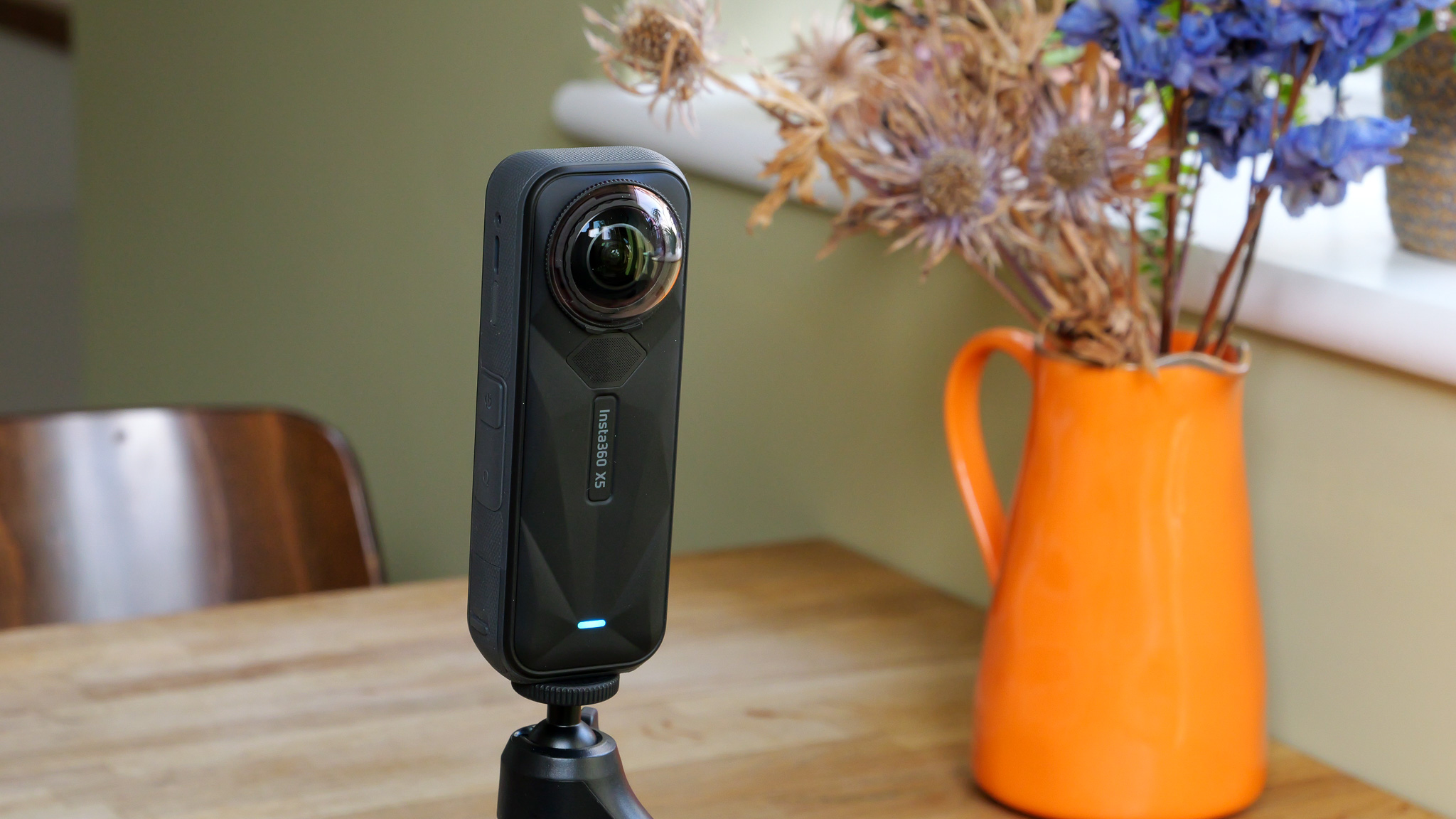
Rank 27484More DJI Osmo 360 images have leaked onlineThe 360-degree camera could launch in JulyIt's said to be similar to the Insta360 X5 in specsRumors around a 360-degree camera from DJI have been swirling since October, and now we have some fresh leaks that supposedly give us a look at the DJI Osmo 360 – as well as hinting at some of the specifications it'll bring with it.Tipster @GAtamer (via Notebookcheck) has posted some pictures of the DJI Osmo 360, showing off the compact camera, the two lenses on the front and back of the device, the small integrated touchscreen, and what looks like an accessory mount.According to the same source, the specs of the DJI Osmo 360 are going to be "almost the same as the X5", referring of course to the Insta360 X5 that launched in April – another 360-degree camera that the DJI Osmo 360 will be challenging head on.Have a read through our Insta360 X5 review and you'll see it's a very, very good 8K camera indeed – one we awarded five stars to. The two cameras have 1.28-inch sensors inside, bigger than those in the X4, so it seems we can expect something similar from DJI.Coming soon?The technical specifications are almost the same as the X5. pic.twitter.com/7HlC9JQHbPMay 31, 2025The @GAtamer post was actually a follow-up to another image leaked by @Quadro_News, which seems to show the DJI Osmo 360 in some kind of packaging. Again, we can see one of the camera lenses and the shape of the upcoming gadget.That's just about all we can glean from these latest DJI Osmo 360 leaks, and we don't get any information here about a launch date or potential pricing. It seems likely that the camera will be appearing sooner rather than later, however.Just a few days ago we got word that the DJI Osmo 360 would be launching in July 2025, so there's not that much longer to wait. We have already seen leaked images of the camera, which match the pictures that have just shown up.We've also heard that a super-small DJI Osmo Nano could be launched alongside the DJI Osmo 360. If these new devices are as good as the cameras in the current range, including the DJI Osmo Action 5 Pro, then there's a lot to look forward to.You might also likeThese are the best action cameras right nowThe DJI Osmo 360 looks like bad news for the GoPro Max 2Major DJI Osmo 360 leak includes dozens of images
-

Picture from ichef.bbci.co.uk
Rank 27485 -

Picture from static.independent.co.uk
Rank 27486 -

Picture from static.independent.co.uk
Rank 27487 -

Picture from static.independent.co.uk
Rank 27488 -

Picture from static.independent.co.uk
Rank 27489 -

Picture from static.independent.co.uk
Rank 27490 -

Picture from static.independent.co.uk
Rank 27491 -

Picture from static.independent.co.uk
Rank 27492 -

Picture from static.independent.co.uk
Rank 27493 -

Picture from static.independent.co.uk
Rank 27494 -

Picture from static.independent.co.uk
Rank 27495 -

Picture from image.cnbcfm.com
Rank 27496 -

Picture from static.independent.co.uk
Rank 27497 -

Picture from static.independent.co.uk
Rank 27498 -

Picture from static.independent.co.uk
Rank 27499 -

Picture from assets1.cbsnewsstatic.com
Rank 27500
