News
This constantly updated list features the latest and most important news articles, ranked in order of significance. The top stories highlight major developments, breaking news, and critical updates across various topics, ensuring you stay informed about the most pressing issues. As new articles are added, the list adapts to reflect the latest priorities, keeping the most impactful stories at the forefront. Whether it’s global events, technology breakthroughs, or industry trends, this dynamic list ensures you always have access to the most relevant and timely information.
-

Picture from ichef.bbci.co.uk
Rank 15801 -

Picture from ichef.bbci.co.uk
Rank 15802 -

Picture from ichef.bbci.co.uk
Rank 15803 -

Picture from cdn.mos.cms.futurecdn.net
Rank 15804Technology is constantly changing the world and how we live in it. It’s become a critical part for every organization; most wouldn’t be able to operate without it. Some recent technology innovations are exciting — like AI. With all the buzz around AI, many organizations quickly jumped at the opportunity to implement it, while others were wary. Many feel like they “should” be using it and worry about losing their competitive edge without it.While AI offers some great benefits, it's not necessary for every organization and use case. For some, it can be detrimental, causing a negative return on investment (ROI). If you’re considering adopting AI tools, there may be an alternative better suited to your needs: automation. Let’s discuss determining ROI and if AI is a worthwhile investment.
AI, automation, and weighing their value
Should you incorporate AI into your processes? Would AI bring good value or require too much work to set up? Does AI deliver a good ROI, or are there better options? These are likely all questions that arise as you consider whether or not you want to incorporate AI into your operational processes. Or maybe you’ve already started using AI and have realized it’s not all that you expected it to be.
AI and ROI potential
AI promises to improve efficiency, simplify manual tasks, and generally make our jobs (and lives) easier. However, about 75% of companies struggle to demonstrate a clear return on investment (ROI) for the AI tools they adopt.ROI is a critical metric to measure; you want to ensure you have enough data to back the investment decision. In my opinion, it’s too early to tell AI’s ROI. We need more time to create a solid measurement framework. Despite this, you can get an idea of AI’s ROI potential for your business with specific indicators:Leading indicators offer quick, apparent returns. For instance, AI can help put specific tasks, like troubleshooting customer issues, on autopilot. This can save time that your team can put toward revenue-generating tasks.Lagging indicators take time to show their benefits. For example, customer satisfaction improves because AI enhances the self-service experience.Consider the leading and lagging indicators specific to your organization and what success would look like for you in these terms.Before investing in AI, the most important thing to consider is: does this use case need human-like intelligence, or does it fall into a more structured logic category? AI is complex, autonomous, and flexible. It excels in situations that require open-ended problem-solving. AI can adapt, reason, and evolve through interactions. It is great for tasks that require human reasoning, like helping a customer troubleshoot a problem in real time.There are a few downsides to consider with AI. It comes with significant data and privacy risks and can be unpredictable. It may also require significant training to avoid undesirable outcomes and “hallucinations.”
Automation and ROI potential
Many use automation and AI interchangeably. While both can enhance productivity, efficiency, and ROI, they differ and offer distinct benefits.Automation has been shown to improve ROI significantly. Automation differs from AI in that it executes pre-defined, rule-based tasks automatically. It’s ideal for situations where fast, reliable outcomes are necessary to achieve business goals. Automation is great for functions that don’t require human reasoning.I like to call these "if this, then that" scenarios. For example, if a customer fills out a lead form on your website, you can have automation set to send a pre-written confirmation email automatically. Automation doesn’t require complex, human-like reasoning to execute a task. It saves time, maintains compliance, ensures data quality, and boosts employee productivity and satisfaction. It’s an excellent solution for repetitive tasks with clear, predefined outcomes.Automation has a couple of downsides if you need help accomplishing more complicated tasks. Automation tools are limited — they can only achieve the tasks they are programmed to perform. They are not adaptable and can’t handle complex tasks. For example, automation can send a new lead a confirmation email, but it cannot interact with them independently. However, it can be argued that automation is still beneficial because it frees up valuable time that your team can use toward more complicated tasks.
Good ROI is critical — the right technology can help
Better productivity means better profit, no matter which way you slice it. Technology today can help you achieve both — but with so many options, it’s hard to know which tools are worthwhile. Before investing, you must carefully consider what use cases are better for AI versus automation and how these technologies will impact your organization and customers.For many businesses, the need for technology is simply about increasing efficiency and saving time. Automation is an excellent solution for specific manual tasks that are a necessity to daily operations — such as document generation, contract management, or eSign software. If your team’s main bottleneck is administrative overhead, automation can provide immediate ROI, without the need for an AI solution.
We've compiled a list of the best document management software.
This article was produced as part of TechRadarPro's Expert Insights channel where we feature the best and brightest minds in the technology industry today. The views expressed here are those of the author and are not necessarily those of TechRadarPro or Future plc. If you are interested in contributing find out more here: https://www.techradar.com/news/submit-your-story-to-techradar-pro
-

Picture from cdn.mos.cms.futurecdn.net
Rank 15805iFi UP Travel connects wireless headphones to in-flight entertainmentStream audio over Bluetooth to in-car audio systems, too$99 / £99 / €99 (about AU$205)
iFi's new UP Travel solves two common issues for travellers: using your wireless headphones with in-flight entertainment that was made for cabled connections, and streaming music to in-car entertainment and other audio systems that don't do Bluetooth audio.The UP Travel is a two-way Bluetooth adapter that you can use to stream from in-flight systems to your headphones, or from your phone to a vehicle or audio product's aux-in port.The device enables you to pair and listen on two sets of headphones at once, though its battery is good for 10 hours, so it might not make it through the longest of flights.It's got a mic with noise and echo suppression for clear calls when you're back on the ground, because why not.
iFi the friendly skies
The UP Travel isn't just a wireless dongle. It's a proper DAC too. Instead of having the Bluetooth chipset handle the wireless and the audio too, the Bluetooth module focuses purely on transmission and reception while the audio conversion is handled by a Cirrus Logic MasterHIFI DAC and iFi's bespoke clocking circuitry, just like in iFi's larger portable DACs.The supported codecs cover all the essentials (although availability depends on your device and what it supports) including aptX Adaptive, aptX HD, aptX Low Latency, LDAC, SBC, AAC and LHDC/HWA. And in a nice touch you can change codecs, so for example you might want the highest possible quality for listening to music but switch to something with lower latency to stay in sync with the in-flight movie.The iFi UP Travel is $99 / £99 / €99 (about AU$205).
The iFi GO Pod Air add wireless streaming to your wired IEMs. (Image credit: iFi Audio)
iFi has also launched a second travel-focused product, the iFi GO Pod Air. It's designed for audiophiles who don't want to give up their wired IEMs but who do need the convenience of cable-free listening. It transmits at up to 24-bit/96kHz and supports all the key high quality codecs.It has built-in mics too, for calls. The GO Pod Air costs $249 / £249 / €249 (about AU$515).
You might also like
Best travel camera for 2025: top choices for your adventuresThe best travel headphones 2025, from Bose, Sony and moreThe best eSIM for international travel you can buy today
-

Picture from ichef.bbci.co.uk
Rank 15806 -
Picture from cdn.mos.cms.futurecdn.net
Rank 15807Android users now can't upload all files to Nextcloud, just because Google revoked a permissionNextcloud says Google is punishing smaller competitors while protecting its own apps from restrictionsNextcloud users now get a worse app experience, not because of failure, but gatekeeping
The ability to seamlessly upload all types of files from Android to the cloud has become a baseline expectation for modern users, especially those who rely on services like Nextcloud to manage their data.In a move that has sparked a backlash, Google has blocked full file upload capabilities in the Nextcloud Files Android app, citing “security concerns.”This single policy change has significantly affected how users interact with one of the leading cloud storage services available today, raising broader questions about fairness, power, and competition in the digital ecosystem.
Nextcloud claims unfair treatment under the guise of security
While users can still upload media files such as photos and videos, a core feature for anyone seeking the best cloud storage for photos, Nextcloud has been forced to disable uploads for all other file types on Android.According to Nextcloud, the issue stems from Google’s refusal to grant an essential file permission that the app has used since 2011. This is the “All files access” permission, which allows an app to read and write all files on a device’s shared storage, not just media files.“To make it crystal clear: All of you as users have a worse Nextcloud Files client because Google wanted that. We understand and share your frustration, but there is nothing we can do,” the company said in a press release.Nextcloud argues that this is not merely a technical issue but a strategic one. The company claims it is being boxed out, not for security reasons, but because it poses a competitive threat to Google’s own cloud ecosystem.“Google owning the platform means they can - and are - giving themselves preferential treatment,” the company states, noting that Google’s own apps, as well as those from other Big Tech players, continue to enjoy the same permissions that Nextcloud has now been denied.Google’s recommendation to use alternative frameworks like the MediaStore API or SAF has not solved the issue. Nextcloud explains that these options don’t meet its requirements, and reviewers have misunderstood their functionality.The situation echoes Microsoft’s past tactics in limiting WordPerfect’s access to Windows APIs, a historical parallel that Nextcloud readily invokes.Under the guise of user safety, Nextcloud claims, Google is making it harder to compete, particularly for smaller developers offering privacy-focused cloud backup solutions.While regulators are tasked with addressing such concerns, Nextcloud notes that progress is slow. A collective complaint filed in 2021 alongside 40 other organizations for a similar issue has yet to receive a response.
You might also like
Take a look at our roundup of the best business VPNs available nowThese are the best cloud document storage solutions to choose fromNvidia CEO wants Saudi Arabia to become a global AI leader
-

Picture from ichef.bbci.co.uk
Rank 15808 -

Picture from ichef.bbci.co.uk
Rank 15809 -

Picture from ichef.bbci.co.uk
Rank 15810 -

Picture from ichef.bbci.co.uk
Rank 15811 -

Picture from ichef.bbci.co.uk
Rank 15812 -

Picture from ichef.bbci.co.uk
Rank 15813 -

Picture from ichef.bbci.co.uk
Rank 15814 -

Picture from ichef.bbci.co.uk
Rank 15815 -

Picture from ichef.bbci.co.uk
Rank 15816 -

Picture from cdn.mos.cms.futurecdn.net
Rank 15817ISO 25000 defines "software security" as a key pillar of product quality, performance, maintainability, and reliability. But in practice, cybersecurity is often an afterthought, deprioritized in the name of speed and innovation, resulting in a growing disconnect between quality and security. The recent case of DeepSeek is a perfect example. Despite rapid product development and cost efficiency, the company failed most of its security tests, exposing major flaws in its risk posture.This isn't an isolated incident. Across various stakeholders and industries, "quality" means different things depending on who you ask. Developers may view it as bug-free functionality, designers may point to user experience, and executives may care most about time to market, ROI, and customer satisfaction. Meanwhile, security often sits outside those priorities—treated as a compliance box or post-release concern.The result? A widening divide. Organizations take an average of 55 days to fix just half of critical vulnerabilities. Attackers don't need nearly that long. Exploits from CISA's Known Exploited Vulnerabilities catalog often circulate within five days of discovery. That's a 50-day exposure window, and that's if you're among the faster teams. Most aren't.To close this gap, teams must move beyond reactive security measures and adopt a proactive, integrated approach to quality—one that treats security as a core part of the development lifecycle, not something bolted on at the end.
Data Flow Vulnerabilities: The Hidden Security Risk
Modern quality assurance (QA) is built around fast, repeatable feedback. Fail a test, file a bug, and fix it before it hits production. Teams are fluent in this rhythm. But when it comes to security issues, the rhythm breaks. Often, the assumption is that vulnerabilities weren't detected in time. But the real problem isn’t just detection, it’s a breakdown in how security signals flow through the development lifecycle.Security tools generate noisy and low-quality signals, leading to false positives and negatives. And, with the rise of proactive, left-sided practices—like threat modeling, IDE plugins, pre-commit hooks, and early scans—the volume of signals has only increased. Tools like SAST, DAST, and dependency scanners flood teams with thousands of alerts. Without a structured way to prioritize, sort, and assign these issues, developers fall back to what they know, and security becomes background noise, the divide deepens, and the path to resolution blurs.To fix this, teams need to treat vulnerabilities like they treat bugs—because that's precisely what they are. Whether it's a flaky unit test or a known SQL injection risk, both represent a failure state and require prioritization. When security signals are pulled into the same systems developers already use—issue trackers, test automation, CI/CD pipelines—they get handled like any other failure, not ignored or delayed.
The Lag Is in the Handoff, Not the Discovery
Delayed security fixes put businesses, customers, and reputations at risk. It's tempting to think that catching vulnerabilities sooner will solve everything. But most teams already know where their weaknesses are. The current lag isn't about visibility. It's about propagation. Security alerts travel on a different track than everything else. QA teams test, triage, and file bugs as part of their day-to-day job. But AppSec alerts? They get forwarded. They live in separate tools. They sit on spreadsheets that no sprint team is ever going to open.A single static scan can produce thousands of results; most go untouched without a structured way to sort through them. According to a Ponemon Institute survey, 61% of IT and security professionals struggle to remediate vulnerabilities effectively. Only 20% believe they can reliably detect vulnerabilities before an application is released.Once a vulnerability is known to the public, the clock is ticking. Exploits circulate quickly. By the time a team triages the alert, assigns it, and discusses a fix, the damage may already be done. And the fallout can be painful.Victims of data breaches underperform the NASDAQ by 8.6% after a year—and more than 11% after two years. Customers don't easily forget, either. More than half (66%) of U.S. consumers say they wouldn't trust a company again after a breach, and 44% believe cyber incidents directly result from poor security measures. That trust is hard to rebuild, and the "patch later" mindset won't cut it anymore. Businesses can't afford to wait until the next release cycle to address known issues. So, what's the better approach?Everything changes if you reframe those alerts as just another signal source—equivalent to a failed unit test. Developers already know how to act on that kind of data. They know how to prioritize based on severity and reproducibility, when to flag issues for later, and when to fix them immediately. Security can fit that mold. It just hasn't been given a seat at the table.
Align Security with Agile and Continuous Deployment
Perfect software doesn't exist. Teams deploy with known bugs all the time because getting the product out the door matters more than perfecting every edge case. Security should be viewed similarly: not every vulnerability must be fixed before release, but every risk should be known, tracked, and managed. That's how mature teams work—not by pretending every build must be flawless but by making tradeoffs with their eyes open.This doesn't mean every security issue needs to block deployment. Just like teams go to market with known minor bugs, they can also do it with low-priority vulnerabilities—so long as there's visibility and a plan.Deploying with a known issue is one thing. Deploying with a critical vulnerability no one's aware of is something else entirely. When teams pull security data into the same locations they manage tests and bugs, those tradeoffs become more intentional. The product team knows what's at stake, the security team has visibility, and teams can jump on it fast if something changes.
Embed Security Testing Throughout the Development Lifecycle
Security is a lifecycle, not a checklist. It should be embedded into planning, implementation, testing, and monitoring. Address risks early in planning to prevent coding vulnerabilities, integrate testing findings into sprint cycles for timely remediation, and implement post-deployment scans to defend against new threats. This proactive, lifecycle-wide approach shifts security from a daunting challenge to a manageable process, prioritizing strategic risk mitigation over chasing perfection.Additionally, all teams, regardless of size or resources, stand to gain from leveraging a comprehensive suite of tools that bring security, quality, and testing together under one roof. When signal sources are fragmented across disconnected systems, teams lose time chasing context and resolving conflicts between tools. But with a unified platform, organizations can centralize insights, reduce noise, and make faster, more informed decisions.This integrated approach helps security shift from a bottleneck to a core enabler of speed and resilience. Instead of reacting to siloed alerts, teams can respond to prioritized, correlated findings within the workflows they already use—accelerating resolution without compromising risk management.
The Stakes Are Already Too High to Wait
The fastest, most effective teams don't just build quickly. They build securely by embedding security into the systems they already trust. They treat security bugs like any other failure and make tradeoffs based on visibility, not guesswork.Teams that close the gap between security and quality will be better equipped to deliver resilient, high-performing software at speed. By integrating security throughout the development lifecycle—with structured prioritization, continuous feedback loops, and tools that unify signals across teams—organizations can reduce risk, protect their reputation, and earn lasting customer trust.When done right, security becomes part of the rhythm of development, not a disruption.
We've made a list of the best patch management software.
This article was produced as part of TechRadarPro's Expert Insights channel where we feature the best and brightest minds in the technology industry today. The views expressed here are those of the author and are not necessarily those of TechRadarPro or Future plc. If you are interested in contributing find out more here: https://www.techradar.com/news/submit-your-story-to-techradar-pro
-

Picture from ichef.bbci.co.uk
Rank 15818 -

Picture from cdn.mos.cms.futurecdn.net
Rank 15819Samsung has removed the AdGuard VPN app from its Galaxy Store in Russia at the government's requestApple already killed AdGuard VPN in 2024, alongside at least 60 VPN appsOver 100 VPNs are currently unavailable in the Apple App Store, with 50 also unavailable in the Google Play Store
Yet another VPN service has disappeared from official App Stores in Russia. This time, Samsung has removed the AdGuard VPN app from its Galaxy App Store in the country at the Roskomnadzor's demand.This comes as part of the Kremlin's actions against VPNs that have seen over 100 apps disappear from the Russian Apple App Store, including some of the best VPN services on the market.Despite Google seemingly resisting most of these demands so far, recent data shows that at least 53 VPNs are also currently unavailable in the Google Play Store in Russia. AdGuard VPN, however, hasn't been affected yet.
"A regrettable development"
"Our app has indeed been removed from the Samsung Store in Russia – a regrettable development, in our view," AdGuard CPO, Denis Vyazovoy, told TechRadar.The VPN service has received a synthetic email from Samsung (see image below) to inform that its "application information has been modified."The change? "Russia was excluded from the sales country lists according to Russian government's request. This app is banned by Russian government," reads the email.AdGuard VPN was already among the virtual private network (VPN) services affected by the big purge from Russia's Apple App Store last year. Unavailable apps also include some of TechRadar's favorites, such as NordVPN, ExpressVPN, and Proton VPN, but also the popular Russian service Amnezia VPN.The provider confirmed to TechRadar, though, that its app is still available in Russia's Google Play Store at the time of writing.It's also worth noting that these removals only affect Russia-based users. The AdGuard VPN app is still available across all official app stores outside Russia.
(Image credit: AdGuard)
"We see this as part of a broader trend of restricting access to tools that help people protect their privacy and maintain access to an open internet," Vyazovoy told TechRadar.The Kremlin's actions against VPNs have intensified since a law enforced in March 2024 criminalized the spread of information about ways to circumvent internet restrictions. This is likely the legal basis upon which the Russian censor body is issuing these demands to Big Tech firms.Yet, experts have long called on these companies to uphold Russian citizens' human rights by refraining from cooperating with these demands and restoring censored VPN apps.Vyazovoy confirmed to TechRadar that the service continues to operate through other channels and the provider is actively looking for ways to remain accessible to all users.If you are using a Galaxy smartphone, I recommend downloading the AdGuard VPN app from the Google Play Store, where the service is still available at the time of writing.The provider also suggests downloading it directly from their official website to be sure to get the latest and safest version.
TechRadar needs you! We want to know what you think about the world of VPNs. Whether you're a novice or a VPN pro, we want to hear your thoughts. Don't worry, though, your responses are completely anonymous, and it takes less than five minutes to complete!To take part, click the link below: https://futurenet.questionpro.eu/tr-vpn
You might also like
Russia demands over 200 VPNs are removed from the Play Store – but Google is resistingRussia to invest over half a billion US dollars in its battle against VPN usageRussia disconnects several regions to test its sovereign net
-
Picture from o.aolcdn.com
Rank 15820If you want to get the most out of your tablet or laptop, a USB-C hub can help. Using a single USB-C slot on your portable computer, a hub gives you back missing connections like HDMI, USB Type A and C, Ethernet, memory card slots and more. After testing more than a dozen models, we think the UGreen Revodok Pro 109 is the best USB-C hub for most people. But we have a recommended budget model and a premium pick to give you more options. We also break down port types, power delivery capabilities and design considerations to help you make the right choice before you buy.
Table of contents
Best USB-C hubs for 2025
What to look for in a USB-C hub
How we test USB-C hubs
Other hubs we tested
Recent updates
Best USB-C hubs for 2025
What to look for in a USB-C hub
Hub vs docking station
The first thing to decide is whether you need a USB-C hub or a USB-C docking station. There’s no set standard for what differentiates the two, but docking stations tend to have more ports, offer a separate DC power adapter and cost more, with some reaching upwards of $400. We have a separate guide to the best docking stations to check out if you’re looking for something bigger than what we’re discussing here. USB-C hubs, in contrast, have between four and 10 ports, can support pass-through charging and typically cost between $30 and $150.
Hubs, sometimes also called dongles or even multiport adapters, make more sense for smaller setups with just a few peripherals, such as a monitor, a wired keyboard and mouse, and the occasional external drive. They’re also more portable, since they’re small and require no dedicated power. That could be useful if you change work locations but want to bring your accessories with you, or if you want to replace your laptop with a more powerful tablet. A docking station or thunderbolt dock makes more sense for someone who needs a robust setup for their laptop, including multiple external monitors, webcams, stream decks, microphones and so on.
Both docks and hubs make it easy to grab your laptop off your desk for a meeting or other brief relocation and when you get back, you only need to plug in one cable to get all your accessories reconnected.
Ports
For a USB-C hub to work, it needs to connect to a port on your laptop or tablet that supports video, data and power — all of which is covered by anything listed as USB 3.0 or better, including USB4 and Thunderbolt 3 and 4. The port, of course, needs to be Type-C as well. The sea of laptops out there is vast, so it’s hard to make generalizations, but modern laptops, including Windows and Apple models, should have at least one USB-C port that will suffice, and indeed, every one of our top picks for the best laptops do.
Next, it’s a matter of finding a good USB-C hub that has the right connections for your needs. Most hubs offer some combo of HDMI, USB, SD card reader, Ethernet and 3.5 mm ports. If you have a 4K monitor and would like at least a 60Hz refresh rate, you’ll need a hub with an HDMI 2.0 port — HDMI 1.4 only goes up to 30Hz. HDMI 2.1 will handle 4K at up to 120Hz, but hubs that have adopted that standard aren’t as common just yet. Keep in mind that a low refresh rate can cause your screen to feel laggy, making your mouse appear glitchy and your webcam movements to look delayed.
Additional USB ports on these accessories are usually Type-A or Type-C. They can support data with different transfer rates, typically 5Gbps or 10Gbps. Some ports only handle passthrough power and no data, and some can do data, power and video, so it’s best to check the spec list to make sure you’re getting the support you need. Keep in mind that a hub may bill itself as a 7-in-1, but one of those ports may not be usable for anything other than charging.
Standard SD and microSD slots are useful for transferring data from cameras and the like or for offloading files from your hard drive. Ethernet ports may deliver faster internet speeds than your Wi-Fi and a hub with a 3.5mm jack can bring back the wired headphone connection that some laptops have ditched.
Power delivery
Nearly all of the USB-C hubs I tested support passthrough charging. That means if your laptop or tablet only charges via USB, you don’t have to take up another port on your laptop to keep everything topped up. Unlike a docking station, powering a hub is optional. The one exception is if you want to close the lid on your laptop while you work on an external monitor. Most computers will go into sleep mode if the lid is closed without power, so either the laptop or the hub will need to be plugged into the wall to prevent that from happening.
Many of the newer hubs include a 100W USB-C power delivery (PD) port, with a healthy 80 to 85 watts going to your Mac, PC or tablet (the hubs take a little of the juice for themselves, hence the 15-watt or so difference). In my tests, a powered USB hub ran hotter than when it wasn't passing the charge through, so I prefer to power the computer directly using its own charger. But for tablets or other devices with no extra ports, that PD option is important.
Some PD ports are also data ports — which is both good and bad. On one hand, it feels wasteful to use a perfectly good data port just for boring old electricity. But on the other hand, USB-C connections that only carry a charge are less versatile, and it makes it seem like it has more accessory hookups than it actually does.
Design
There’s surprisingly little design variation among hubs. Most look like a flat slab, a little smaller than a smartphone, and have an attached Type-C host cable. The hues range from a silvery black to a silvery gray. Some are thinner than others, some have all ports on one edge and some have ports on both sides. All of this is just to say that aesthetics probably won’t make or break your buying decision.
One variation that could tip the scales is the length of the cable. A longer one will give you more freedom as you arrange the hub on your desk, potentially even letting you hide it behind your laptop. Or you may prefer a shorter one to keep the hub neatly set beside your laptop.
How we test USB-C hubs
Before we test anything, we take a look at what’s available and how they’ve been received by shoppers, forum-goers and other publications. I became familiar with a few reputable brands when I was testing docking stations, so I looked into hubs from those companies as well. I focused on items that would help with an average day of productivity — not high-end setups or demanding gaming situations. Once I settled on a dozen or so that would make good candidates, I had them shipped to my humble office in the desert and started testing them out over the course of a few weeks.
I used an M1 MacBook Pro running MacOS Sonoma as the host computer and plugged in accessories that include a 4K Dell monitor, a ZSA USB-C ergo keyboard, a Logitech USB-A gaming mouse, an Elgato USB-C 4K webcam, a Logitech streaming light, a USB-A 3.0 Sandisk thumb drive, a USB-C Samsung T7 Shield external drive and a pair of wired headphones I got for free on an airplane (I should probably invest in some wired headphones, but the cord dangling on my chest drives me nutty so all my earbuds are wireless). I used high-end HDMI and USB-C cables to ensure that any data or connectivity issues weren’t related to my equipment.
Then I put each USB-C hub through a gamut of basic tests. I looked at what could be plugged in at once, the resolution on the monitor, data transfer speeds, the overall build quality of the hub and general usability factors, like the placement of the ports and the length of the cords. And, finally, the price-to-value ratio helped determine the best ones for a few different use cases.
Other hubs we tested
HyperDrive Next 10 Port USB-C Hub
There’s a lot to like about HyperDrive’s Next 10 Port USB-C Hub. The tethered cable is a lavish 13 inches long, the HDMI 2.0 port outputs clear and crisp 4K visuals at 60Hz and the data transfers are screaming fast. It has the coveted two USB-C data ports plus a PD port, and there’s even a headphone jack. The only thing that holds back a full-throated endorsement is the way our unit handled a streaming light. Having it on at full brightness made the webcam flicker every time. The issue went away at 75 percent brightness, but the same problem didn’t happen on any other hub I tested.
Anker 341 USB-C Hub (7-in-1)
There’s nothing wrong with the Anker 341 USB-C hub. In fact it’s a current recommendation in our iPad accessories guide and it comes at a great $35 price. It gives you two USB-A ports as well as SD slots. But at this point, a 1.4 HDMI connection, which only supports 4K resolution at 30Hz feels a little retro. There’s also just a single USB-C downstream port and the data transfer tests proved to be a touch slower than the other hubs. But if you’ve got a lower resolution monitor and don’t need more than one USB-C, you won’t be disappointed with it.
Anker 555 8-in-1
It was a tough call between the UGreen Revodoc Pro 109 and the Anker 555 8-in-1 for our top recommendation. Both have a similar port array with an HDMI, Ethernet, two USB Type A, a PD USB-C and a USB-C 3.2 on the 555. And the Anker USB-C hub is $15 cheaper. We went with the UGreen hub for its more premium build, extra USB-A port and longer cord that gives you two extra inches to work with. But if you want to save a few bucks this hub is a worthwhile pick.
Startech 4-Port USB-C Hub (data only)
I only became aware of Startech when I started researching for this guide. The quality is decent and the yellow accents are a welcome bit of color in the otherwise very gray world of hubs. The performance is solid, with no hiccups that I encountered. The brand’s 4-Port USB-C Hub has a long cord that wraps around the hub itself, which is unique. It doesn’t bother with power delivery, which isn’t an issue if you can power your computer directly. But the four USB ports (three Type-A and one Type-C) max out at 5Gbps and there’s no HDMI connector. It goes for $46, and unfortunately for it, there are cheaper ways to get a few more USB ports for your setup.
Recent updates
April 2025: Added our experience with the Anker 555 8-in-1 hub to the Other hubs we tested section. This article originally appeared on Engadget at https://www.engadget.com/computing/accessories/best-usb-c-hub-120051833.html?src=rss
-

Picture from cdn.mos.cms.futurecdn.net
Rank 15821Figma launches new design and dev toolsAI powers the suite Focused on giving teams ability to go from idea to product faster
Last week in San Francisco, design and development platform Figma unveiled four new tools aimed at giving users the full end-to-end package.Figma Make, Figma Sites, Figma Draw, and Figma Buzz offers teams the ability to ideate and create everything from vector images to full-blown websites. And, as you’d expect, it’s all AI-powered for faster iteration.At Config London, I got a more in-depth peek into exactly what these tools are capable of - and how they fit into Figma’s plans to create a platform that lets users go from idea to product launch without pause.
Create and launch at speed
One of the biggest issues facing businesses today is team siloing - where one hand doesn’t know what the other is doing (or, at least, has a different way of doing the same thing).With that in mind, Figma has released four new tools alongside its beloved Figma Design and FigJam that almost entirely remove that problem.Yuhki Yamashita, Figma’s Chief Product Officer, explained the thinking behind the new line-up, saying, “How do we help you do everything, going from an idea to a final product? And all the things that you will see in the future, too, will be anchored in this, in this framework of helping people go through this journey faster, explore more ideas, and make that process as efficient as possible.”
Figma CPO Yuhki Yamashita on stage during Config London (Image credit: Figma // Future)
Figma Make is an overarching tool for content ideation. Here, you can start from scratch or copy and paste existing designs from Figma Design, and collaborate on these with the rest of the team (Figma calls this a “multiplayer” tool). You can then port over into other apps like Figma Sites to tailor the design to suit the product.What’s interesting here is the concept of throwing away designs. Effectively, what Figma wants is to make it easy to rapidly ideate, that if something doesn’t work, you can throw it out and start afresh.During the press briefing, Yamashita said: “Our thought experiment was, how can we make it so easy for you to go from the idea into your head to something that is actually you can put in front of users and validate really quickly. And if it doesn't work, that's great. You can then move on to the next idea, or you can keep iterating from there.”Figma Sites is an AI-powered website builder for all-in-one design, prototyping, and publishing. One of the chief purposes behind this is saving time - a space where developers can work on templates, responsive design, custom interactions, and transitions and motion effects. Using grids, and with a little help from AI, designing responsive sites looks and feels easy (assuming you know what you're doing, that is).During Config London, I was treated to a brief, playful example - taking static words and prompting the AI to come up with three different ways to add some design sparkle, for example, repelling each word as the cursor hovers over it. However, as Yamashita later noted, there are more practical uses here such as connecting an API to the back-end.There’s also the promise of future updates, with Yamashita saying, “we wanted to make sure that we could support scaled use cases, too. For example, a marketing site with tons of content, or maybe a blog. And with these kinds of content, it's much easier if we have a CMS, so that a non-designer can come in and comfortably edit that content in a way that's familiar to them. And this is something that's coming soon.”
(Image credit: Figma)
Figma Draw is, in a sense, Figma’s AI-powered answer to Adobe Illustrator. But it goes a little deeper than that, with the company keen to help designers make content that doesn't have a generic look and feel, while letting them freely express themselves and elevate their craft.I saw a few examples of what the Figma community has already created during the event, some in hand-drawn stylings, others photorealistic images - and it’s fair to say, they’re certainly impressive. Yamashita explained, “We add things like texture and noise to make it feel much more organic, while still being a vector.”Figma Buzz tackles the social media marketing side - once a product is launched, Buzz is a tool for promoting it online. But more importantly, it's a way to help those on the team who can’t or don’t use Figma Design to create content that matches brand guidelines. Built for designers and marketing teams, Yamashita called this “the purpose-built tool for on-brand asset creation” for dynamic and custom assets at scale.He and his team asked themselves “how could it feel as simple as filling out a form, so that you can actually create some dynamic content?” Figma Buzz is the answer to that. Helpfully, the tool also connects to Figma Design, serving up all the features designers use, without “complicating the experience” for non-designers.I saw this one in action on stage and came away impressed. In a matter of seconds (ok, maybe ten or so seconds), a single post was automatically localized 80 different ways, switching language, image, and national flag for the correct territories - all without removing that on-brand element.
Figma Buzz demonstration in action, creating social media assets in real-time (Image credit: Figma // Future)
You can check out Figma’s latest tools right now by clicking here and navigating to the Products section. To watch the full Config London keynote speech with Yamashita and Figma CEO Dylan Field, it's on YouTube here.
You might also like
We took a look at the best mockup software for small businesses‘It's like magic and everything just works’: We spoke to Adobe’s AI maestro to find out what’s new with Firefly and how it levels up creativity for allFigma’s latest survey shows AI is not yet living up to its over-hyped promise
-

Picture from cdn.mos.cms.futurecdn.net
Rank 15822James Gunn has dropped a big tease about Wonder Woman's DCU debutThe DC Studios co-chief won't say when Diana Prince will return to the big screenBut fans are convinced she'll be part of Gunn's next project, which could be a team-up movie
James Gunn has set tongues wagging among DC comic-book fans after he teased that Wonder Woman's DC Universe (DCU) debut might not as far away as many people think.Posting on Threads yesterday (May 15), the DC Studios co-chief dropped the biggest hint yet that Diana Prince could be part of his and Peter Safran's new-look cinematic universe sooner than expected.Asked by a fan if he could share any news on Wonder Woman's possible arrival in the DCU, Gunn replied: "Not to be shared publicly yet but yes. Encouraging."
Gunn shared a promising update on Wonder Woman's DCU debut on May 15 (Image credit: Threads)
Admittedly, it's not much to go on. However, given that Wonder Woman is the only member of DC Comics' Trinity – that trinity being, the company's three most popular heroes in Superman, Batman, and Wonder Woman – not to get her own DCU project yet, it's nonetheless intriguing to hear Gunn talk up her eventual appearance in the DCU.Fans have long questioned the decision not to announce a Wonder Woman film as part of Gunn and Safran's initial DCU movie and TV show lineup in early 2023.At the time, Gunn's Superman movie, which arrives on July 11, was confirmed to be the first of numerous superhero flicks that'll comprise DCU Chapter One. The Brave and the Bold, a Batman film inspired by its comic-book namesake, was also unveiled alongside Chapter One's initial 11-strong slate.Gunn did reveal a Wonder Woman-esque TV series as part of Chapter One's original lineup. However, while that show – Paradise Lost – is billed as a Game of Thrones-inspired story that'll be set on Themyscria, aka Prince's idyllic home island, the Amazonian won't be its lead character. Unsurprisingly, that irked some DC aficionados who felt that, despite Wonder Woman's enduring popularity, she was being overlooked.
Why Gunn's Wonder Woman tease has sent DC fans into a frenzy
Gal Gadot is the latest actor to play Diana Prince/Wonder Woman (Image credit: Warner Bros)
Gunn's Threads post comes hot on the heels of Warner Bros. Discovery (WBD) CEO David Zaslav's own comments about the company's desire to capitalize on the popularity of four specific DC superheroes.Speaking during WBD's Q1 2025 earnings call (as reported by Yahoo), Zaslav said: "When you look at the major characters... that James Gunn and Peter Safran are developing with their 10-year plan around DC, that is to build asset value globally [with] Wonder Woman, Batman, Superman, [and] Supergirl. So, we look at those as big asset builders and big differentiators."Clearly, Zaslav wants WBD subsidiary DC Studios to take a more proactive approach to building the DCU around its most iconic metahumans – and, surprising no-one, that includes Wonder Woman.
Batman, Wonder Woman, and Superman teamed up twice in the now-defunct DCEU (Image credit: Netflix)
With Zaslav and Gunn publicly responding to queries about Diana Prince in recent days, fans have renewed hope that it won't be too long until the Princess of Themyscira is back on the big screen. And, if a new fan theory is to be believed, some observers believe she'll return in Gunn's next project, which – whisper it quietly – could be a team-up between Wonder Woman, Superman, and Batman.Taking to Threads on May 10, Gunn revealed that he'd started working a new DCU movie. Curiously, though, he confirmed that it was a new project, i.e., not one of the seven that currently make up DCU Chapter One, aka 'Gods and Monsters'.That post, coupled with his comments about Wonder Woman, have unsurprisingly caused a stir. So much so, in fact, that some fans claim he must be penning the script for a Trinity film. Indeed, a thread on the DCULeaks Reddit page is full of people theorizing that this is what Gunn is secretly working on.
Comment from r/DCULeaks
What's my take on the situation? A movie that brings DC Comics' three greatest heroes together would not only be (hopefully) absolutely brilliant, but would also help us to forget about the – how can I put this politely – less-than-ideal team-up we got with Zack Snyder's Justice League and Batman v Superman's undercooked third act.Marvel has proved that people will flock to see their favorite superheroes unite on the silver screen, so there's no reason why the DCU wouldn't benefit from seeing Prince, The Dark Knight, and the Man of Steel join forces to take down a common foe.That all said, it could be years before a Trinity film sees the light of day. Yes, Superman is ready to take flight in the DCU and, while Kara Zor-El isn't part of the Trinity, Supergirl: Woman of Tomorrow, which lands in theaters next June, will introduce wider audiences to the fourth main pillar Zaslav mentioned earlier this week.But, until The Brave and the Bold's development gets off the ground, and either Paradise Lost or a standalone Wonder Woman film introduce us to the DCU's Diana Prince, I can't see a world where a Trinity movie would be the right project for Gunn to tackle next.We live in hope, but if the now-defunct DC Extended Universe (DCEU) has taught us anything, it's that cinematic franchises need to walk before they can run, and making and releasing a Trinity movie before its legendary metahumans are all established in the DCU would be the opposite of that.
You might also like
Superman trailer #2 breakdown: 7 big details and Easter eggs you definitely missedConfusion reigns in James Gunn's DCU as conflicting reports emerge over supposed cancellation of Colin Farrell-starring moviePeacemaker season 2 finally has a teaser trailer – here are 3 things you need to know about the hit Max show's return
-

Picture from ichef.bbci.co.uk
Rank 15823 -

Picture from ichef.bbci.co.uk
Rank 15824 -

Picture from cdn.mos.cms.futurecdn.net
Rank 15825Microsoft was meant to make EU-specific changes to Azure by last monthECCO has issued its second amber report against MicrosoftThe company must now engage in Plan B
Microsoft has failed to deliver a special, EU-specific version of Azure – a milestone it was meant to achieve by mid-April 2025.The Washington tech giant had previously committed to building a Hoster Product for EU providers, promising features like multi tenancy support, unlimited virtualization and pay-as-you-go SQL Server licensing.It all stems from a November 2022 antitrust complaint, when CISPE accused Microsoft of engaging in anticompetitive business practices that saw it favor its own Azure cloud over competitors.
Microsoft missed a major CISPE antitrust milestone
CISPE complained that it was more expensive to run Microsoft software on rival cloud platforms than on Azure, thus the company pledged to tweak some of its licensing terms to open up competition.The European Cloud Competition Observatory (ECCO) published its second report on Microsoft, maintaining its amber rating – not a good look for a company that's been the subject of antitrust investigations on a global scale. "Some concerns exist but corrective actions have been proposed," ECCO explains."Although there have been setbacks, specifically in the delivery of a product-based resolution, both sides continue to engage in positive discussions," CISPE wrote.CISPE Secretary General Francisco Mignorance commented: "It is disappointing that the proposed product did not deliver, but this is in not the end of the Agreement. Phase 2 opens the door to discuss alternative, commercially equivalent solutions that enable CISPE members and Europe’s cloud infrastructure providers to compete fairly, while still offering Microsoft’s productivity tools to their customers."Microsoft must now propose alternatives – a Plan B – by July 10, 2025, or face potential new legal action. In the meantime, the UK's CMA continues to review the company's licensing tactics.TechRadar Pro has asked the company for more details on the missed deadline, but we did not receive an immediate response.
You might also like
Microsoft hit by new legal claim over restrictive licensing and overcharging allegationsWe've listed the best cloud storage and best cloud backup softwareSave some money with the best free office software
-

Picture from ichef.bbci.co.uk
Rank 15826 -

Picture from ichef.bbci.co.uk
Rank 15827 -

Picture from ichef.bbci.co.uk
Rank 15828 -
Picture from cdn.mos.cms.futurecdn.net
Rank 15829Google has updates for Global Accessibility Awareness DayThe new features cover Android and Google ChromeYou can now ask Gemini questions about images on screen
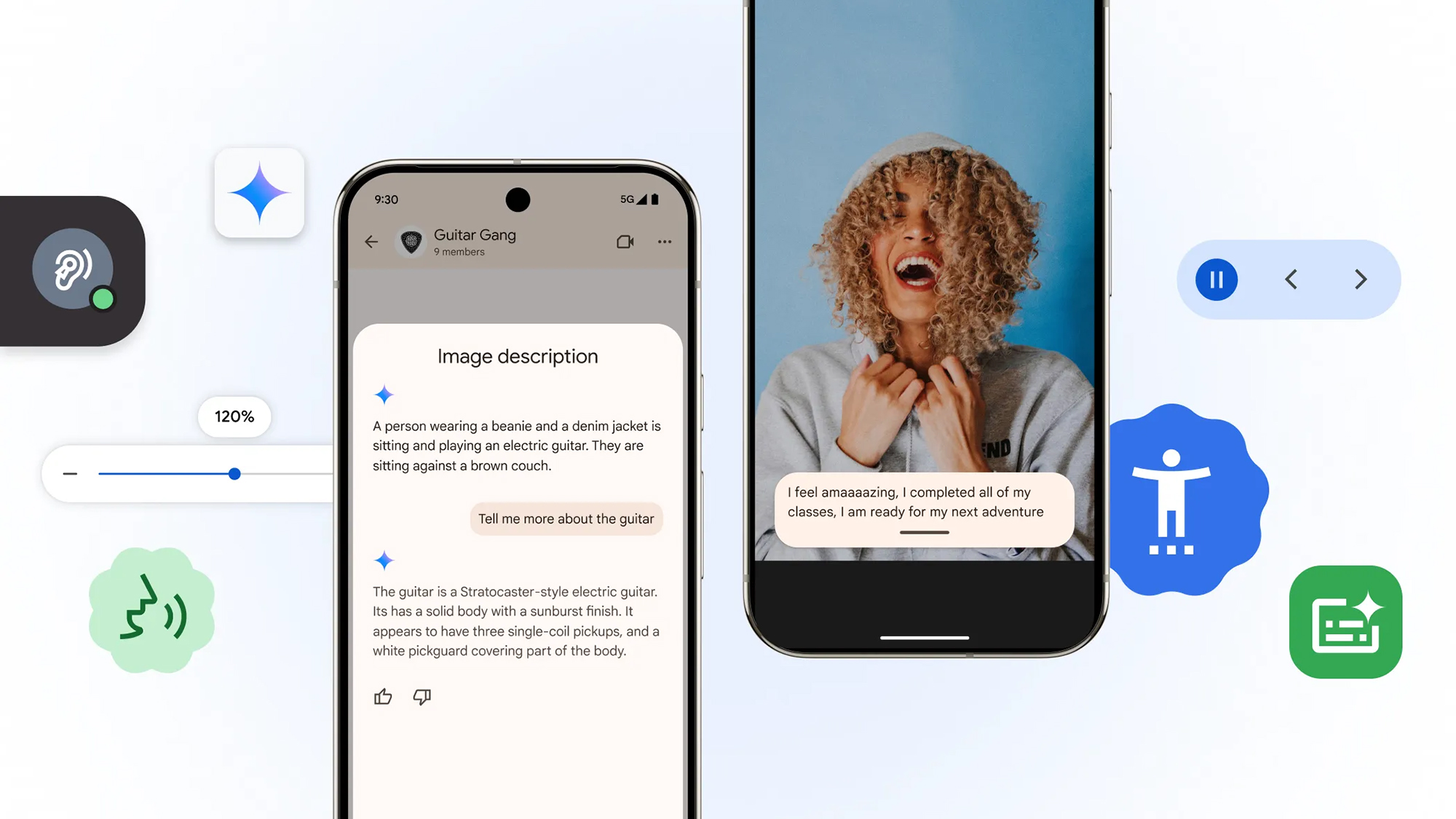
We've already seen a bunch of updates for Apple products in honor of Global Accessibility Awareness Day this week, and now it's Google's turn – with four important upgrades on the way to Android and Chrome.As per the official blog post, the TalkBack screen reader feature in Android is getting some extra smarts, on top of the existing Gemini-powered functionality. The feature provides image descriptions for blind and low-vision users, even when no alt text is provided.Now, you'll be able to ask Gemini follow-up questions about the image that's showing on screen – so if you need to know what color something is, or what else is showing in the picture, Gemini will be able to help out.There's also an update to Expressive Captions, which provides on-screen subtitles for anything with audio on your phone. Those subtitles will now reflect drawn on words, so you'll be able to tell the difference between "no" and "noooooooooo", Google says.
Chrome and language support
Page Zoom in Android can now zoom on text only (Image credit: Google)
We've got some accessibility improvements to talk about with Google Chrome, too. First up, scanned PDFs are getting Optical Character Recognition (OCR), which means you'll be able to search for text inside them, and copy that text somewhere else.For Chrome on Android, Page Zoom (above) is adding a feature to let you increase the size of text on pages, without affecting anything else (like images or layouts). To set up the feature, tap the three dots (top right) in a tab, then Settings > Accessibility.Google is also improving speech recognition technologies around the world, giving developers more resources for non-standard speech patterns and non-English languages, as part of its ongoing Project Euphoria initiative.Finally, a full suite of accessibility features are on the way to Google's Bluebook app, which can be used as a testing platform. Upgrades for dictation and the screen reader tech should make the app more accessible than ever.
You might also like
Android 16 is coming soon, with these new featuresGemini is coming to Google TV later this yearGoogle just showed us the new look of Android 16
-

Picture from ichef.bbci.co.uk
Rank 15830 -

Picture from cdn.mos.cms.futurecdn.net
Rank 15831Over the last week, I’ve been tasked with testing the new Sony WH-1000XM6 headphones to their absolute limit. And yes, they’re pretty great. With class-leading noise cancelling capabilities, awesome audio and features for days, these compete against even some of the best headphones around. But should you buy them now?For many, the answer will be a resounding yes – but, you wouldn’t be alone in having a few reservations or questions. So, if you’re on the fence, here are my top three reasons to pick up the Sony WH-1000XM6 right now… as well as three reasons to hold fire.If you’d like to check out my full thoughts, head over to my Sony WH-1000XM6 review – but for the quicker takeaway, let’s dive straight into things…
(Image credit: Future)
Why you should buy them
1. You get class-leading active noise cancelling capabilities
Now, when it comes to noise cancelling, these are by far the best Sony headphones you can buy. But I’d go a step further. They’re also arguably the best noise cancelling headphones available – period.The Japanese tech giant’s new cans use the fresh QN3 HD noise cancelling processor, which is seven times faster than the old QN1. It harnesses the capabilities of twelve mics in order to offer truly sound crushing ANC. Whether you’re looking for near-silence on your daily commute, an isolated listening session at the local café, or cans to help you lock in at the office, the WH-1000XM6 have you covered.Even when compared to the noise-nixing legends that are the Bose QuietComfort Ultra Headphones, the XM6 are more than capable of holding their own.I found them to be equally as good, if not better, than the Bose in my real-world testing, which included vacuuming my apartment, walking in traffic-heavy areas, and taking public transport. On occasion, you will hear sounds creep through, but fear not – the most harsh noises will be drastically dampened, meaning you can stay focused on your favorite tunes, at all times.
(Image credit: Future)
2. They sound fantastic and can mold to your specific taste
In terms of sound quality, the Sony WH-1000XM6 perform very nicely indeed. There’s a fantastically balanced sound signature out of the box, which aims to get closer to the ‘flat’ presentation that many audio engineers seek out. No need to worry about over-zealous bass or harsh treble here.But still, you’re able to get an exciting listen out of Sony’s new flagship cans. In my hours upon hours of testing, I was treated to clear highs, rich mids and driving low-end output, which kept me coming back time after time. And with Sony’s ‘noise shaper’ technology, these cans can pre-empt sudden sound changes for a distortion-free, controlled listen.There’s also DSEE Extreme for upscaling lower quality audio files, and Sony’s proprietary LDAC codec for getting the best out of ‘hi-res’ tracks over Bluetooth. And if you really want to make the XM6 sound your own, you can have a play with EQ settings, which include a Find Your Equalizer test that creates a tailor-made sound, just for you.
(Image credit: Future)
3. You get access to a treasure trove of smart features
But wait… the smart features in the app don't stop there. Sony has added even more features to its Sound Connect app for WH-1000XM6 owners. There’s Auracast, a type of Bluetooth technology that enables you to tune into an audio broadcast transmitted from a phone, TV or similar device without pairing. But there’s also an instant mute function on the mic that's useful for calls, and Scene-based Listening, which can adjust ANC levels based on your environment.And on top of these new additions, you’re getting the very best of everything that’s come before in the WH-1000X line. I’m talking multi-point connectivity, wear detection, voice assistant compatibility and adaptive sound control, which adjusts audio output depending on your location and movement.There’s also an Ambient Sound mode and Speak to Chat for when you want to be more aware of your surroundings. Alternatively, just cover your hand over the right earcup and you’ll be able to hear everything around you super-clearly until you lift your hand away.And I could go on… there’s a Cinema listening mode that up-mixes stereo sound into a more immersive, three-dimensional format, and Background Music mode, which makes it seem as if your tunes are playing in a café or living room.
(Image credit: Future)
Why they might not be right for you at the moment
1. They’re not cheap… to say the least
Okay, I might’ve made the Sony WH-1000XM6 sound like the perfect pair of headphones so far. But still, they might not be right for everyone, at least at the minute. And perhaps the most obvious reason for that is they’re pretty pricey.In fact, they’ll cost even more than their predecessor, the Sony WH-1000XM5, did at launch. The brand spanking new XM6 have a list price of $449 / £400 / AU$699, which is $50 / £20 / AU$50 more than the last flagship model at launch.The XM5 are now widely available for closer to $300 / £250 and rivals like the aforementioned Bose QuietComfort Ultra are also on sale for under $350 / £350 pretty regularly.I also need to note here that they cost the same as the Bowers & Wilkins PX7 S3, and those have clearly superior sound quality, though the Sony beat them on ANC power and features.So, even though the XM6 offer better sound quality than their predecessor and ANC that stands up to Bose’s recent supremacy, it might take a discount for some to take the plunge on a purchase.
Sony WH-1000XM6 headphones next to their predecessor, the Sony WH-1000XM5 (Image credit: Future)
2. They don’t supply the best battery life around
The Sony WH-1000XM6 dish out 30 hours of playtime with ANC on. Is that bad? Not at all. But is it particularly impressive? Again, no, not really. To be frank, 30 hours is pretty average for a pricier pair of headphones like these.For instance, it's the same amount you’ll get out of the five-star rated Bowers & Wilkins Px7 S3, as well as the Sonos Ace headphones.On the flip side, there are some competitors that totally blow that 30 hours of playtime out of the water. The fantastic Cambridge Audio Melomania P100 boast a battery life of 60 hours with ANC on and as the name suggests, a mind-boggling 100 hours with noise cancelling off. Another pair that manages 60 hours is the Sennheiser Momentum 4 Wireless, which are great all-rounders with a significantly lower price than the WH-1000XM6.
(Image credit: Future)
3. You might not be bowled over by their looks
So this last one is a lot more subjective, but the design of the Sony WH-1000XM6 might not be for you. See, I do like the look of these new cans overall, but I can’t help but feel that the earcups are quite chunky. So, if you’re after a more curved or low-key look, these might not be the absolute best headphones for you.In addition, Sony has only opted to launch the XM6 in three colorways: Black; Midnight Blue; and Platinum Silver. There’s no Smoky Pink variant at the point of release, which was a popular addition to the XM5 lineup after entering the fray in September 2024. Fans of a more vibrant look may also be better served by the Bose QuietComfort Headphones (hold the Ultra – these are the cheaper model), which you can grab in green, blue and lilac.If I was picking some headphones on looks alone, I’d have to go with the Marshall Monitor III ANC. They have a faux leather casing on the earcups, discreet buttons and a luxury-looking carry case. When it comes to style alone, they’re among the best.
(Image credit: Future)
You might also like
I reviewed the Sony WH-1000XM6 headphones, and they’re a glorious fusion of the best parts of their predecessorsSony WH-1000XM6 headphones are official – here are the 3 things you need to know, and yes, the design is more portable
-

Picture from ichef.bbci.co.uk
Rank 15832 -

Picture from ichef.bbci.co.uk
Rank 15833 -

Picture from cdn.mos.cms.futurecdn.net
Rank 15834An AirPods Pro 3 hint has just been spotted in some Apple codeThis follows rumors about ANC boosts and possibly heart-rate monitoringAirPods Pro 3 could come this year, but there’s no solid release date yet
Apple’s AirPods Pro are some of the best earphones you can buy, with fantastic sound and features packaged up into a tiny product. If you’ve been hoping for Apple to release an AirPods Pro 3 update this year, you’re in luck, as it seems the company might be working on just such a device.Interestingly, this idea didn’t come from a well-connected analyst or a bit of lucky guesswork – it came from Apple itself. It appears that the company might have accidentally leaked the AirPods Pro 3 in its own software code, as spotted by eagle-eyed researcher Aaron Perris.According to Perris, Apple has updated a text string with info that hints at future AirPods. The text previously read “requires Apple AirPods Pro 2nd Generation” – now, it says “requires Apple AirPods Pro 2 or later.” It’s not clear which app or software this string appears in, though.You might think that this is a simple update to account for Apple’s AirPods 4, which launched after the AirPods Pro 2. Yet Perris claims that there was already a separate text string for AirPods 4 in the software. That suggests that the information cited may be referring to an as-yet-unreleased set of AirPods Pro, although we can’t be certain.
When might we see AirPods Pro 3?
(Image credit: TechRadar)
Right now, there’s no solid information on when the AirPods Pro 3 might be announced. Apple hasn’t given any indication of when the launch date might occur, so most information you’ll see at the moment is speculation.However, the fact that Apple has apparently made the update spotted by Perris could suggest that AirPods Pro 3 will land sooner rather than later – after all, the change might be part of preparations the company is making to release the headphones. While that’s just conjecture at this point, a 2025 release date would make sense, given that it will be three years after the AirPods Pro 2 update.So far, AirPods Pro 3 have been rumored to come with a new design, an updated chip, and “much better” noise cancelation. We’d also love to see the ability to connect to multiple cross-platform devices (including Android phones), as current AirPods are limited to Apple products.With Apple’s WWDC 2025 conference less than one month away, the event could be an ideal time for Apple to reveal AirPods Pro 3 to the world. Keep your eyes peeled.
You might also like
AirPods Pro 3: all the latest rumors and leaks, plus what we want to seeAirPods Pro 3 with 'much better' noise cancellation are coming 'soon' says leaker – but I'm still skepticalAirPods Pro 2 review: fantastic wireless earbuds for Apple users
-

Picture from ichef.bbci.co.uk
Rank 15835 -

Picture from ichef.bbci.co.uk
Rank 15836 -

Picture from ichef.bbci.co.uk
Rank 15837 -

Picture from cdn.mos.cms.futurecdn.net
Rank 15838Retailers like Aldi, Amazon, and Carrefour have backed a complaint against Visa/MastercardHigh fees and a lack of transparency are central to the discussionFees rose 33.9% between 2018 and 2022
Major European retailers and online platforms have urged the European Commission to address high fees charged by Visa and Mastercard, according to a report by Reuters.Complaints relate to the negative impact of fees on EU competitiveness and the lack of transparency surrounding them, with the two payment network providers dominating about two-thirds of transactions in the euro zone.Retailers have accused the International Card Schemes (ICS) of unchecked fee increases and complex pricing structures that aren't always so clear.
Visa and Mastercard criticized over fees in Europe
A 2024 report by Brattle Group revealed a 33.9% cumulative rise across ICS fees between 2018 and 2022, despite no corresponding service improvement or justification.Visa has defended its fees: "This includes extremely high levels of security and fraud prevention, near-perfect operational resilience and reliability, and a wide range of consumer protections and high-quality, innovative products and services that serve consumer and merchant needs."An extract from the letter addressed to the Commission's antitrust chief Teresa Ribera, financial services commissioner Maria Luís Albuquerque and economy chief Valdis Dombrovskis, seen by Reuters, reads:"International Card Schemes (ICS) have been able to increase their fees without competitive challenge or regulatory scrutiny. They have also rendered their system of fees and rules so complex and opaque that players are unable to understand, let alone challenge, what they are paying for and why."Supporters include major trade associations and corporations, such as Aldi, Amazon, Carrefour, H&M, IKEA, and eBay.They're calling for antitrust action against the two payment network providers, including the introduction of fee regulation, transparency, and further regulatory tools.The two companies had previously agreed to reduce their multilateral interchange fees for payments in the EEA by an average of around 40%.
You might also like
We've listed the best payment gatewaysVisa slams Amazon over credit card banTake payments anywhere with the best mobile credit card processors
-
Picture from o.aolcdn.com
Rank 15839Managing subscriptions directly from your iPhone is one of the simplest ways to prevent unwanted charges and keep track of active services. Whether you're looking to cancel a streaming platform, cloud storage plan or any other recurring charge that you signed up for through Apple, doing so only takes a few steps.
If you download an app from the App Store, you may find the app unlocks additional features through a subscription. It’s easy to manage your subscription and app directly through your iPhone, allowing you to keep an eye on what you’re paying out. Some apps might tempt you with a free trial, so if you don’t want to pay a monthly subscription fee or you’ve had enough of your subscription, you can cancel or renew on your iPhone. Here’s how to find and cancel your subscriptions on iPhone.
How to cancel a subscription using your iPhone
Apple allows you to manage and cancel App Store subscriptions pretty easily. Subscriptions tied to your Apple ID include services such as Apple Music, Apple TV+, Apple Arcade, iCloud+ and third-party offerings purchased through the App Store.
To cancel a subscription:
Open the Settings app on your iPhone.
Tap your Apple ID name at the top of the screen.
Select Subscriptions.
Scroll through your list of active subscriptions.
Tap the subscription you want to cancel.
Tap Cancel Subscription, then confirm.
If the subscription is already marked as “Canceled” or shows an expiration date, no further action is needed.
Keep in mind that when you cancel a subscription, it typically remains active until the end of the current billing cycle(since you’ve already paid for it). You won’t be charged again, but you’ll still be able to use the service until the subscription officially ends.
Rob Webb for Engadget
How to cancel a subscription through the App Store
In addition to the Settings app, you can also access subscription details from within the App Store.
Open the App Store.
Tap your profile icon in the upper-right corner.
Tap Subscriptions.
Select the subscription you want to cancel.
Tap Cancel Subscription and follow the confirmation prompts.
This method leads to the same subscription menu found in the Settings app, so it’s simply a different way to get there. Both approaches work equally well, as they require the same number of taps.
What to do if you don’t see the subscription listed
If a subscription you want to cancel isn’t listed in the Subscriptions section, it may not be billed through Apple. Some services, such as Spotify, Netflix or Hulu, often require you to manage your subscription directly through their website or billing provider.
To check if a subscription is handled outside of Apple:
Look at or search for the confirmation emails you received when signing up.
Check your bank or credit card statement for the company name.
Open the app and look under its account or settings section for billing info.
If the subscription isn’t associated with your Apple ID, canceling it will require visiting the provider’s website or app, or contacting its customer support directly.
How to cancel Apple One
If you’re subscribed to Apple One, which bundles several Apple services into one plan, you can cancel the entire bundle or individual services to stop using them.
To cancel Apple One:
Go to Settings > Apple ID > Subscriptions.
Tap Apple One.
Tap Cancel Apple One to remove the bundle.
If you only want to cancel one service within the bundle, tap Choose Individual Services and turn off the specific one you no longer want.
Canceling Apple One may remove access to multiple services, including Apple Music, iCloud+, and Apple Arcade, depending on your plan.
How to cancel a free trial
If you signed up for a free trial, be sure to cancel before the trial period ends to avoid charges. Apple will begin billing you automatically once the trial converts to a paid subscription.
Free trials follow the same cancellation process:
Go to Settings > Apple ID > Subscriptions.
Select the trial you want to cancel.
Tap Cancel Subscription.
The trial will end immediately if canceled, and you may lose access to premium features.
How to resubscribe after canceling
If you change your mind and want to restart a canceled subscription, you can do so from the same Subscriptions menu, as long as the service is still available.
Open Settings > Apple ID > Subscriptions.
Scroll down to the Inactive section.
Tap the service you want to reactivate.
Select a plan and confirm your payment method.
Your subscription will resume under the current terms, and the billing cycle starts from the date you resubscribe.
To downgrade or cancel iCloud+:
Go to Settings > Apple ID > iCloud > Manage Storage or iCloud Storage.
Tap Change Storage Plan > Downgrade Options.
Sign in if prompted.
Select the Free 5GB plan to cancel your paid plan.
Changes take effect at the end of your current billing period.
How to check for hidden or expired subscriptions
To view old subscriptions:
Go to Settings > Apple ID > Subscriptions.
Scroll to the Inactive or Expired section at the bottom of the screen.
These entries can’t be canceled again and are listed for reference only. If a subscription you no longer use is listed under “Active,” it’s still billing and needs to be manually canceled.
More tips for subscription management
Use reminders: Set calendar reminders to review subscriptions before trials or renewals occur.
Review billing statements: Check your monthly charges for unexpected renewals.
Enable purchase sharing: If you're in a Family Sharing group, know that some subscriptions can be shared or managed by the organizer.
Consider using Apple’s Report a Problem page if you were charged for a subscription you didn’t authorize: reportaproblem.apple.com
If a subscription doesn’t have a cancel option or is listed as “renewing soon,” you may not be able to cancel it from the iPhone directly. In this case:
Double-check for another Apple ID you may have used to subscribe.
Try restarting your iPhone and checking the Subscriptions list again.
If it’s an Apple service like iCloud+ and the cancel button isn’t visible, you may need to change your iCloud storage plan instead.
This article originally appeared on Engadget at https://www.engadget.com/mobile/smartphones/how-to-cancel-subscriptions-on-iphone-110015175.html?src=rss
-

Picture from ichef.bbci.co.uk
Rank 15840 -

Picture from ichef.bbci.co.uk
Rank 15841 -

Picture from ichef.bbci.co.uk
Rank 15842 -
Picture from cdn.mos.cms.futurecdn.net
Rank 15843Meta addresses the FTC's complaints over Instagram and WhatsApp acquisitionsIt says quality and output have improved since it took over ownershipIt added that the FTC's evidence was speculative
Meta has filed a Rule 52(c) motion for judgement, claiming that the FTC has failed to prove its case relating to an antitrust lawsuit it brought on over Meta's acquisitions of Instagram and WhatsApp.According to Meta, no distinct monopoly power evidence has been shown – being that Meta's apps are free to use, traditional pricing-based monopoly indicators don't apply.The social media giant also noted that the FTC failed to show that it had reduced the quality or output of its services, instead arguing that user engagement has grown and app quality has improved since it took over.
Meta says the FTC has no evidence over its social media monopoly
In its early days, Instagram was a small photo-sharing app with limited features, no revenue, and poor infrastructure. The company proudly proclaims to have massively improved the app's quality, reach, and features post-acquisition - with co-founder Kevin Systrom testifying to the fact that Meta had accelerated the app's growth, allowing Instagram to "thrive."Meta also added that WhatsApp was focused on simple messaging before it was bought out, with no plans to add social features or ads, therefore it was not deemed a competitive threat to Facebook.As a whole, the FTC's evidence has been widely criticized by Meta, with even the FTC's lead expert admitting that much of the competitive harm claim was speculative."The FTC has no evidence that Meta has a 60 percent share of any market that includes TikTok or YouTube along with Snapchat," the motion added.Meta also noted: "Virtually every feature of TikTok exists on Instagram (and Facebook), and virtually every feature of Instagram exists on TikTok."The social media giant's conclusion is simple: "The Court should enter judgment in Meta’s favor under Rule 52(c)."
You might also like
Google "could face breakup" after being found guilty of having illegal ad tech monopoliesCheck out our roundup of the best social media management toolsGoogle's Gemini AI is going to try and help build better online ads
-

Picture from ichef.bbci.co.uk
Rank 15844 -

Picture from ichef.bbci.co.uk
Rank 15845 -

Picture from ichef.bbci.co.uk
Rank 15846 -

Picture from ichef.bbci.co.uk
Rank 15847 -
Picture from o.aolcdn.com
Rank 15848It looks like we're entering the era of crazy-thin phones. This week, Samsung finally announced the Galaxy S25 Edge, its slimmest smartphone yet. Is there actually a point to it, or is Samsung just trying to beat Apple to its rumored super-thin iPhone? Engadget's Sam Rutherford joins us to dive into the S25 Edge, as well as some pre-Google I/O news from the Android Show.
Subscribe!
iTunes
Spotify
Pocket Casts
Stitcher
Google Podcasts
Topics
Surface Pro 12-inch review: less weight, less power? – 2:04
ASUS’ Xbox handheld photos leak in FCC filing – 21:39
OpenAI restructures business, announces plan for hostile takeover-proof public benefit corp – 26:14
The EPA announces plans to shut down the Energy Star Program – 31:16
Telemessage, a Signal clone favored by Trump administration officials has been hacked – 34:44
Samsung subsidiary buys Masimo and now it owns all the fancy speakers – 36:35
Half-Life 3 is fully formed and playable?! – 40:59
Around Engadget – 49:53
Pop culture picks – 51:42
Credits
Hosts: Devindra Hardawar and Cherlynn LowGuest: Sam RutherfordProducer: Ben EllmanMusic: Dale North and Terrence O'Brien
This article originally appeared on Engadget at https://www.engadget.com/mobile/smartphones/engadget-podcast-who-needs-samsungs-super-thin-galaxy-s25-edge-113049744.html?src=rss
-

Picture from cdn.mos.cms.futurecdn.net
Rank 15849The Breville Luxe Brewer is a new premium drip coffee makerIt has a removable water tank and customizable brewing profilesIt's available with either a glass or stainless steel insulated carafe
Breville, maker of some of the best coffee makers we've tested here at TechRadar, has launched a new drip coffee machine that helps you get more flavor from your beans, and avoid one of the most common pitfalls when making filter coffee: water spills.Even the best drip coffee makers tend to have an integrated water tank, so you have to fill it using the carafe (risking spillage) and you can't easily see how clean it is, whether it needs descaling, or how much water is inside.That's not the case with the new Breville Luxe Brewer, which has a 12-cup water tank with integrated filter that simply lifts off the base, and has an extra-wide top for easy filling.
(Image credit: Breville)
Like the Fellow Aiden Precision Coffee Maker I reviewed recently, the Breville Luxe Brewer can make brewing as simple or technical as you like. You can begin brewing a pot of coffee with a single button press, or get technical by customizing the bloom volume (the amount of hot water dispensed to pre-infuse your coffee grounds before brewing), bloom time (how long that water is allowed to sit on the coffee grounds), brewing temperature, and flow rate. Once you've found your preferred settings, you can save them as a preset for next time.Other features include a programmable timer so you can wake to freshly brewed coffee first thing in the morning, a cold-brew setting that promises to make smooth, full bodied filter coffee in just 30 minutes, and a hot plate to keep your brew warm for up to six hours.
Hot stuff
Opinions on hot plates vary. Personally I find them convenient and don't find they affect the taste of my drinks too much, but if you disagree then you'll be pleased to know that it's not the only way to keep your coffee at the right temperature. Like its predecessor, the Breville Precision Brewer, the Breville Luxe Brewer is available in two versions: one with a glass carafe, and one with an insulated double-walled jug to keep your coffee hot for up to four hours.The machine is supplied with two filter baskets – one cone-shaped and one flat-bottomed – which are intended to help your coffee infuse in different ways, bringing out subtly different flavor profiles.According to research by the Speciality Coffee Association (SCA) and partners, the cone should create fruitier notes, while the flat-bottomed basket brings out softer chocolatey and floral flavors.
(Image credit: Breville)
The Breville Luxe Brewer is on sale now, and costs $319.95 (about £240 / AU$500) with a glass carafe, or $349.95 (about £260 / AU$550) with a thermal pitcher.The new brewer isn't yet available outside the US, but we'll keep you updated with international launch dates and prices when they are announced, and hope to bring you a full review very soon.
You might also like
Ninja Luxe Café vs Ninja Luxe Café Pro: choose your perfect coffee makerI'm a certified barista, and Fellow has just launched the most exciting home espresso machine I've seen this yearWhat are ESE coffee pods? Everything you need to know about these quick alternatives to freshly ground coffee
-

Picture from cdn.mos.cms.futurecdn.net
Rank 15850Two Netflix video game film remakes have received exciting updates from their creatorsThe streamer's Gears of War movie has reportedly found its directorThe filmmaker behind Netflix's Bioshock flick has provided a positive update on its script
Two highly anticipated Netflix video game movies have received significant updates.The streaming giant's adaptations of Bioshock and Gears of War have been trapped in development hell for years now. But, with new information about both projects emerging, it sounds like there'll be forward momentum on the pair in the near future.Where Netflix's take on 2K Games' beloved Bioshock game franchise is concerned, director Francis Lawrence recently spoke positively about the development of its script. During a conversation with IGN that took place on May 6 but was only published yesterday (May 15), Lawrence admitted that making progress on the film had been "tricky" of late but, ahead of a meeting with its new screenwriter, he was confident that the bulk of the project's problems were behind it."It's a tricky adaptation, so there's lots of things to figure out and to get right," Lawrence, whose previous credits including The Hunger Games film series, said. "There [have beeen] regime changes at Netflix, and so things stall out and get re-energized, and stall out and get re-energized, [but] I think we're in a pretty good place, honestly."I just actually just got a [new] draft [of the script]," he added. "[And] we have a meeting with the writer [Justin Rhodes] tomorrow [May 7]."
The streamer's Gears of War film was initially revealed in November 2022 (Image credit: Xbox Game Studios)
As for Netflix's similarly long-gestating Gears of War flick, The Hollywood Reporter has claimed that David Leitch is in talks to helm that project.Leitch, whose most recent movie was 2024's Ryan Gosling-fronted offering The Fall Guy, hasn't officially signed on to make it. However, he's supposedly thrashing out terms with Netflix to board the big-budget adaptation.If Leitch signs on, his production company 97North will reportedly co-develop the film alongside The Coalition. That's the Xbox-owned studio that took over development of the movie's video game franchise namesake from Epic Games in 2014. Jon Spaihts, who co-wrote the scripts for the first two Dune films, A Minecraft Movie, and Passengers, is said to be penning the Gears of War flick's screenplay.
Gaming the system
Netflix has enjoyed success with its TV adaptations of beloved video game franchises, such as Arcane (Image credit: Netflix/Riot Games/Fortiche Production)
Netflix has made no secret of its desire to turn its streaming platform into the go-to hub for all things video games-related.Indeed, the world's best streaming service hasn't just become home to a number of Netflix video game originals and classic third-party titles, such as the Grand Theft Auto franchise, in recent years. It's also looking to make its own mark on the golden age of video game film adaptations.From money-printing productions like A Minecraft Movie and The Super Mario Bros. Movie, to fan-favorite offerings including the Sonic the Hedgehog film series, the world's leading entertainment companies are going all-in on big-screen video game adaptations.It's no great surprise, then, that Netflix wants its slice of the pie. The streaming titan has already shown it can produce unmissable video game-inspired TV shows, such as its multi-award-winning and hugely popular League of Legends animated series Arcane, plus its reimagining of Capcom's Devil May Cry and Castlevania franchises. If you've seen any or all of them, it won't shock you to learn that these have appeared on our best Netflix shows list over the last few years.So, the foundations are in place for the streamer to create similarly great new Netflix movies that are influenced by, or are direct translations of, game series like Gears and Bioshock. Of course, there are those (myself included) who are still trepidatious about both projects – after all, they've languished in development purgatory for years at this point.However, if Lawrence and – if he signs on – Leitch can get them up and running, and deliver takes on both that honor the tone, vibe, and style of these acclaimed franchises, I'll be the first to suggest that they deserve a spot in our best Netflix movies guide. Now, would you kindly get the development cogs fully turning on these projects please, Netflix?
You might also like
Netflix is getting 114 new movies and TV shows – here's what you need to knowNetflix has renewed The Four Seasons for season 2 – here are 4 things I want to see when it returnsWednesday season 2's confirmed all-star cast could make the hit Netflix show even better than it was


