News
This constantly updated list features the latest and most important news articles, ranked in order of significance. The top stories highlight major developments, breaking news, and critical updates across various topics, ensuring you stay informed about the most pressing issues. As new articles are added, the list adapts to reflect the latest priorities, keeping the most impactful stories at the forefront. Whether it’s global events, technology breakthroughs, or industry trends, this dynamic list ensures you always have access to the most relevant and timely information.
-

Picture from static.independent.co.uk
Rank 85051 -

Picture from static.independent.co.uk
Rank 85052 -

Picture from static.independent.co.uk
Rank 85053 -

Picture from static.independent.co.uk
Rank 85054 -

Picture from image.cnbcfm.com
Rank 85055 -

Picture from ichef.bbci.co.uk
Rank 85056 -

Picture from static.independent.co.uk
Rank 85057 -

Picture from ichef.bbci.co.uk
Rank 85058 -

Picture from static.independent.co.uk
Rank 85059 -

Picture from static.independent.co.uk
Rank 85060 -

Picture from static.independent.co.uk
Rank 85061 -

Picture from static.independent.co.uk
Rank 85062 -

Picture from ichef.bbci.co.uk
Rank 85063 -
Picture from static.independent.co.uk
Rank 85064 -

Picture from static.independent.co.uk
Rank 85065 -

Picture from static.independent.co.uk
Rank 85066 -

Picture from static.independent.co.uk
Rank 85067 -

Picture from static.independent.co.uk
Rank 85068 -

Picture from static.independent.co.uk
Rank 85069 -

Picture from static.independent.co.uk
Rank 85070 -

Picture from static.independent.co.uk
Rank 85071 -

Picture from assets2.cbsnewsstatic.com
Rank 85072 -
Picture from cdn.mos.cms.futurecdn.net
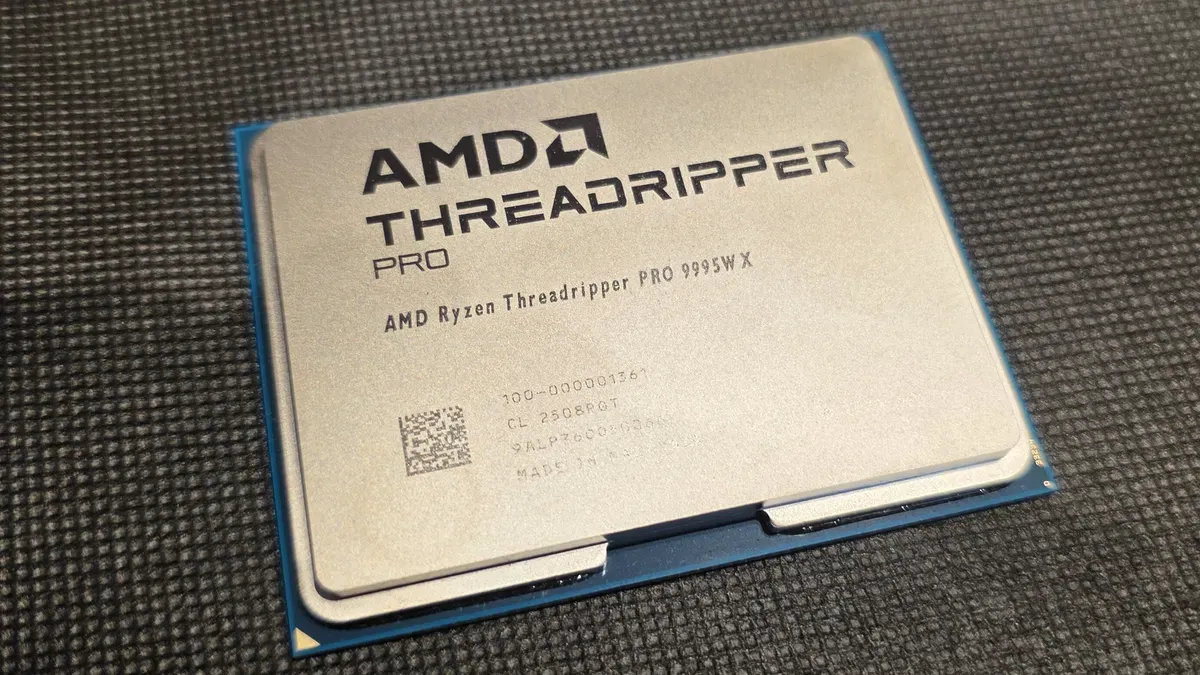
Rank 85073Ryzen Threadripper Pro 9995WX now on sale with Zen 5, 96 cores, 192 threadsAMD’s most powerful workstation CPU available from major retailers for $11,699Most professionals won’t need the 9995WX despite the impressive specs The AMD Ryzen Threadripper Pro 9995WX is now available to buy from major retailers, including Amazon and Newegg, with a starting price of $11,699 - much cheaper than initial predictions.It’s the top chip in AMD’s new Threadripper Pro 9000 WX-series and is built on the latest Zen 5 architecture, sporting 96 cores, 192 threads, and offers a boost clock of up to 5.4GHz.The 9995WX uses TSMC’s 4nm process and fits the sTR5 socket. The CPU supports 8-channel DDR5-6400 memory, offers up to 148 PCIe lanes, and carries a 350W TDP.For professional workloadsThis processor is aimed at professional workloads that can scale across dozens of threads.AMD lists compatibility with chipsets like Pro 695, TRX50, and WRX90.The chip also supports ECC memory and includes features like AMD Pro technologies and EXPO for memory tuning.For those running highly parallel tasks like visual effects rendering or scientific modeling, this processor can deliver impressive throughput, but at this price, it’s hard to recommend unless the application is truly pushing the limits of core count.While AMD’s new CPU can deliver unmatched multi-threaded performance in the right environment, most professionals will likely find better value in AMD's lower-tier options (the EPYC 9655 matches Threadripper PRO 9995WX core count for less than half the price) or in Intel's workstation CPUs, depending on their specific use case.With no integrated graphics, a discrete GPU is required. Cooling is also left to the buyer, as no cooler is bundled.Unless you're operating in a niche that truly benefits from 96 cores, it’s unlikely to be the best choice or offer the best value for most users.Buyers in the UK can, as always, expect to pay slightly more than their American counterparts. Novatech is currently selling the new chip there for £10,510, or around $14,205.You may also like16-Core AMD EPYC 4005 CPU is almost 3X faster than AMD's first server flagshipRare AMD CPU powers this just-announced NAS offeringAMD just launched its 96-core Ryzen Threadripper Pro 9995WX CPU
-

Picture from static.independent.co.uk
Rank 85074 -

Picture from static.independent.co.uk
Rank 85075 -

Picture from static.independent.co.uk
Rank 85076 -

Picture from static.independent.co.uk
Rank 85077 -

Picture from static.independent.co.uk
Rank 85078 -

Picture from ichef.bbci.co.uk
Rank 85079 -

Picture from static.independent.co.uk
Rank 85080 -

Picture from static.independent.co.uk
Rank 85081 -

Picture from static.independent.co.uk
Rank 85082 -

Picture from image.cnbcfm.com
Rank 85083 -

Picture from ichef.bbci.co.uk
Rank 85084 -

Picture from static.independent.co.uk
Rank 85085 -

Picture from static.independent.co.uk
Rank 85086 -

Picture from image.cnbcfm.com
Rank 85087 -

Picture from static.independent.co.uk
Rank 85088 -

Picture from static.independent.co.uk
Rank 85089 -

Picture from ichef.bbci.co.uk
Rank 85090 -

Picture from static.independent.co.uk
Rank 85091 -

Picture from static.independent.co.uk
Rank 85092 -

Picture from static.independent.co.uk
Rank 85093 -

Picture from static.independent.co.uk
Rank 85094 -

Picture from static.independent.co.uk
Rank 85095 -

Picture from image.cnbcfm.com
Rank 85096 -
Picture from static.independent.co.uk
Rank 85097 -

Picture from static.independent.co.uk
Rank 85098 -

Picture from static.independent.co.uk
Rank 85099 -

Picture from cdn.mos.cms.futurecdn.net
Rank 85100AI agents, the much-touted next phase of generative AI, have commanded enterprises’ attention. Right now, 61% of business leaders are actively adopting AI agents, according to a recent survey by my organization – with ambitious plans to scale them organization-wide.The fixation is justified: agents can work autonomously, navigate complex workflows, learn from experience, and leverage other software as tools. They are a step change from AI that talks with you, like chatbots, to AI that works for you. The result is major productivity: Gartner estimates that by 2028, agents will automate 15% of day-to-day business decisions.But business leaders shouldn’t mistake agents’ sophistication with omnipotence. Agents can fall into the same traps as older, less sophisticated software – including dreaded IT silos.Battling silosFor decades, IT professionals have battled silos: applications, databases, and other systems that aren't interoperable. In the 1980s and 1990s, enterprises struggled to connect disparate applications into a single ERP solution.Accounting, procurement, and sales workstreams were stubbornly separate – squandering coveted cross-company insights. More recently, enterprises have struggled to unify crucial customer data across disparate CRMs, and have also labored to integrate data spread across on-premise locations and multiple cloud environments.No matter the decade or technology, the result of silos is always the same: wasted time, wasted resources, and wasted potential. When agents become trapped in silos, the outcome is no different. Their return on investment plummets, too.We are already seeing agentic silos take shape. Enterprises are using agents with rigid divisions – one agent for sales activities, another for procurement tasks, a third for CRMs – with little connective tissue between them. What if those agents need to work together to troubleshoot a complex problem, like a sudden and unexpected shift in product demand?If they’re siloed, they cannot pool their abilities and function as a whole greater than the sum of their parts. Not orchestrating agents is like hiring several subcontractors to build a house but restricting their tools and communication. The result is a poorly built house – or jumble of agents with poor performance.Agents and silosAgents can also be siloed from the technology that enterprises already have in place. Imagine an HR Agent tasked with orchestrating employee PTO – but unable to access certain calendar applications and documents.Imagine an IT Agent tasked with troubleshooting software problems – but unable to access troves of past incident reports and help desk tickets. These agents would fail to complete their fundamental tasks, and the time and resources that went into building them would be wasted.There is something deeply ironic about siloed agents. Agents' value lies in their very ability to traverse the full enterprise stack, bridging tools and processes that require human time and talent. When agents get stuck, they are a victim of the very problem they are trying to solve. Businesses are investing in the problem, not the solution.Siloed agents have an additional pitfall: they need to be governed and secured piecemeal. Relying on an ad hoc, patchwork approach to governance and security means an agentic use case is likely to fall through the cracks. If this occurs, agents’ most valuable asset – their autonomy – can quickly turn into a liability. Issues like bias, drift, and security vulnerabilities are amplified by agents’ access and independence.Reaching potentialFor agents to reach their full potential, business leaders must first fix the fragmentation underneath. Enterprises need a single data fabric that can unify the structured and unstructured data that powers agents. While many enterprises haven’t achieved this yet, a growing number understand the value: 72% of leaders view their organization’s proprietary data as key to unlocking the value of generative AI, according to my company’s most recent CEO Study.Enterprises also need a hybrid control plane automating the sprawling landscape agents work across, unifying APIs, apps, events, files, and mainframe data. And enterprises should invest in a central nervous system for their agents. The future is multi-agent: It will be teams of agents, rather than a single agent, that tackle complex tasks. Enterprises need a single hub to supervise and route those agents. In other words, enterprises need a general contractor for all those subcontractors.The need for orchestrationBetter integrated and orchestrated agents also boost observability. Rather than governing and securing agents piecemeal, enterprises can apply comprehensive rules and oversight from a single point. This also allows AI security teams and AI governance teams to collaborate: if a shadow agent deployment is spotted by security tools, it can quickly and automatically steer the agent into the proper governance workstream.Enterprises are rightfully investing in agents. But if they want that investment to translate into impact, they should be making equal commitments to agent integration and orchestration. Otherwise, they will end up with a whole that is less than the sum of its parts. In 2025 and beyond, it won't just be the businesses with the best agents that win. It will be the businesses with the most flexible ones.I tried 70+ best AI tools.This article was produced as part of TechRadarPro's Expert Insights channel where we feature the best and brightest minds in the technology industry today. The views expressed here are those of the author and are not necessarily those of TechRadarPro or Future plc. If you are interested in contributing find out more here: https://www.techradar.com/news/submit-your-story-to-techradar-pro