News
This constantly updated list features the latest and most important news articles, ranked in order of significance. The top stories highlight major developments, breaking news, and critical updates across various topics, ensuring you stay informed about the most pressing issues. As new articles are added, the list adapts to reflect the latest priorities, keeping the most impactful stories at the forefront. Whether it’s global events, technology breakthroughs, or industry trends, this dynamic list ensures you always have access to the most relevant and timely information.
-

Picture from static.independent.co.uk
Rank 69701 -

Picture from techcrunch.com
Rank 69702 -

Picture from static.independent.co.uk
Rank 69703 -

Picture from static.independent.co.uk
Rank 69704 -
Picture from cdn.mos.cms.futurecdn.net
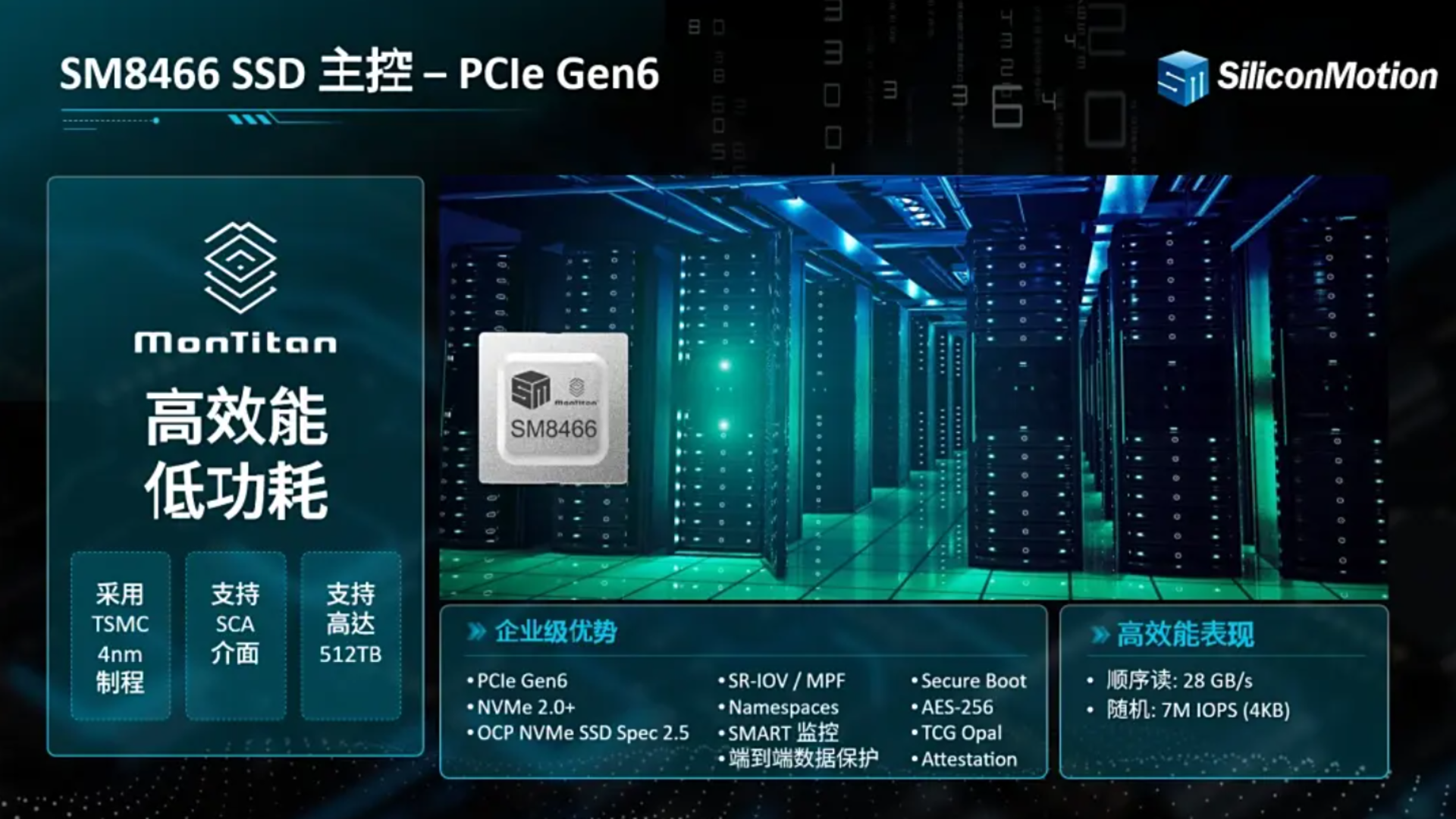
Rank 69705Silicon Motion SM8466 SSD brings enterprise-grade speed and security to the future of data infrastructureUp to 512TB of NAND makes this controller ready for tomorrow’s storage-heavy workloadsDesigned for scale, not your setup, this SSD will likely stay in the server roomSilicon Motion’s new SM8466 SSD controller makes a strong case for what next-generation storage could deliver.Built using TSMC’s 4nm process, the controller is engineered for performance-heavy environments and claims to nearly double the throughput of PCIe 5.0 devices.But while its specifications may seem tailored for the fastest SSDs in enterprise settings, its practical relevance to consumer desktops remains questionable, at least for now.Performance figures promise a leap, but for whom?Silicon Motion claims the SM8466 can hit a peak sequential read speed of 28GB per second, nearly twice the throughput of PCIe 5.0 solutions.This kind of performance may be ideal for real-time analytics, large-scale database operations, and high-definition media processing, but for most users, such capabilities far exceed everyday requirements.The 7 million random IOPS (input/output operations per second) for reads and writes further suggest its optimization for virtualized environments and high-load scenarios where latency must be kept low and response times consistent.Whether this qualifies it as the best SSD is a matter of perspective, especially given the limited relevance to mainstream PCs.From a system design standpoint, the controller’s support for up to 512TB of NAND sounds promising for hyperscale storage applications.However, this leap in storage capacity isn’t poised to redefine the consumer market.Even the largest HDD options currently available for desktop use don’t approach this scale, and integrating such capacity into a single PCIe SSD will be both cost-prohibitive and thermally challenging outside data centers.Beyond raw performance, the SM8466 includes a suite of features geared toward enterprise deployment.It supports secure booting, AES-256 encryption, and TCG Opal compliance, which together aim to meet modern data protection requirements.Its SMART monitoring system adds an extra layer of diagnostics and early failure detection, but these features are more useful in server racks than home rigs.Physically, the SCA interface consolidates power, data, and management into a single connector, streamlining installation and minimizing cabling complexity.Virtualization technologies such as SR-IOV and MPF allow the controller to present multiple virtual storage functions, further reinforcing its appeal to cloud service providers rather than average users.The benefits of the SM8466 are clear for large-scale, high-demand environments, but the average consumer is unlikely to experience these advantages before the decade ends.Via Guru3dYou might also likeThese are the best NAS devices aroundUK police arrest four following cyberattacks on M&S, Co-op, HarrodsWe've rounded up the best cloud storage platforms on offer
-
Picture from o.aolcdn.com
Rank 69706Just a day after the xAI team issued a comprehensive apology and explanation about why its chatbot was spreading antisemitic rhetoric, Tesla updated its software for its cars to include the supposedly fixed Grok. According to Tesla, all new vehicles delivered on or after July 12 will have Grok available in-car. There's no additional subscription cost, but Tesla is limiting Grok's availability to models in the U.S. for now.
For older models to run Grok, it requires a Tesla with an AMD processor, the latest software update of 2025.26, and either a stable Wi-Fi connection or Tesla's $9.99 Premium Connectivity subscription. It's worth noting that Grok will simply be an AI chatbot you can ask questions to, but won't be able to interface with the car itself. In other words, Grok can't help you set up directions to your destination, lower the music's volume or control the car's temperature. Instead, it can offer excruciatingly cringe-inducing responses under its "Unhinged" personality, as seen in an X post from Tesla.
While Tesla has incorporated the chatbot into its newly delivered cars, the company still faces safety concerns with its Full Self-Driving system, which uses mostly cameras and AI. Tesla added that Grok may become available to more of its vehicles with over-the-air software updates in the future, but noted that "Grok availability is subject to change or end at any time." Like when Grok went "MechaHitler" only a few days ago and had to be disabled.This article originally appeared on Engadget at https://www.engadget.com/ai/great-grok-is-in-cars-now-too-202153874.html?src=rss
-

Picture from ichef.bbci.co.uk
Rank 69707 -

Picture from static.independent.co.uk
Rank 69708 -

Picture from static.independent.co.uk
Rank 69709 -

Picture from assets2.cbsnewsstatic.com
Rank 69710 -

Picture from assets1.cbsnewsstatic.com
Rank 69711 -

Picture from assets3.cbsnewsstatic.com
Rank 69712 -

Picture from static.independent.co.uk
Rank 69713 -

Picture from static.independent.co.uk
Rank 69714 -

Picture from ichef.bbci.co.uk
Rank 69715 -

Picture from ichef.bbci.co.uk
Rank 69716 -

Picture from assets2.cbsnewsstatic.com
Rank 69717 -

Picture from ichef.bbci.co.uk
Rank 69718 -

Picture from ichef.bbci.co.uk
Rank 69719 -

Picture from ichef.bbci.co.uk
Rank 69720 -

Picture from static.independent.co.uk
Rank 69721 -

Picture from assets3.cbsnewsstatic.com
Rank 69722 -

Picture from static.independent.co.uk
Rank 69723 -

Picture from static.independent.co.uk
Rank 69724 -

Picture from techcrunch.com
Rank 69725 -

Picture from ichef.bbci.co.uk
Rank 69726 -

Picture from static.independent.co.uk
Rank 69727 -

Picture from static.independent.co.uk
Rank 69728 -

Picture from static.independent.co.uk
Rank 69729 -

Picture from image.cnbcfm.com
Rank 69730 -

Picture from image.cnbcfm.com
Rank 69731 -

Picture from static.independent.co.uk
Rank 69732 -

Picture from static.independent.co.uk
Rank 69733 -
Picture from o.aolcdn.com
Rank 69734NASA's Parker Solar Probe made history with the closest-ever approach to the sun last December, and we're finally getting a look at some of the images it captured. The space agency released a timelapse of observations made using Parker's Wide-Field Imager for Solar Probe (WISPR) while it passed through the sun's corona on December 25, 2024, revealing up close how solar wind acts soon after it's released. The probe captured these images at just 3.8 million miles from the solar surface. To put that into perspective, a NASA video explains, "If Earth and the sun were one foot apart, Parker Solar Probe was about half an inch from the sun."
The probe got an unprecedented view of solar wind and coronal mass ejections (CMEs) during the approach, which could be invaluable for our understanding of space weather. "We are witnessing where space weather threats to Earth begin, with our eyes, not just with models," said Nicky Fox, associate administrator, Science Mission Directorate at NASA Headquarters. After completing its December flyby, the Parker Solar Probe matched its record distance from the surface in subsequent approaches in March and June. It'll make its next pass on September 15.
This article originally appeared on Engadget at https://www.engadget.com/science/space/these-are-the-closest-ever-images-of-the-sun-from-parker-solar-probes-historic-flyby-215549723.html?src=rss
-

Picture from image.cnbcfm.com
Rank 69735 -

Picture from static.independent.co.uk
Rank 69736 -

Picture from assets2.cbsnewsstatic.com
Rank 69737 -

Picture from static.independent.co.uk
Rank 69738 -

Picture from static.independent.co.uk
Rank 69739 -

Picture from image.cnbcfm.com
Rank 69740 -

Picture from cdn.mos.cms.futurecdn.net
Rank 69741Teamgroup P250Q SSD self-destruct flash circuits promise instant sanitization for high-risk data in classified deploymentsHardware-level erasure targets the Flash IC directly, ensuring total data elimination without softwareBuilt-in AES-256 encryption aligns with military-grade standards for data-at-rest protectionTeamgroup has launched the P250Q Self-Destruct SSD, a drive built for high-security environments where there may be a need for sensitive data to be erased swiftly and irreversibly.Combining hardware and software-based erasure, it aims to address growing concerns around industrial and military data protection.But while the technology appears advanced, the usefulness of such a feature outside tightly controlled environments remains uncertain.Inside the self-destruct feature: promise and practicalityAt the core of the P250Q is a patented destruction circuit engineered to wipe data at the hardware level by targeting the Flash IC.The drive also features an auto-resume function to continue destruction after a power cut, which Teamgroup says ensures, “data destruction continues seamlessly after an unexpected power outage,” eliminating the risk of partial erasure or incomplete sanitization.Just like the Teamgroup P35S SSD, the P250Q’s one-click trigger and multi-stage LED indicators present a simplified control mechanism, but questions remain about real-world deployment.Would a user be expected to physically hold the SSD while passing through security checkpoints? And if so, wouldn’t that make the device more conspicuous and likely to attract attention?This highlights the uncertainty of using self-destruct features in actual threat scenarios, a concept Ovrdrive dropped due to the challenges of mass production.Despite the concerns, the P250Q’s specs are competitive, with storage options ranging from 256GB to 2TB, built on 3D TLC NAND Flash.It runs on a PCIe Gen4x4 interface and supports NVMe 1.4, reaching up to 7,000MB/s read and 5,500MB/s write speeds.The drive also includes S.M.A.R.T. health monitoring, which improves reliability over time.The P250Q may struggle to prove its relevance beyond specialized use cases - it may appeal to organizations governed by strict data handling rules, but for most users, even those seeking the best secure drives or best rugged hard drives, its practical value may remain limited.You might also likeCheck out the best portable SSDs you can get todayThese are the best NAS devices aroundWe've also rounded up the best cloud storage platforms on offer
-

Picture from static.independent.co.uk
Rank 69742 -

Picture from static.independent.co.uk
Rank 69743 -

Picture from assets2.cbsnewsstatic.com
Rank 69744 -

Picture from image.cnbcfm.com
Rank 69745 -

Picture from ichef.bbci.co.uk
Rank 69746 -

Picture from static.independent.co.uk
Rank 69747 -

Picture from static.independent.co.uk
Rank 69748 -

Picture from static.independent.co.uk
Rank 69749 -

Picture from static.independent.co.uk
Rank 69750

