Best Chemistry Courses
There are many different types of chemistry, and each one has its own unique application. Whether you want to study the chemical makeup of the universe or the reactions that occur in everyday life, there is a course out there for you.
-
Picture from www.intelligent.com
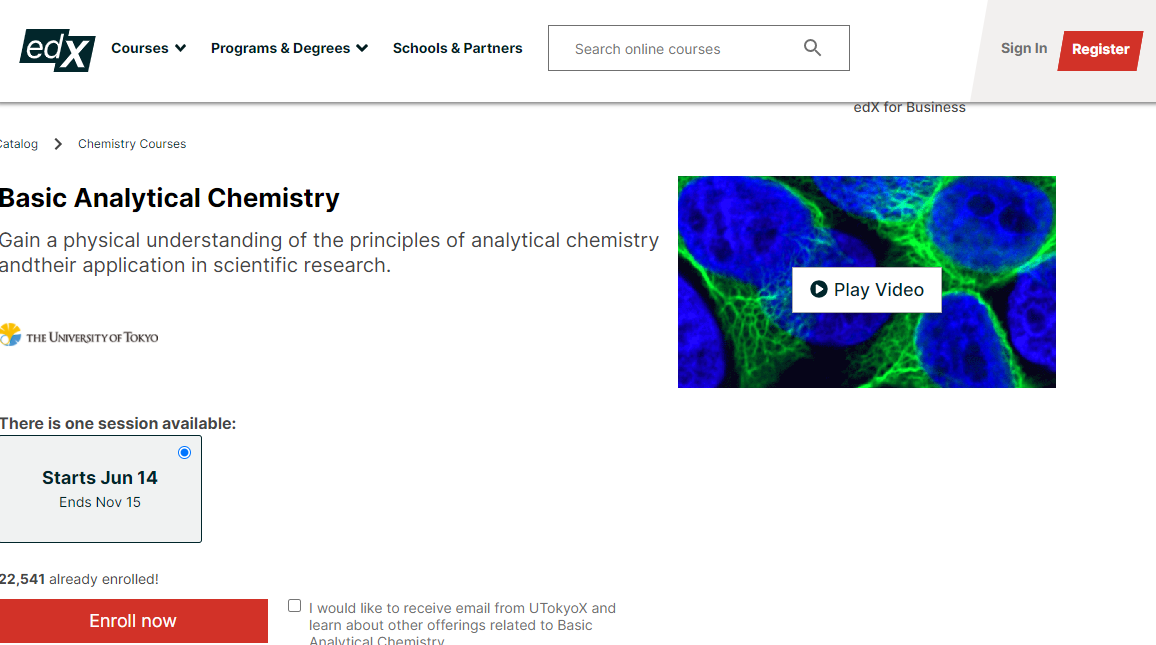
Rank 1About this course:
Analytical chemistry takes a prominent position among all fields of experimental sciences, ranging from fundamental studies of Nature to industrial or clinical applications.Analytical chemistry covers the fundamentals of experimental and analytical methods and the role of chemistry around us.
This course introduces the principles of analytical chemistry and provides how these principles are applied in chemistry and related disciplines - especially in life sciences, environmental sciences and geochemistry.
This course, regardless of your background, will teach you fundamental analytical concepts and their practical applications.
By the end of the course, you will deeply understand analytical methodologies in a systematic manner. Finally, this course will help you develop critical, independent reasoning that you can apply to new problems in chemistry and its related fields.
This course is for anyone interested in analytical sciences.
What you'll learn:
A basic background in the chemical principles, particularly important to analytical chemistry
The ability to judge the accuracy and precision of experimental data and to show how these judgments can be sharpened by the application of statistical methods
A wide range of techniques that are useful in modern analytical chemistry
The skills needed to solve analytical problems in a quantitative manner
Laboratory skills to obtain high-quality analytical dataSyllabus
Module 1: Basic Tools of Analytical Methods
1. Chemical Measurements and Analytical tools
2. Experimental Error
3. Statistics and Quality Assurance
4. Chemical Equilibrium
5. Sample Preparation
Module 2: Chemical Equilibria for Quantitative Analysis
6. Gravimetric Analysis
7. Effects of Electrolytes
8. Systematic Treatment
9. Monoprotic Acid-Base Equilibria
10. Polyprotic Acid-Base Equilibria
11. Acid-Base Titrations
12. EDTA Titrations
Module 3: Electrochemical Analysis and Spectrophotometry
13. Fundamentals of Electrochemistry
14. Potentiometry
15. Redox Titrations
16. Fundamentals of Spectrophotometry
17. Applications of Spectrophotometry
18. Spectrophotometers
Module 4: Spectrochemical Analysis and Analytical Separations
19. Atomic Spectroscopy
20. Mass Spectrometry
21. Introduction to Analytical Separations
22. Gas Chromatography
23. High-Performance Liquid Chromatography
24. Electrophoresis Analyses
Article from: https://www.edx.org/course/basic-analytical-chemistry
-
Picture from www.intelligent.com
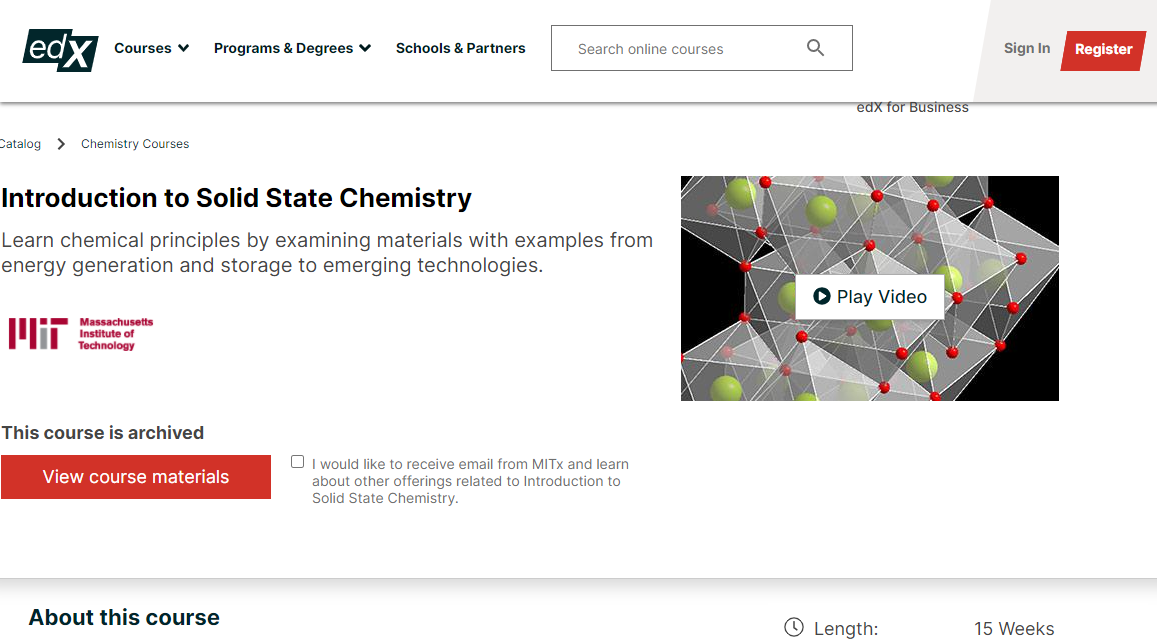
Rank 2About this course
This first-year University chemistry course explores the basic principles of the chemical bond by studying the properties of solids. Properties such as stiffness, electrical conductivity, thermal expansion, strength, and optical properties are the vehicle by which you can learn a great deal of practical chemistry. AP Chemistry High School students and teachers are among the thousands of learners who have successfully taken the course and enjoyed it.
You will see how experts use their knowledge of trends in the periodic table to predict the properties of materials. 3.091x is an engineering course so there is an emphasis on applications and how materials are used. The on-campus version of the course has been taught for over forty years and is one of the largest classes at MIT.
This course will cover the relationship between electronic structure, chemical bonding, and atomic order, and characterization of atomic arrangements in crystalline and amorphous solids: metals, ceramics, semiconductors, and polymers (including proteins). There will be topical coverage of organic chemistry, solution chemistry, acid-base equilibria, electrochemistry, biochemistry, chemical kinetics, diffusion, and phase diagrams. Examples will be drawn from industrial practice (including the environmental impact of chemical processes), from energy generation and storage (e.g., batteries and fuel cells), and from emerging technologies (e.g., photonic and biomedical devices).
What you'll learn
You will develop your “chemical intuition”
A quantitative understanding of chemical principles
Understanding of crystal structure and its relationship to properties
Materials properties such as conductivity, optical transmission, stiffness, thermal expansion, and strength
An understanding of electronic structure, chemical bonding, and atomic order and arrangementsWho can take this course?
Unfortunately, learners residing in one or more of the following countries or regions will not be able to register for this course: Iran, Cuba and the Crimea region of Ukraine. While edX has sought licenses from the U.S. Office of Foreign Assets Control (OFAC) to offer our courses to learners in these countries and regions, the licenses we have received are not broad enough to allow us to offer this course in all locations. edX truly regrets that U.S. sanctions prevent us from offering all of our courses to everyone, no matter where they live.
Article from: https://www.edx.org/course/introduction-to-solid-state-chemistry
-
Picture from www.intelligent.com
Rank 3About this Course
This course is designed to cover subjects in advanced high school chemistry courses, correlating to the standard topics as established by the American Chemical Society. This course is a precursor to the Advanced Chemistry Coursera course. Areas that are covered include atomic structure, periodic trends, compounds, reactions and stoichiometry, bonding, and thermochemistry.
Article from: https://www.coursera.org/learn/chemistry-1#instructors
-
Picture from www.intelligent.com
Rank 4About this Course
Chemical reactions underpin the production of pretty much everything in our modern world. But, what is the driving force behind reactions? Why do some reactions occur over geological time scales whilst others are so fast that we need femtosecond-pulsed lasers to study them? Ultimately, what is going on at the atomic level? Discover the answers to such fundamental questions and more on this course in introductory physical chemistry.
The course covers the key concepts of three of the principal topics in first-year undergraduate physical chemistry: thermodynamics, kinetics and quantum mechanics. These three topics cover whether or not reactions occur, how fast they go and what is actually going on at the sub-atomic scale.
Article from: https://www.coursera.org/learn/physical-chemistry
-
Picture from www.intelligent.com
Rank 5What you'll learn:
Know exactly what is Matter, Element and Compound.
Learn the scientific methods and type of Mixtures.
Know the Three State of Maters and Units of Measurements.
Calculate Scientific Notation and Significant Figures.
Determine if the results you obtained are Accurate and Precise.
Understand the Units and Dimensional Analysis.
Understand the Atomic Theory and Models of the Atom.
know the Law of Conservation and law of Multiple Proportions.
Learn Atomic Mass, Mass Number and Isotopes.
Know how elements are organized in the Periodic Table.
Learn how to name the Ionic Compounds.
Know how to write Chemical equations.
Learn how to make a Chemical Balance.
Understand The Mole Concept.
Be able to do Mole calculations successfully.
Learn determination of Chemical formulas.
Understand the Stiochiometry.
To calculate the Limiting Reactant and the Yield of the reaction.
Study all the Solubility Rules
Understand the Electrolyte and Non-Electrolyte solutions
Know all the Types of Chemical Reactions
Be able to do Calculations on Molar Concentration and Dilution Analysis
Understand the Gravimetric Analysis and the Titration
Understand Boyle’s Law, Charles’s Law, Gay-Lussac’s Law, Avogadro’s Law, Combined Gas Law, The Ideal Gas Law, Real Gases, Gas Density and Gas Stoichiometry.
You will understand Thermochemistry the study of heat change in chemical reactions.
You will be able to distinguish between Exothermic & Endothermic reactions.
You will learn Enthalpy and the First Law of Thermodynamics.
You will be able to calculate Heat Capacity (C) for any element.
Learn how to calculate standard enthalpy of reaction (ΔH0) for any chemical reaction.
You will understand the Properties of Waves.
You will know how Bohr’s Model of the Atom works.
Understand Schrodinger Wave Equation.
Be able to find the four quantum numbers in Schrodinger Equation.
You will be bale to write the Electron configuration for any element.
Understand the Ground State Electron Configurations and Classification of Elements.
know the Electron Configurations of Cations and Anions.
You will learn The Atomic Radius, The Ionization Energy, Effective nuclear charge (Zeff) and The Electron Affinity.
You will be able to understand Groups Elements Properties.
You will be able to understand the difference between ionic bond and covalent bond.
You will understand electronegativity and formal charge.
You will be able to write Lewis structure.
You will understand the VSEPR theory.
You will understand the Hybridization.Who this course is for:
This course is for High School Students, Chemists, Pharmacy student, biology student, Nursing student and Engineering student,under graduated or graduated.
Everyone who has a big passion with chemistry and want to discover more about it.
Section 1 - Matter and Measurement
An Introduction To Chemistry
Methods Of Science
Categories Of Science
Steps Of Scientific Method
Theory And Law
The Scientific Method
Law of Conservation of Mass
Matter, Element And Compound
Types Of Mixtures
The Three States Of matter
Properties And Changes Of matter
Units Of Measurements
Scientific Notations
Significant Figures
Accuracy And Precession
Units and Dimensional AnalysisSection 2 - Atoms, Molecules, and Ions
Dalton’s Atomic Theory
Atomic Symbols and Models
Law of Conservation of Mass
Law of multiple proportions
The Structure of The Atom
Discovery of the Electron
The nuclear model of the atom
Atomic Mass, Mass Number and Isotopes
Mass number and Atomic Masse
Periodic Table of the Elements
Metals, Nonmetals, and Metalloids
Molecular Substances
Ionic Substances
Organic Compounds
Ionic Compounds
Rules for predicting Charges
Naming of Ionic Compounds
Formula of Ionic Compounds
Naming of Binary Molecular Compounds
Acids and Corresponding Anions
Naming of Hydrates
Writing Chemical Equations
Balancing Chemical EquationsSection 3 - Calculations With Chemical Formulas And Equations
Introduction to Calculations in Chemistry
Mass and Moles of Substance
Molecular Mass and Formula Mass
The Mole Concept
Mole Calculations
Determining Chemical Formulas
Elemental Analysis, Percentage of C, H and O
Determining Formulas
Molecular Formula from Empirical Formula
Stoichiometry: Quantitative Relations in Chemical Reactions
Limiting Reactant
Theoretical YieldSection 4 – Chemical Reactions
Introduction to Chemical Reactions
Ionic Theory of Solutions and Solubility Rules
Electrolytes and Non-electrolytes
Solubility Rules
Molecular and Ionic Equations
Acid Base, Neutralization and Oxidation-Reduction Reactions
Oxidation number
Types of Oxidation-Reduction Reactions
Working with solutions
Quantitative AnalysisSection 5 – Gaseous State
Introduction to the Gaseous State
Gas Pressure and Its Measurement
Boyle’s Law: Relating Volume and Pressure
Charles’s Law: Relating Volume and Temperature
Gay-Lussac’s Law : Relating Pressure and Temperature
Combined Gas Law : Relating Pressure, Temperature and Volume
Avogadro’s Law: Relating Volume and Amount
The Ideal Gas Law
Standard Temperature and Pressure (STP)
Gas Density; Molecular-Mass Determination
Gas Stoichiometry
Gas Mixtures; Law of Partial Pressures
Real GasesSection 6 – Thermochemistry
Introduction to Thermochemistry
Thermodynamics
Thermodynamic Equations
Heat Capacity (C)
Standard Enthalpy of Formation ΔH formationSection 7 – Quantum Theory and the Electronic Structure of Atoms
Properties of Waves
Bohr’s Model of the Atom
Schrodinger Wave Equation
Aufbau principle and Hund's Rule
Electron configurationSection 8 – Periodic Relationships
Ground State Electron Configurations and Classification of Elements
Electron Configurations of Cations and Anions
Effective nuclear charge (Zeff)
The Atomic Radius
The Ionization Energy
The Electron Affinity
Groups Elements PropertiesSection 9 – Ionic and Covalent Bonding
The Ionic and Covalent Bonding
Electronegativity and Polar Covalent Bond
Writing Lewis Structures
Formal ChargeSection 10 – Molecular Geometry and Chemical Bonding Theory
Valence shell electron pair repulsion (VSEPR) model
Dipole Moments and Polar Molecules
Valence Bond Theory
HybridizationIn addition to that, there are a lot of QUIZZES added to this course in order to enhance students understanding to the contents of this course and get the desired value !!!
For example in One Quiz you will practice on solving the following questions:
Can an element be broken down into a simpler substance?
What is a compound?
What is a mixture?
How many classifications of mixtures are there?
Mixtures can be separated. Which of the following represents a way a mixture cannot be separated?
Which of the following is a compound?
Which of the following is an element?
Are there more compounds or more elements?
Which of the following is not a mixture?
Can compounds be separated?This Course contains the following Quizzes:
Elements, Compounds and Mixtures
Properties and Changes of Matter
Scientific Notation
Significant Figures
Periodic Table of The Elements
Naming an Ionic Compound from Its Formula
Balancing Chemical Equations
Mole Calculation for atoms, molecules, units and ions
Calculate the percentage composition
Limiting Reactant
Classification of Solutes in Aqueous Solution
Solubility Rules for Ionic Compounds
Types of Oxidation-Reduction Reactions
Oxidation Numbers
Boyle’s Law
Charles's law
Gay-Lussac's
Combined Gas Law
The Ideal Gas Law
Gas Stoichiometry
Exothermic and Endothermic
Enthalpy
Hess law
Properties of waves
Bohr’s Model
Electron Configurations
Electron Configurations of Cations and Anions
The Atomic Radius
Ionization energy
Covalent bonds, Ionic bonds and Polar covalent bonds
Formal Charge (FC)
Article from: https://www.udemy.com/course/general-chemistry-101-chapter-1-matter-measurment/
-
Picture from www.intelligent.com
Rank 6What you'll learn:
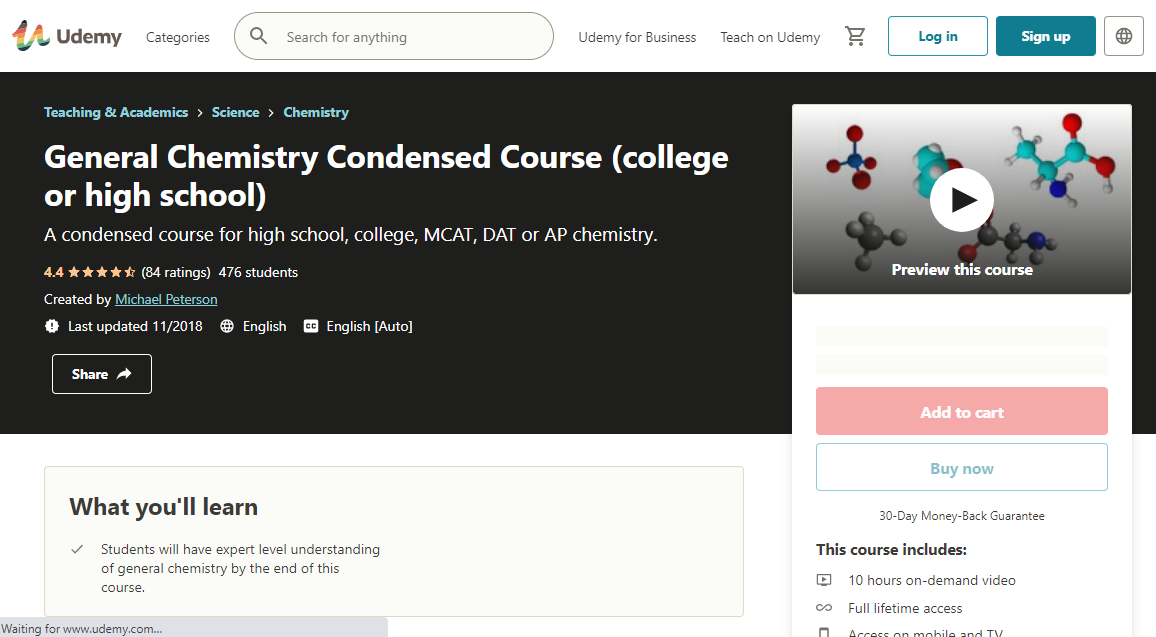
Students will have expert level understanding of general chemistry by the end of this course.
Requirements
A basic understanding of high school math is required.
Description
This is a condensed general chemistry course. It takes all of the major topics in a general chemistry course and condenses them into understandable bite-sized animated video chunks. It is great for high school or college students and anyone studying for a major exam like the MCAT, DAT or AP chemistry exam. The course is condensed into 11 understandable lectures, with over 40 lectures.
Who this course is for:
Anyone in college or high school chemistry or who has an interest in chemistry.
Article from: https://www.udemy.com/course/general-chemistry-condensed-course-college-or-high-school/
-
Picture from www.intelligent.com
Rank 7What you'll learn:
By the end of this course you will have received a thorough preparation in the principles of Chemistry. If you follow the course carefully the you should be looking
Requirements
There are no essential course requirements, just a desire to learn more about Chemistry and a willingness to make the necessary effort!
Description:
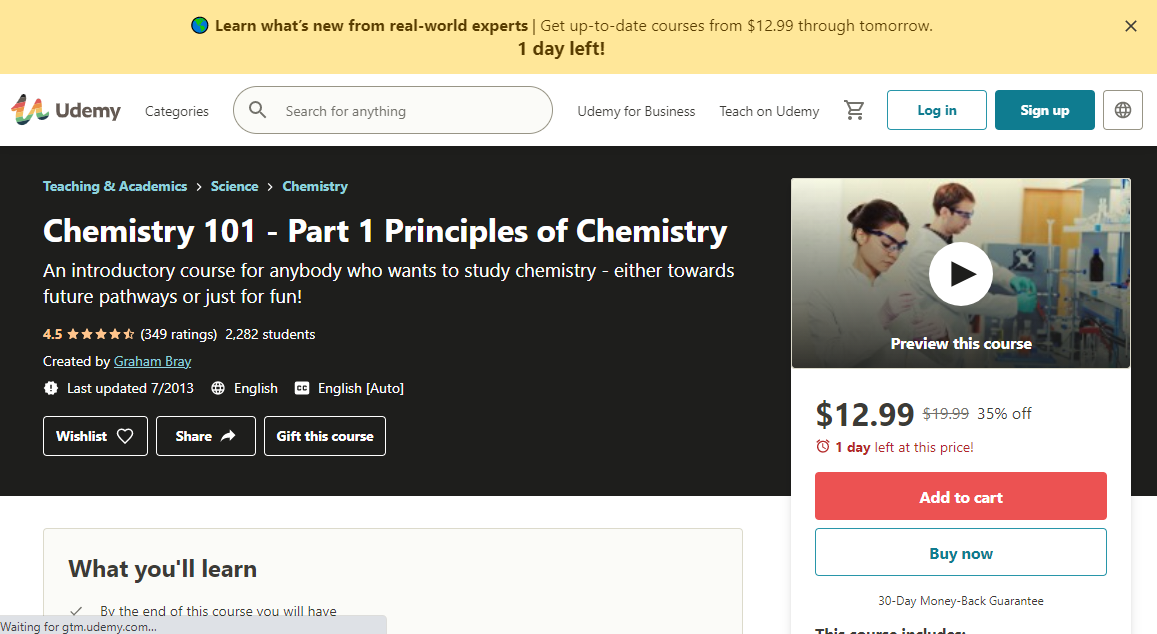
This course is a comprehensive introduction to Chemistry, covering everything you will need to know as you prepare for possible future exams. It doesn't matter how much, or how little, prior knowledge of Chemistry you've got as this course will take you through all the necessary stages.
The content is based on the International GCSE specification as followed by thousands of students around the world, and will prepare you thoroughly for progression to advanced programmes.
In Section 1, The Principles of Chemistry, there are five video lessons, each one lasting about 20 minutes. The first lesson introduces the states of matter and atomic structure. In the next lesson we progress to relative formula mass and chemical equations - don't be put off by these as everything is very carefully explained! Lesson 3 covers chemical formulae, and we progress in lesson four to look at reacting masses, ionic bonding and covalent bonding. Lesson five wraps up this part of the course with metallic crystals and electrolysis.
Who this course is for:
This course is intended for :
students who wish to follow a career in the sciences or medicine and who require really clear chemistry instruction
students who may already be following a course but who need additional support in order to successfully progress
anybody with a genuine interest in learning about the first principles of Chemistry!Article from: https://www.udemy.com/course/chemistry-101-part-1-principles-of-chemistry/
-
Picture from d3njjcbhbojbot.cloudfront.net
Rank 8Improve the way you teach primary science by building your chemistry knowledge
To teach primary science effectively teachers must have strong subject knowledge, but many primary teachers are not science experts.
On this course, you’ll explore the key knowledge required to teach the chemistry elements of the primary science curriculum.
You’ll learn about the common misconceptions and misunderstandings children may have and learn how you can help your students identify and overcome them.
You’ll discover practical activities to do with your primary school students that will help them to learn scientific concepts in a fun and engaging way.
What topics will you cover?
Why good subject knowledge is essential when teaching primary science.
Developing subject knowledge for the chemistry in the primary science.
Understanding children’s misconceptions and identifying teaching strategies to identify and overcome them.
Curriculum topics of: understanding materials and their properties; states of matter; changes of materials.Who is this accredited by?
The CPD Certification Service: The CPD Certification Service was established in 1996 and is the leading independent CPD accreditation institution operating across industry sectors to complement the CPD policies of professional and academic bodies.
Learning on this course
On every step of the course you can meet other learners, share your ideas and join in with active discussions in the comments.
What will you achieve?
By the end of the course, you‘ll be able to...
Identify the importance of good subject knowledge when teaching primary science.
Develop personal subject knowledge of chemistry.
Apply subject knowledge to class teaching of pupils aged 5-11 years old.
Explore practical activities to teach scientific concepts in the primary curriculum.
Identify common misconceptions children may have in primary science concepts.
Develop teaching strategies to identify and overcome children’s misconceptions.Who is the course for?
This course is designed for primary teachers and trainee teachers in primary education (pupils aged 5-11 years) who want to develop their chemistry subject knowledge.
The course refers to the English National Curriculum, but the subject matter is equally transferable to other curricula, and you’ll be encouraged to explore connections with your own national curriculum.
What's included?
This is a premium course. These courses are designed for professionals from specific industries looking to learn with a smaller group of like-minded individuals.
Unlimited access to this course
Includes any articles, videos, peer reviews and quizzes
Certificate of Achievement to prove your success when you're eligible
Download and print your Certificate of Achievement anytimehttps://www.futurelearn.com/courses/teaching-primary-science-chemistry
That is the end of the list.